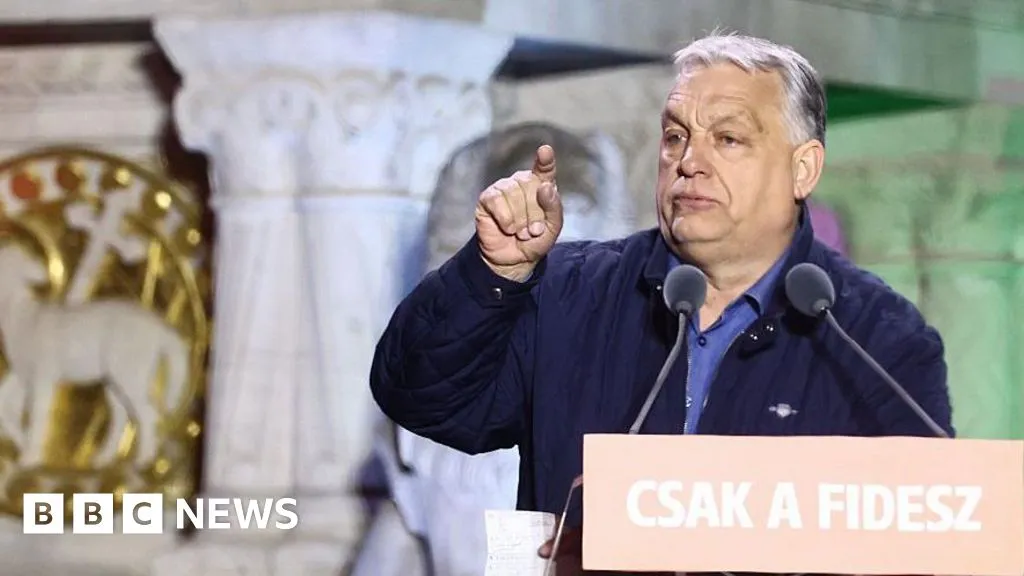
But Orbán remains highly valued by US President Donald Trump, who has called on Hungarians to "get out and vote" for his "true friend, fighter, and WINNER".Addressing supporters on Saturday night, the Fidesz leader kept to his main campaign themes of targeting Brussels and Ukraine. "We don't give our children, we don't give our weapons and we don't give our money," he said.Sean Gallup/Getty ImagesPéter Magyar has appealed to voters not to be tempted to commit electoral fraudHis message resonated with the crowd, who chanted "we won't let that happen". One supporter, Johanna, said she backed his policies on protecting the family and particularly on the war in Ukraine.Veronika (L) and Johanna were optimistic Fidesz would win on SundayHe has proved to be a winner four times in a row, but a fifth consecutive victory may be beyond his reach. The economy is struggling, and he has been buffeted by a series of scandals, including revelations that Foreign Minister Péter Szijjártó regularly spoke to his Russian counterpart before and after European Union summits, which he has admitted. Hungary is not just in the EU, it is in Nato too, but Orbán has vetoed €90bn (£78bn) in aid to Ukraine, angering his European partners.One of the few pollsters that suggests he can still win is Nézőpont Institute, whose head Ágoston Mráz points to 22 so-called "battleground seats" out of the total 106 constituencies. If Fidesz were to win those seats, he foresees a potential victory. However, as 5% of the votes in those seats will not be counted immediately, it could take several days for the final result to become clear.He also argues that Fidesz voters may not be as loud as their Tisza counterparts."Conservative voters are not normally as enthusiastic or their self-confidence is probably limited. They are more hidden voters, they are not ready to answer questions of pollsters, and among the Fidesz voters there are more, in percentage, blue-collar voters than in the Tisza Party voter camp."ReutersOrbán became rattled during a speech in late March when he was jeered by protestersIf Magyar is to win, Tisza will need to defeat Fidesz in some important towns and cities, not least Hungary's sixth-biggest city, Györ, close to the Slovak border in the north-west.Orbán himself put Györ on the campaign map last month when he noticeably lost his cool towards booing protesters and accused them of "pushing Ukrainian interests".Conversely, Magyar hosted a very large rally in a central square in Györ last Thursday.Gergely Németh, a 20-year-old student who said he was going to the square with his mother, explained that as a family they had struggled financially because of government policy.Although mothers with two or more children have increasingly become exempt from income tax under Orbán's pro-family policies, not everyone has benefited.Student Gergely Németh says all the young people he knows want Fidesz outLike many first-time voters who talked to the BBC, Németh said his main priority was defeating Fidesz: "I think it's not the man, Péter Magyar, who's most important. More important is that someone changes these politicians in the parliament."For the past two years Györ has had an independent mayor and deputy mayor, but Fidesz still has a majority on the local council."I know what Fidesz brings, I know what Fidesz does, I live in it," says Deputy Mayor Roland Kósa, who speaks of an arrogance towards power. "When we got elected, what we faced even before and after is that Fidesz basically looked through us and said and thought we do not exist - this is still their city, this is still their country."Roland Kósa, deputy mayor in Győr, says Fidesz squandered huge sums and years of opportunity in his cityKósa believes that the right way to take on Fidesz has been by breaking out of party politics.Although Magyar forged his political career as a centre-right conservative under Orbán, he dramatically turned on his party two years ago, and now attracts voters from across the political spectrum.
SRCBBC News - World
LANGEN
LEANCenter
WORDS659
ENT12
SAT · 2026-04-11 · 23:25 GMTBRIEF NSR-2026-0412-63806
NSR-2026-0412-63806News Report·EN·Political Strategy
Hungarians decide whether to end 16 years of Orbán rule and elect rival
Hungarians are deciding whether to end Viktor Orbán's 16-year rule amid economic struggles and scandals. Orbán, supported by Donald Trump, campaigns on protecting Hungarian interests against Brussels and Ukraine, while rival Péter Magyar seeks to unseat him by appealing to voters in key districts.
BBC News - WorldFiled 2026-04-11 · 23:25 GMTLean · CenterRead · 3 min
BBC News - WorldFIG 01
Reading time
3min
Word count
659words
Sources cited
6cited
Entities identified
12entities
Quality score
100%
§ 01
Briefing Summary
AI-generatedNEWSAR · AI
Hungarians are deciding whether to end Viktor Orbán's 16-year rule amid economic struggles and scandals. Orbán, supported by Donald Trump, campaigns on protecting Hungarian interests against Brussels and Ukraine, while rival Péter Magyar seeks to unseat him by appealing to voters in key districts. Orbán has angered EU partners by vetoing aid to Ukraine and maintaining ties with Russia. Polls suggest a close race, with the outcome potentially hinging on 22 "battleground seats" where results may be delayed due to uncounted votes. The election's outcome will determine Hungary's future direction within the EU and its relationship with Ukraine and Russia.
Confidence 0.90Sources 6Claims 5Entities 12
§ 02
Article analysis
Model · rule-basedFraming
Political Strategy
Economic Impact
Tone
Measured
AI-assessed
CalmNeutralAlarmist
Factuality
0.70 / 1.00
Factual
LowHigh
Sources cited
6
Well sourced
FewMany
§ 03
Key claims
5 extracted01
Orbán accused booing protesters of 'pushing Ukrainian interests'.
quoteBBC
Confidence
1.00
02
5% of the votes in battleground seats will not be counted immediately.
statisticÁgoston Mráz/Nézőpont Institute
Confidence
1.00
03
Foreign Minister Péter Szijjártó regularly spoke to his Russian counterpart before and after EU summits.
factualBBC
Confidence
1.00
04
Orbán has vetoed €90bn in aid to Ukraine.
factualBBC
Confidence
1.00
05
Donald Trump has called on Hungarians to vote for Orbán.
factualBBC
Confidence
1.00
§ 04
Full report
3 min read · 659 words§ 05
Entities
12 identifiedKey playerOppositionContextPositiveNeutralNegative
People5
Organizations4
§ 06
Keywords & salience
9 termshungarian election
1.00
orbán
0.90
fidesz
0.80
ukraine
0.70
péter magyar
0.70
european union
0.60
political scandals
0.50
donald trump
0.50
nato
0.40
§ 07
Topic connections
Interactive graph Network visualization showing 32 related topics
View Full Graph Person Organization Location Event|Click node to navigate|Edge numbers = shared articles