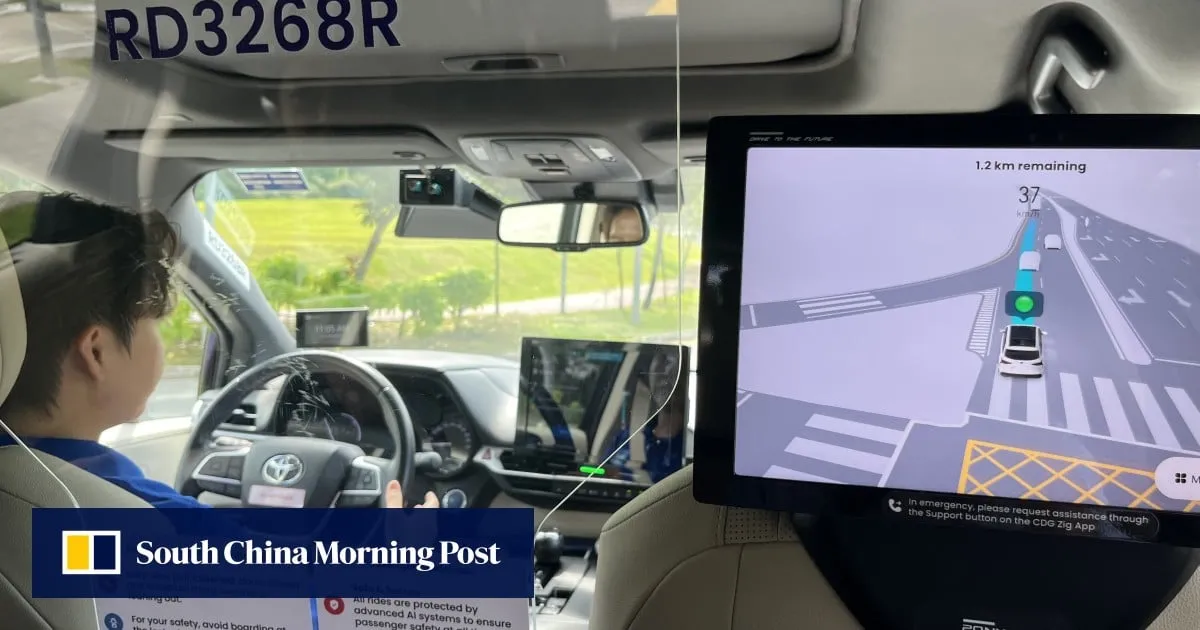
In a quiet street in northern Singapore, a car plies the road like any other – except it is a left-hand drive from China and the person in the driver’s seat has been trained to keep his hands off the wheel and his foot off the pedals unless an emergency arises.Eventually, there will be no need for a safety officer or any human behind the wheel at all – mirroring the autonomous vehicles (AVs) already operating in cities such as Beijing, Shenzhen, San Francisco and Los Angeles.For now, Singapore is in the early stages of rolling out AVs, specifically robotaxis, to the public.Jeffrey Siow, the acting transport minister, said last September that the country aimed to have around 100 to 150 of these vehicles on the road by the end of this year.Major ride-hailing companies Grab and ComfortDelGro were given the green light to collaborate with leading Chinese AV manufacturers WeRide and Pony.ai, respectively, to test and deploy shuttle taxi services on public roads in Punggol.A fleet of robotaxis is seen parked outside a building in Punggol, Singapore. Photo: Jean IauChinese AV companies are industry leaders, experts say, and are keen to show that their vehicles can operate in international markets – despite profitability concerns, as most are still in the start-up phase and rely heavily on investments.Such companies had commercialised autonomous driving technologies and were already running large-scale operations in major Chinese cities as well as overseas markets like the United Arab Emirates, said Lyu Chen, an assistant professor at Nanyang Technological University’s School of Mechanical and Aerospace Engineering.“For Singapore, this is an attractive combination: on one hand, you have AV technology that is already deployment-ready; on the other hand, you have local partners who understand fleet operations, dispatch and service delivery. In a tightly regulated market where operational reliability is critical, that matters a great deal,” Lyu said.Walter Theseira, an associate professor of economics at the Singapore University of Social Sciences, said AV companies inevitably had to conduct tests in their potential biggest markets.“The reason why it has been US and Chinese cities is because with AV technology still in the unprofitable phase, and expected to be so possibly for years to come, it makes no sense to implement large field trials and experimental deployments in markets where there is doubt about scaling,” Theseira said.“Even for the Chinese, the point is likely not about Singapore, but about demonstrating external validity outside China, and opening up other markets.”A mobile phone screen displays the booking interface of a driverless robotaxi service app. Photo: Jean IauWhile neither WeRide nor Pony.ai was operationally profitable in 2025, both reported revenue growth and narrower losses.Further ReadingOn April 1, Grab and Guangzhou-based WeRide launched their service in Singapore, initially for free until the middle of the month. Fares will then transition to a flat rate of S$4 (US$3.10) per passenger by mid-2026.Grab said more than 1,000 people had signed up for the rides in its 11 AVs in the weeks since applications had opened. Its Punggol fleet comprises an eight-seater robobus and 10 five-seater WeRide GXR electric vehicles.Key marketWeRide said Singapore’s strong regulatory framework, clear long‑term vision for autonomous mobility and industry-leading partners such as Grab made it a key market and the ideal environment for robotaxi trials.“Like most countries, Singapore has its own unique set of traffic and urban conditions. Its tropical climate, busy residential estates and tight turning spaces, including at Housing and Development Board pickup or drop-off points, require a high level of driving precision and system reliability,” the company told This Week in Asia.It said its autonomous driving technology had been tested and operated in more than 40 cities across 12 countries, including densely populated urban centres such as Guangzhou and Beijing, giving it extensive experience in adapting its systems to different climates and road environments.In March, WeRide said it looked forward to working with Grab to introduce its GXR robotaxi across “key Southeast Asian” markets.A sign in in Singapore indicates where people should queue for robotaxi services. Photo: Jean IauMeanwhile, ComfortDelGro and Pony.ai began invite-only free trials along a similar route on Tuesday ahead of a service roll-out to the public at an undisclosed date.Michael Huang, head of Singapore point-to-point mobility business at ComfortDelGro, said the company had gained practical experience through a robotaxi pilot with Pony.ai in Guangzhou, which validated its deployment capabilities on real-world urban roads – experience that has since informed its plans for Singapore, where it has applied the same proven safety protocols, dispatch operations and fleet management systems.By 2030, the Singapore-based ComfortDelGro, which operates more than 55,000 vehicles across 13 countries, aims to transition around 10 per cent of its global fleet to robotaxis.“China is one of the most mature markets for autonomous mobility and Pony.ai’s success with robotaxis deployment in major Chinese cities is a strong testament to their capabilities,” Huang said.Safety operators are required to complete three weeks of training in Guangzhou and pass both written and practical tests before being certified.Huang said AVs would be instrumental in alleviating global driver shortages, adding that the company had engaged with drivers and local unions on the future of mobility.07:39Pony.ai set to further open China’s autonomous-driving frontierPony.ai set to further open China’s autonomous-driving frontier“AVs are designed to complement our human driver ecosystem, enabling us to maintain service availability while meeting the transport needs of underserved areas,” he said.The ecosystem also created new career pathways for taxi drivers looking to change roles, Huang added, with former cabbies and driving instructors now safety officers and fleet managers.WeRide similarly said 14 Grab driver-partners had completed training to become certified safety operators who would be in-vehicle during the initial phase of public rides, with another cohort undergoing training and assessments.Safety concernsStill, AVs are not without their issues. On March 31, more than 100 Baidu Apollo Go robotaxis in Wuhan failed, simultaneously freezing in the middle of busy streets and elevated highways and leaving passengers stranded – highlighting the vulnerabilities of managing rapidly growing fleets.In January, an AV being tested by ComfortDelGro struck a road divider during routine mapping and familiarisation runs in Punggol. The vehicle had detected a small object on the road and responded. The safety operator took over steering manually, but the vehicle hit the divider in the process.There were no passengers in the vehicle and no one was hurt, but ComfortDelGro said it put its local fleet of self-driving vehicles on a safety timeout while the incident was reviewed in coordination with authorities.Huang said Singapore’s Land Transport Authority and ComfortDelGro had reviewed operating procedures on transitions between autonomous and manual driving, and on when safety operators should intervene.An Apollo Go robotaxi drives past another parked AV on the side of a road in Wuhan, Hubei province, China, in 2024. Photo: Reuters“Such reviews are an integral part of the familiarisation phase where the AV familiarises itself with Singapore’s road conditions, and fleet operators and safety operators understand the behaviour of AVs, without any passengers on board,” he said.One reason Singapore’s AV roll-out was slower than elsewhere was the country’s regulatory approach, Lyu said, with the city state developing safety standards and assessment frameworks alongside the technology, rather than letting deployment race ahead of governance.“This may appear slower from the outside, but it is a sensible approach if the aim is to build an AV system that is not only technically capable, but also trusted, governable and scalable,” Lyu said.Looking ahead, Lyu said Singapore had to improve the efficiency of testing, validation and approval processes if it wanted to meet its AV target by the end of the year.The city state should also move from isolated pilot schemes to repeatable operating models – especially in clearly geofenced and well-defined scenarios – and build up the supporting ecosystem around AVs, including vehicle maintenance, workforce training and insurance mechanisms, he added.Digital displays inside a robotaxi on the streets of Singapore. Photo: Jean IauLyu further called for the deployment of larger fleets to test whether AVs could move beyond pilot demonstrations and become a genuine part of the transport ecosystem. This would generate more real-world operating data, expose edge cases faster and build public confidence, he said, while also testing whether AVs could meaningfully improve first- and last-mile connectivity and ease longer-term staffing shortages across the transport sector.For Theseira, the key question is what kinds of services AVs can provide and how scalable those services will be.“To actually have the AVs deployable in a wide range of services – that is unknown as to how long it could take because that’s a software problem and only resolvable through testing and validation,” he said.“Thus, while it’s easy to look at the ‘number of AVs’, the more important issue is how tested, flexible, and scalable are the service offerings.”
SRCSouth China Morning Post
LANGEN
LEANCenter-Right
WORDS1 456
ENT12
SUN · 2026-04-12 · 00:00 GMTBRIEF NSR-2026-0412-63893
NSR-2026-0412-63893News Report·EN·Technology
Singapore’s robotaxi drive revs up with help from Chinese AV leaders
Singapore is in the early stages of launching robotaxis, aiming for 100-150 vehicles by the end of 2024. Ride-hailing companies Grab and ComfortDelGro are partnering with Chinese autonomous vehicle (AV) manufacturers WeRide and Pony.ai to test and deploy these services in Punggol.
Jean IauSouth China Morning PostFiled 2026-04-12 · 00:00 GMTLean · Center-RightRead · 6 min
South China Morning PostFIG 01
Reading time
6min
Word count
1 456words
Sources cited
3cited
Entities identified
12entities
Quality score
100%
§ 01
Briefing Summary
AI-generatedNEWSAR · AI
Singapore is in the early stages of launching robotaxis, aiming for 100-150 vehicles by the end of 2024. Ride-hailing companies Grab and ComfortDelGro are partnering with Chinese autonomous vehicle (AV) manufacturers WeRide and Pony.ai to test and deploy these services in Punggol. Singapore is partnering with Chinese AV companies because they are industry leaders with deployment-ready technology and experience in large-scale operations. These partnerships allow Singapore to leverage advanced AV technology while local companies handle fleet operations. AV companies are conducting tests in Singapore to demonstrate their vehicles can operate in international markets and because Singapore is a market where scaling is possible.
Confidence 0.90Sources 3Claims 5Entities 12
§ 02
Article analysis
Model · rule-basedFraming
Technology
Economic Impact
Tone
Measured
AI-assessed
CalmNeutralAlarmist
Factuality
0.70 / 1.00
Factual
LowHigh
Sources cited
3
Well sourced
FewMany
§ 03
Key claims
5 extracted01
WeRide nor Pony.ai was operationally profitable in 2025, both reported revenue growth and narrower losses.
factual
Confidence
1.00
02
Grab and ComfortDelGro are collaborating with WeRide and Pony.ai to test robotaxi services in Punggol.
factual
Confidence
1.00
03
AV companies inevitably had to conduct tests in their potential biggest markets.
quoteWalter Theseira, an associate professor of economics
Confidence
0.90
04
Singapore aims to have around 100 to 150 robotaxis on the road by the end of this year.
statisticJeffrey Siow, the acting transport minister
Confidence
0.90
05
Chinese AV companies are industry leaders and are keen to operate in international markets.
factual
Confidence
0.80
§ 04
Full report
6 min read · 1 456 words§ 05
Entities
12 identifiedKey playerOppositionContextPositiveNeutralNegative
Organizations4
§ 06
Keywords & salience
8 termsrobotaxis
1.00
autonomous vehicles
0.90
singapore
0.80
chinese av companies
0.70
testing and deployment
0.60
fleet operations
0.50
ride-hailing
0.50
profitability concerns
0.40
§ 07
Topic connections
Interactive graph Network visualization showing 51 related topics
View Full Graph Person Organization Location Event|Click node to navigate|Edge numbers = shared articles