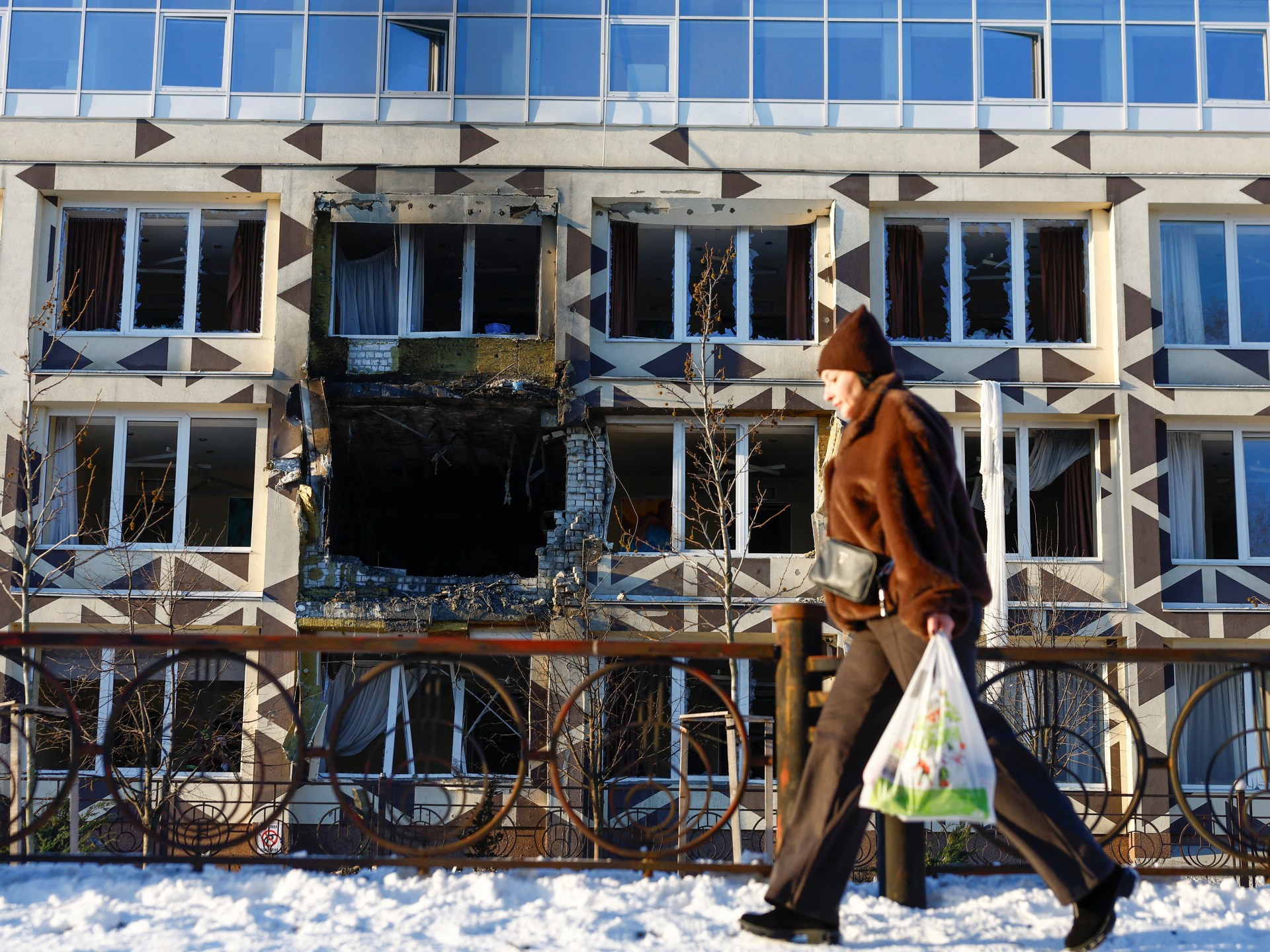
Russian mortality rates reportedly soar, troops test new tactics and Zelenskyy reshuffles Defence Ministry.A resident walks past a private hospital hit by alleged Russian drone attacks in Kyiv, Ukraine, on January 5, 2026 [Valentyn Ogirenko/Reuters]Published On 8 Jan 2026Russian mortality rates on the front lines are rising to levels that cannot be sustained by the current method of voluntary recruitment, Ukrainian figures suggest.“In December, 35,000 occupiers were eliminated – and this has been confirmed with video footage,” said Ukrainian President Volodymyr Zelenskyy in a Monday evening address. “In November, there were 30,000, and in October, 26,000 eliminated occupiers.”Recommended Stories list of 4 itemslist 1 of 4US backs security guarantees for Ukraine, as France and UK pledge troopslist 2 of 4Ukraine’s Zelenskyy names military intelligence chief as top aidelist 3 of 4Ukraine reports ‘concrete results’ from talks with Western allieslist 4 of 4Will Russia accept Western troops in Ukraine?end of listUkrainian commander-in-chief Oleksandr Syrskii echoed that analysis.“The enemy lost over 33,000 personnel [in December]. This figure includes only confirmed video cases, but the actual losses of the occupiers are greater,” he wrote on the Telegram messaging service.That, he said, made December 2025, “the first month when the unmanned systems units of the Ukrainian Defence Forces neutralised approximately as many servicemen of the occupying army as Russia conscripted in a month”.(Al Jazeera)Russia has kept regular conscripts out of its war in Ukraine, recruiting volunteers on a contract basis to fight in its “special military operation”.On December 27, Ukrainian military intelligence (GUR) chief Kyrylo Budanov told state broadcaster Suspilne that Russia had reached its quota of 403,000 recruits in 2025 – an average of 33,583 per month, and planned to increase that slightly to 34,083 per month in 2026.Ukraine’s casualty reports, if accurate, suggest they are no longer sustainable and may force Russia to start using its active reserve.The Institute for the Study of War, a Washington-based think tank, observed in November that forward reserve units in Belgorod had begun to receive heavy equipment such as howitzers, thermobaric weapons and all-terrain vehicles.“Reserve territorial defence units assigned with protecting rear-area critical infrastructure do not require such heavy equipment suited for offensive operations,” the ISW said, adding “Russia is setting conditions to deploy Belgorod Oblast active reservists for combat missions.”(Al Jazeera)Analysts have said that deploying reservists or conscripts could carry significant political risk for Russian President Vladimir Putin, who has left mainstream Russian society unscathed by his war of aggression.Ukraine estimates that almost 420,000 Russian troops were killed or wounded last year.Zelenskyy first noted the rising mortality rate of Russian troops on December 16.“The increase in these figures is the result of the right decisions. There must be more decisions like these,” he said on Monday.He was referring to the production of drones, which Ukraine successfully stepped up in 2025 and plans to increase this year.This, he said, was the main reason why he appointed former First Deputy Prime Minister Mykhailo Fedorov as defence minister on Friday.Zelenskyy described Fedorov as “deeply involved in the issues related to the drone line and works very effectively on digitalising public services and processes”.The president praised departing Defence Minister Denys Shmyal, whom he moved to the energy portfolio, for reaching the production target of 1,000 intercept drones per day by the end of last year.(Al Jazeera)Russia claims that Ukraine has its own recruitment problems.“Ordinary Ukrainians are becoming increasingly disillusioned with the actions of the authorities due to the situation at the front,” said Russian commander-in-chief Valery Gerasimov in a year-end report to Putin on December 18.He said Ukrainian recruitment levels had dropped by half during 2025 to 14,000 in November, and that Ukraine’s prosecutors had opened a total of 160,000 cases against defectors since 2022.Al Jazeera is unable to verify either Russian or Ukrainian claims.Russia has not been without success in 2025.Its average daily rate of advance was 13.24sq km (5.1sq miles) a day, compared with 9.87sq km (3.8sq miles) a day in 2024, said the ISW.But a monthly breakdown showed an inconsistent pattern of land grabs, rather than a steady increase. Russia’s territorial gains still amounted to 0.8 percent of Ukraine, consisting of villages and fields.New Russian tacticsRussia has said it aims to capture the rest of Donetsk, Zaporizhia and Kherson, three regions it has, on paper, annexed in their entirety.To achieve this, Russia has been experimenting with new tactics, using drones to cut Ukrainian supply lines and creating a kill zone as deep as 15km (9 miles) behind the front line.Russia introduced wired fibre-optic drones impervious to electronic jamming in 2025, and Syrskii credited these for Russia’s ability to capture the city of Siversk in Donetsk during the recent months.“The Russians have followed our path and created separate drone systems units, which already number 80,000 military personnel,” wrote Syrskii. “In the second stage, in 2026, they plan to double their numbers to 165,500. And by 2030, they aim to reach almost 210,000.”Russia also shifted tactics a few months ago, from large mechanised assaults that had resulted in huge losses of personnel and equipment, to infiltration tactics using several teams of two soldiers to establish bridgeheads and supply drops before reinforcements arrive.These tactics enabled it to capture two-thirds of the hotly contested eastern town of Pokrovsk, in Donetsk, by the end of last year, and roughly half of neighbouring Myrnohrad.Anticipating the further honing of these tactics, Ukraine has said it is improving the training of new troops.“We clearly understand what we will have to face in the near future,” wrote Syrskii. “We have set the task of forming special units designed to effectively detect and destroy enemy high-tech drone units, control points, and the crews of the occupiers’ unmanned aerial systems.”The long-range warOn Monday, the war claimed the first two civilian deaths of the year in Ukraine. A patient was killed when a Russian drone struck a hospital in Kyiv, and a second civilian was killed southwest of the capital.On the same day, Russia struck heating and electricity plants in the northern city of Kharkiv.During the first week of the year, Russia launched 789 drones and 10 missiles against Ukrainian cities.Ukraine shot down 83 percent of the drones and one of the missiles.Russia sharply increased its packages of long-range aerial attacks against Ukraine shortly after United States President Donald Trump won the November 2024 election.During 2025, it launched 54,000 long-range attack drones and 1,900 missiles against Ukraine, said the ISW.Russia introduced an innovation on Sunday, deploying Shahed drones with mounted Man-Portable Air Defence Systems (MANPADS) designed to shoot down drone-hunting aircraft, according to Ukrainian electronic and radio warfare expert Serhiy Beskrestnov.“I ask the pilots of the army aviation to take note of the emergence of a new threat. They should avoid approaching the Shahed on a head-on course,” Beskrestnov said.The information warOn December 29, Russia claimed Ukraine had attempted to strike Putin’s residence on the shores of Lake Valdai in Novgorod, and on January 1, its Ministry of Defence said flight data from a downed drone proved this.The target audience appeared to be US President Donald Trump, whom Putin phoned to give him the news in person.Despite initially declaring he believed the story was true, Trump on Sunday [January 4] told reporters on Air Force One, “I don’t believe that strike happened.”
SRCAl Jazeera
LANGEN
LEANCenter
WORDS1 204
ENT9
THU · 2026-01-08 · 12:12 GMTBRIEF NSR-2026-0108-6396
NSR-2026-0108-6396News Report·EN·Conflict
Russian war deaths are rising to unsustainable levels, says Ukraine
According to Ukrainian figures, Russian mortality rates in the war in Ukraine significantly increased in late 2025, reaching unsustainable levels based on current recruitment methods. Ukrainian President Zelenskyy stated that Russian losses were 35,000 in December, 30,000 in November, and 26,000 in October.
John T PsaropoulosAl JazeeraFiled 2026-01-08 · 12:12 GMTLean · CenterRead · 5 min
Al JazeeraFIG 01
Reading time
5min
Word count
1 204words
Sources cited
5cited
Entities identified
9entities
Quality score
100%
§ 01
Briefing Summary
AI-generatedNEWSAR · AI
According to Ukrainian figures, Russian mortality rates in the war in Ukraine significantly increased in late 2025, reaching unsustainable levels based on current recruitment methods. Ukrainian President Zelenskyy stated that Russian losses were 35,000 in December, 30,000 in November, and 26,000 in October. Commander-in-chief Syrskii confirmed similar figures, noting December 2025 saw Ukrainian unmanned systems neutralizing approximately the same number of soldiers Russia recruited. Ukraine suggests these casualty reports, if accurate, may force Russia to utilize its active reserve. The Institute for the Study of War observed reserve units in Belgorod receiving heavy equipment, potentially indicating preparation for offensive operations.
Confidence 0.90Sources 5Claims 5Entities 9
§ 02
Article analysis
Model · rule-basedFraming
Conflict
Political Strategy
Tone
Mixed Tone
AI-assessed
CalmNeutralAlarmist
Factuality
0.70 / 1.00
Factual
LowHigh
Sources cited
5
Well sourced
FewMany
§ 03
Key claims
5 extracted01
Russia had reached its quota of 403,000 recruits in 2025.
statisticKyrylo Budanov
Confidence
0.80
02
Russian mortality rates on the front lines are rising to levels that cannot be sustained by the current method of voluntary recruitment.
factualUkrainian figures
Confidence
0.70
03
Ukraine estimates that almost 420,000 Russian troops were killed or wounded last year.
statisticUkraine
Confidence
0.60
04
The enemy lost over 33,000 personnel [in December]. This figure includes only confirmed video cases.
statisticOleksandr Syrskii
Confidence
0.60
05
In December, 35,000 occupiers were eliminated – and this has been confirmed with video footage.
statisticVolodymyr Zelenskyy
Confidence
0.60
§ 04
Full report
5 min read · 1 204 words§ 05
Entities
9 identifiedKey playerOppositionContextPositiveNeutralNegative
People3
§ 06
Keywords & salience
9 termsrussian war deaths
0.90
ukraine
0.80
mortality rates
0.70
military losses
0.70
military recruitment
0.60
zelenskyy
0.60
conscription
0.50
military intelligence
0.40
unmanned systems
0.40
§ 07
Topic connections
Interactive graph Network visualization showing 51 related topics
View Full Graph Person Organization Location Event|Click node to navigate|Edge numbers = shared articles