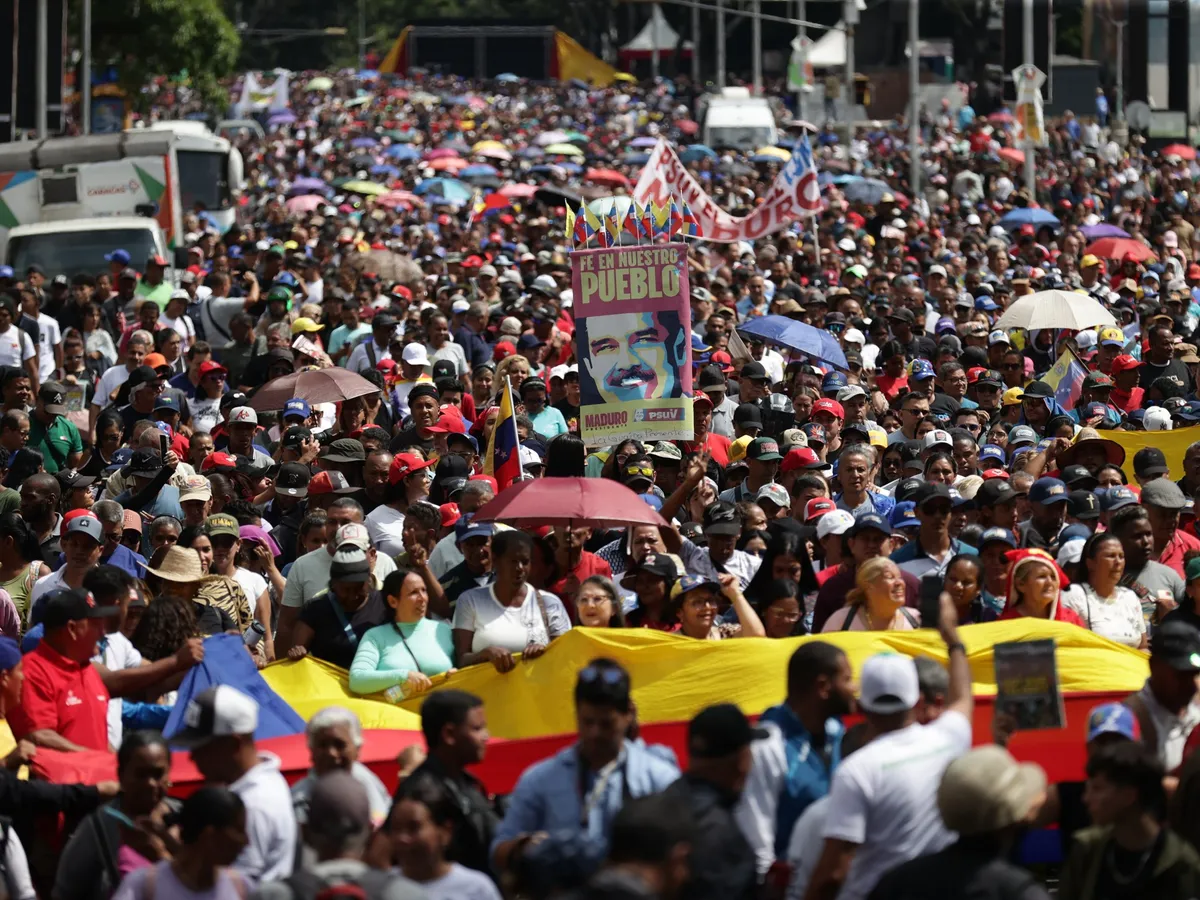
EXPLAINERThe sociopolitical ideology founded by former Venezuelan President Hugo Chavez is rooted in anti-imperialism.Supporters of Chavismo march in Caracas, Venezuela [File: Ronald Pena R/EPA]Published On 9 Jan 2026For decades, the idea of a political alliance between Venezuela and the United States has seemed impossible with Caracas defining itself by Chavismo, a left-wing populist ideology rooted in anti-imperialism and confronting Washington’s policies.But after US President Donald Trump ordered the abduction of Venezuelan President Nicolas Maduro on Saturday, followed by US insistence that Caracas’s interim government must take orders from Washington, questions about the future of Chavismo in Venezuela have begun to emerge.Recommended Stories list of 3 itemslist 1 of 3Maduro abduction shows influence, limits of US Secretary of State Rubiolist 2 of 3Rodriguez says ‘no foreign agent’ running Venezuela, US role still unclearlist 3 of 3How strong are Latin America’s military forces, as they face US threats?end of listSo what is Chavismo? Is it still a living movement – or has it morphed so far from its origins that it is in effect dead?Here’s what to know:What is Chavismo?Chavismo is named after its founder, Hugo Chavez, Venezuela’s late, outspoken socialist politician and leader. It is based on his policies and reforms when he served as president from 1999 until his death in 2013.Inspired by the ideologies of Venezuelan military officer Simon Bolivar, who fought for the independence of Latin American states from Spanish colonialism in the mid-1800s, Chavez introduced many social reforms that he believed would reduce poverty and bring about equality in the country.These reforms included the government supporting social welfare programmes, nationalising industries and confronting what Chavez called imperialist policies from countries like the US, which, according to Chavez, prioritised capitalism over human rights.During a trip to the US in 2006, Chavez said: “Capitalism is the way of the devil and exploitation.”“If you really want to look at things through the eyes of Jesus Christ, who I think was the first socialist, only socialism can really create a genuine society.”Venezuelan President Hugo Chavez speaks at the UN General Assembly in New York in 2006 [File: Ray Stubblebine/Reuters]Besides Chavez’s political party, the United Socialist Party of Venezuela, other parties like the far-left Revolutionary Movement Tupamaro and Fatherland for All also support the political ideology.After Chavez’s death, Maduro, a former bus driver from Caracas who was a longtime supporter of Chavez and is often seen as his protege, became president.Speaking at Chavez’s funeral in March 2013, Maduro promised to continue the Chavismo of his predecessor and said Venezuela would be ruled by democracy and socialism.“We’ll continue protecting the poor. We’ll continue giving food to those who need it. We’ll continue building the education of our children. We’ll continue building the Grand Homeland. We’ll continue building peace, … peace for our continent, the peace of our people,” he said at the time.However, it is hard to define Chavismo as a socialist ideology because it is heterogeneous, said Yoletty Bracho, an associate professor of political science at France’s Avignon University who focuses on Venezuela.“[Chavismo] is a political movement that was built upon the reunion of diverse actors across the political and social spectrum: social movements, historical left-wing parties, military actors. Maintaining a kind of coherence between these various sectors was one of the challenges during the Chavista democratic era,” she told Al Jazeera.“Later on, due to authoritarian consolidation, Chavismo reduced its heterogeneity to serve the interests of the political and military elites and their capacity of staying in power,” she added.Has Chavismo worked in Venezuela?According to a March 2013 report by the European nonprofit Center for Economic and Policy Research, after Chavez came to power, poverty in the country “decreased significantly”, dropping by nearly 50 percent, while extreme poverty dropped by more than 70 percent. At the same time, nationalisation of the oil industry led to the economy growing.But some critics said, despite this, Venezuela’s private sector still dominated the economy.A 2010 report by The Associated Press news agency citing Venezuela’s Central Bank said despite Chavez seeking to make the country a socialist economy, the private sector still controlled two-thirds of its economy, which was the same level as when he was elected in 1998.In an interview with American TV presenter John Stossel in 2017, scholar and political activist Noam Chomsky said Chavez’s ideology “was quite remote from socialism”.“Private capitalism remained. … Capitalists were free to undermine the economy in all sorts of ways,” he added.Many critics also argued that Chavismo is already dead – that it died under Maduro’s rule when the ousted president ruled the country in a hardline manner.Securing human rights was supposed to be a key aspect of Chavismo. But especially since Maduro came to power, rights groups have documented how the government has cracked down on human rights defenders and protesters critical of the administration, tried to regulate media coverage of protests and political events in the country, and carried out more human rights violations, including arbitrary detentions of opposition leaders.Bracho told Al Jazeera that while the Chavista government under Chavez and Maduro sought to advance political inclusion and social justice in Venezuela, it also became extremely corrupt and repressive.“For many years now, many people in the country and even opposition leaders do not feel represented by the Chavista government, which seeks to govern through socialism,” she said.Moreover, while the ideology of Chavismo sought to advance Venezuela’s economy by shunning neoliberal policies and prioritising democracy, under Maduro’s rule, the economy began shrinking. According to the International Monetary Fund, from 2014 to 2021, Venezuela’s economy shrank by almost 80 percent.“Chavismo initially had a great impact on wealth redistribution and, importantly, bringing into the political arena wide sectors of the population that had been historically marginalised,” Renata Segura, International Crisis Group’s programme director for Latin America and the Caribbean, told Al Jazeera.But after Chavez’s death, “Chavismo also lost the leader who captured the imagination of many Venezuelans”, she said. “During Maduro’s reign, the regime lost much of its ideological coherence. Corruption, incapacity to run the state and an ever-growing economic crisis has made Chavismo become empty promises that soon lost almost all support among Venezuelans.”According to the magazine America’s Quarterly, which focuses on stories from Latin America, groups that called themselves “Chavistas no-Maduristas”, or supporters of Chavez who oppose Maduro’s rule due to his manner of governance, formed an alliance in 2016 called the Platform for the Fight of Chavismo and the Left, seeking to preserve Chavismo under Maduro’s rule.But despite the pockets of dissent, a large group of Chavistas have remained loyal to Maduro due to his economic incentives to address the country’s financial crisis and his measures to counter US sanctions and foreign influence on the country.Since 2005, the US has sanctioned individuals and entities in Venezuela for “criminal, antidemocratic or corrupt actions”. In 2017 during Trump’s first term as president, Washington also imposed broad financial sanctions against the government for alleged democratic backsliding.
SRCAl Jazeera
LANGEN
LEANCenter
WORDS1 146
ENT6
FRI · 2026-01-09 · 05:54 GMTBRIEF NSR-2026-0109-6533
NSR-2026-0109-6533Analysis·EN·Political Strategy
What is Chavismo – and is it dead after US abduction of Venezuela’s Maduro?
Chavismo, the left-wing populist ideology founded by former Venezuelan President Hugo Chavez, is rooted in anti-imperialism and social reforms. The ideology, inspired by Simon Bolivar, aims to reduce poverty and inequality through social welfare programs and nationalizing industries.
Priyanka ShankarAl JazeeraFiled 2026-01-09 · 05:54 GMTLean · CenterRead · 5 min
Al JazeeraFIG 01
Reading time
5min
Word count
1 146words
Sources cited
4cited
Entities identified
6entities
Quality score
100%
§ 01
Briefing Summary
AI-generatedNEWSAR · AI
Chavismo, the left-wing populist ideology founded by former Venezuelan President Hugo Chavez, is rooted in anti-imperialism and social reforms. The ideology, inspired by Simon Bolivar, aims to reduce poverty and inequality through social welfare programs and nationalizing industries. It also confronts what it views as imperialist policies from countries like the US. Following the US abduction of Venezuelan President Nicolas Maduro in January 2026, questions have emerged about the future and viability of Chavismo in Venezuela. The article explores the origins and tenets of Chavismo to assess whether it remains a living movement or has deviated from its original principles. Chavismo is supported by parties like the United Socialist Party of Venezuela, Revolutionary Movement Tupamaro, and Fatherland for All.
Confidence 0.90Sources 4Claims 5Entities 6
§ 02
Article analysis
Model · rule-basedFraming
Political Strategy
Conflict
Tone
Mixed Tone
AI-assessed
CalmNeutralAlarmist
Factuality
0.70 / 1.00
Factual
LowHigh
Sources cited
4
Well sourced
FewMany
§ 03
Key claims
5 extracted01
Maduro promised to continue the Chavismo of his predecessor.
factualMaduro
Confidence
1.00
02
Capitalism is the way of the devil and exploitation.
quoteHugo Chavez
Confidence
1.00
03
US President Donald Trump ordered the abduction of Venezuelan President Nicolas Maduro.
factualnull
Confidence
0.90
04
Chavismo is a left-wing populist ideology rooted in anti-imperialism.
factualnull
Confidence
0.90
05
Chavez introduced social reforms to reduce poverty and bring about equality.
factualnull
Confidence
0.80
§ 04
Full report
5 min read · 1 146 words§ 05
Entities
6 identifiedKey playerOppositionContextPositiveNeutralNegative
People3
§ 06
Keywords & salience
9 termschavismo
1.00
hugo chavez
0.90
anti-imperialism
0.80
venezuela
0.80
socialism
0.70
us relations
0.60
social reforms
0.50
nicolas maduro
0.50
populist ideology
0.40
§ 07
Topic connections
Interactive graph Network visualization showing 6 related topics
View Full Graph Person Organization Location Event|Click node to navigate|Edge numbers = shared articles