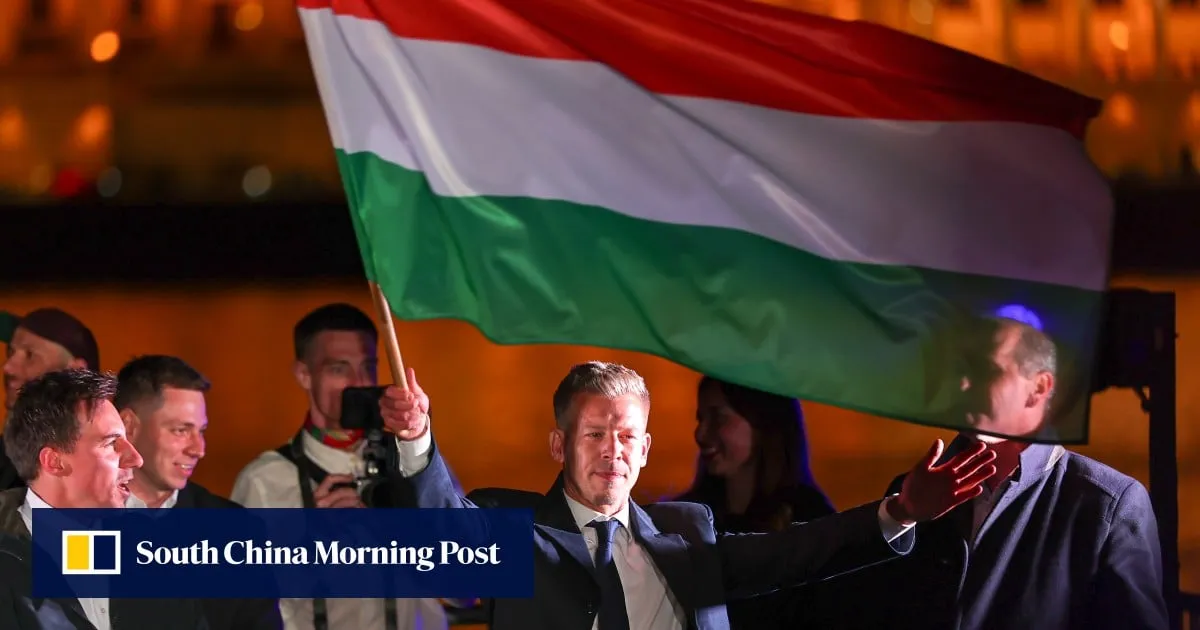
Hungary’s stunning political transition will not trigger a dramatic overturning of its ties with China, Chinese experts suggest, with China-EU relations also expected to see limited impact.A landslide parliamentary election victory on Sunday for the centre-right Tisza Party, led by Peter Magyar, ended Hungarian Prime Minister Viktor Orban’s 16 years in power.Orban conceded defeat and congratulated Magyar in a phone call.Magyar is now on course to become Hungary’s next prime minister, and his Tisza Party is projected to secure a two-thirds supermajority in the 199-seat Hungarian parliament.Meanwhile, support collapsed for Orban’s Fidesz Party, which was reduced to 55 seats – fewer than half of the 135 it held going into the election.Viktor Orban’s defeat ends his 16-year tenure as Hungary’s prime minister. Photo: ReutersOrban’s defeat was within the realm of expectations, according to Wang Yiwei, director of the Centre for European Studies at Renmin University in Beijing.Yet, a change in Hungary’s leadership might not lead to a rejection of investment from China, which had put substantial capital into the central European country, he said.“There is [also] unlikely to be a significant impact on the EU’s relations with China,” Wang added.The paramount challenge facing the Magyar government would be to revive the Hungarian economy, according to Wang Hongyi, associate professor at the Beijing Foreign Studies University (BFSU) Centre for Central and Eastern European Studies.That would make any decoupling from China unlikely at such a juncture, otherwise it would risk “digging its own grave”, he said.“The foundation of practical cooperation that China and Hungary have built over the past decade or so will not undergo any disruptive changes.”By strengthening ties with China and blocking European Union sanctions against Beijing, Orban had become China’s strongest ally in the bloc and a diplomatic outlier among his European peers.Further ReadingAnd as the EU and NATO toughened their stance on China, Orban-led Hungary had become an increasingly vital strategic partner of Beijing within both organisations.SCMP Plus is a new premium news platform that gives you an all-inclusive edge to stay ahead on China news. To access our exclusive content you’ll need to subscribe.Already a subscriber?LOG INDuring Chinese President Xi Jinping’s 2024 state visit to Budapest, the two countries elevated their relationship to that of an “all-weather comprehensive strategic partnership for the new era” – one of the highest tiers in Beijing’s diplomatic hierarchy for bilateral ties.Since 2010, Orban had pursued a strategy of opening up towards the East, making Hungary the first European country to sign a cooperation agreement with China under the Belt and Road Initiative.In addition, while the EU as a whole sought to “de-risk” its economic relations with China, the Orban government doubled down on wooing more Chinese investments, especially in the electric vehicle and battery manufacturing sectors.In contrast, the primary foreign policy goal of Magyar’s Tisza appeared to be restoring Hungary’s position as a reliable member of the EU.On the campaign trail, Magyar said little about China. However, last year he indicated that Hungary should avoid becoming reliant on Chinese loans. Still, he noted at the time that his government would adopt a pragmatic approach towards China.According to Ding Chun, director of the Centre for European Studies at Fudan University in Shanghai, the future Hungarian leadership might not be as close to Beijing as Orban, but Magyar was unlikely to dismantle the country’s ties with China.“After all, bilateral cooperation is mutually beneficial,” Ding said. “Moreover, the ruling party must also consider its own national interests.”China in 2025 was the largest source of foreign investment in Hungary for the third straight year, according to the Hungarian Investment Promotion Agency.Last September marked the fourth renewal of the bilateral currency swap agreement between the countries. The deal’s value has now quadrupled over the past 12 years, rising from an initial 10 billion yuan to the current 40 billion yuan (US$5.86 billion).In US dollar terms, two-way trade between China and Hungary soared nearly 55 per cent from a year ago during the January–February period, dwarfing the increase of about 23 per cent in China’s import and export with the EU, according to Chinese customs data.On Monday, Beijing congratulated Magyar on his victory. “China attaches great importance to the development of China-Hungary relations,” Chinese foreign ministry spokesman Guo Jiakun said.Guo added that Beijing “stands ready to work with Hungary’s new government on the basis of mutual respect, equality and mutual benefit”, to strengthen high-level exchanges, enhance political mutual trust and expand practical cooperation.It remained to be seen how far Magyar could realign with the EU, particularly over the bloc’s agenda on China, Chinese observers said.Ding of Fudan said Magyar would “have to consider how much the EU could give and how much he could offer in exchange” when EU pursued a united position on China.According to Wang of BFSU, Hungary was likely to navigate the rift between the West and China by balancing the EU’s “de-risking” strategy with pragmatic cooperation, leaning towards the latter.He said Hungary’s election would not significantly alter China-EU relations, partially because Budapest viewed Beijing “rationally”.Specifically, the need to repair ties with the EU and unlock €18 billion (US$21 billion) in frozen funds could lead the new government to align its China policy more closely with the bloc.
SRCSouth China Morning Post
LANGEN
LEANCenter-Right
WORDS864
ENT12
MON · 2026-04-13 · 13:14 GMTBRIEF NSR-2026-0413-65786
NSR-2026-0413-65786Analysis·EN·Political Strategy
Why Beijing isn’t panicking over Hungarian PM Viktor Orban’s stunning election defeat
Hungary's Prime Minister Viktor Orban, in power for 16 years, conceded defeat to Peter Magyar's Tisza Party in Sunday's parliamentary election. Magyar's party is projected to secure a supermajority in the Hungarian parliament.
Orange Wang,Laura ZhouSouth China Morning PostFiled 2026-04-13 · 13:14 GMTLean · Center-RightRead · 4 min
South China Morning PostFIG 01
Reading time
4min
Word count
864words
Sources cited
3cited
Entities identified
12entities
Quality score
100%
§ 01
Briefing Summary
AI-generatedNEWSAR · AI
Hungary's Prime Minister Viktor Orban, in power for 16 years, conceded defeat to Peter Magyar's Tisza Party in Sunday's parliamentary election. Magyar's party is projected to secure a supermajority in the Hungarian parliament. Chinese experts suggest this political transition is unlikely to dramatically alter Hungary's ties with China, despite Orban being Beijing's strongest EU ally. Analysts believe the new Hungarian government will prioritize economic revival, making a decoupling from Chinese investment improbable. They also anticipate limited impact on overall China-EU relations, as practical cooperation between China and Hungary is expected to continue.
Confidence 0.90Sources 3Claims 5Entities 12
§ 02
Article analysis
Model · rule-basedFraming
Political Strategy
Economic Impact
Tone
Measured
AI-assessed
CalmNeutralAlarmist
Factuality
0.70 / 1.00
Factual
LowHigh
Sources cited
3
Well sourced
FewMany
§ 03
Key claims
5 extracted01
During Chinese President Xi Jinping’s 2024 state visit to Budapest, the two countries elevated their relationship to that of an “all-weather comprehensive strategic partnership for the new era”.
factual
Confidence
1.00
02
A landslide parliamentary election victory on Sunday for the centre-right Tisza Party, led by Peter Magyar, ended Hungarian Prime Minister Viktor Orban’s 16 years in power.
factual
Confidence
1.00
03
By strengthening ties with China and blocking European Union sanctions against Beijing, Orban had become China’s strongest ally in the bloc.
factual
Confidence
0.90
04
The paramount challenge facing the Magyar government would be to revive the Hungarian economy.
quoteWang Hongyi, associate professor at the Beijing Foreign Studies University
Confidence
0.80
05
Orban's defeat was within the realm of expectations.
quoteWang Yiwei, director of the Centre for European Studies at Renmin University in Beijing
Confidence
0.70
§ 04
Full report
4 min read · 864 words§ 05
Entities
12 identifiedKey playerOppositionContextPositiveNeutralNegative
People5
Organizations4
§ 06
Keywords & salience
10 termshungarian election
0.90
viktor orban
0.80
china-hungary relations
0.80
peter magyar
0.70
china-eu relations
0.60
political transition
0.60
fidesz party
0.50
tisza party
0.50
economic cooperation
0.50
strategic partnership
0.40
§ 07
Topic connections
Interactive graph Network visualization showing 7 related topics
View Full Graph Person Organization Location Event|Click node to navigate|Edge numbers = shared articles