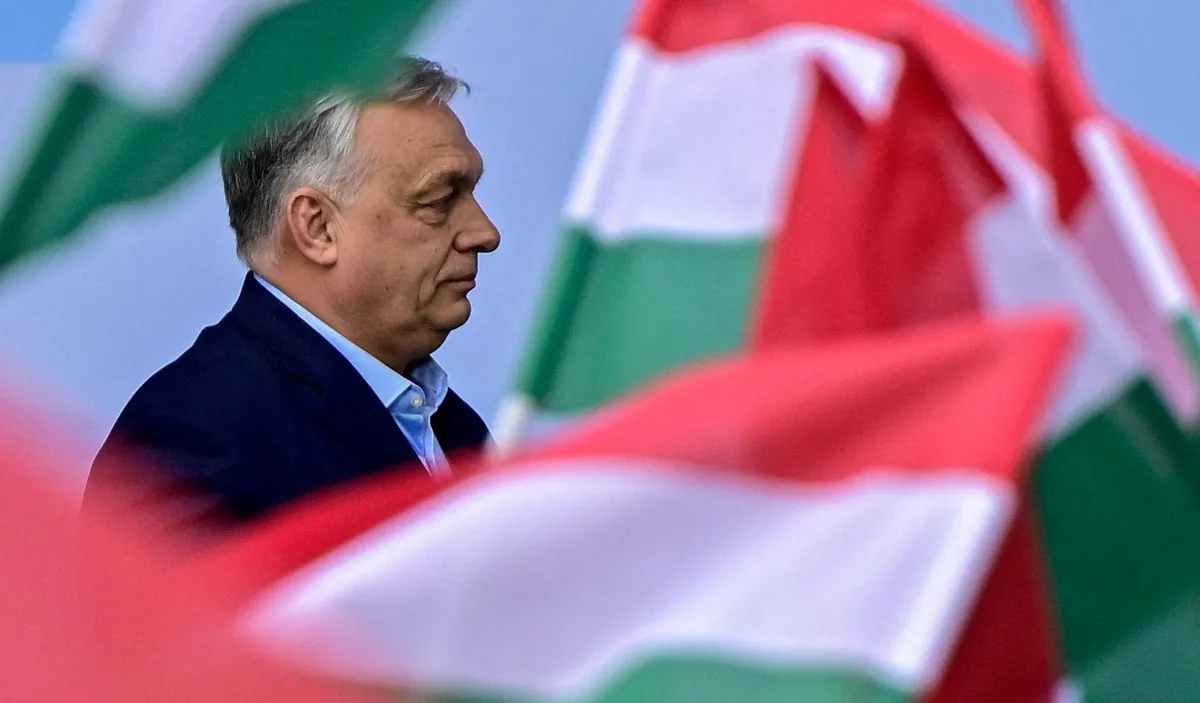
The practicalities of Hungary’s election may not matter as much as the psychological impact, observers tell Al Jazeera.Hungarian Prime Minister Viktor Orban attends the first so-called 'Patriots Grand Assembly' of nationalist groups from Europe, in Budapest, Hungary, March 23, 2026 [Marton Monus/Reuters]Published On 2 Apr 2026Europeans are looking at Hungary’s parliamentary election on April 12 as a pivotal moment for the continent.No single member state has stymied the European Union’s ability to express a common foreign, defence, energy and migration policy as much as Hungary.Recommended Stories list of 4 itemslist 1 of 4Hungary’s Orban orders extra security, alleges Ukraine attacks plotlist 2 of 4Hungary’s Orban continues to block Ukraine loan at EU summitlist 3 of 4EU calls for clarification after Hungary accused of leaking info to Russialist 4 of 4Is the tide turning on Europe’s hard-right populists?end of listUnder Prime Minister Viktor Orban, Hungary has refused to participate in a common EU asylum policy or shared defence mechanism; opposed Europe’s swift turn towards energy autonomy based on solar and wind power while continuing to import Russian oil and gas; and vetoed the opening of talks to admit Ukraine as a member, as well as 90 billion-euro ($105bn) in low-cost loans to Ukraine.For this reason, say observers, the victory or defeat of Orban’s Fidesz party, in power for 16 years, will likely have far-reaching effects on how the European Union governs itself in future.“We have two governments in the EU [Hungary, Slovakia] and another outside it, North Macedonia, which are fanatically Trumpian and at the same time fanatically pro-Russian,” said Angelos Syrigos, a conservative New Democracy MP in Athens, referring to United States President Donald Trump, who opposes the EU.“In the European Council [of 27 government leaders], the threat of a veto pushes states to find mutually agreeable solutions. We don’t want vetoes. Orban constantly vetoes things,” he told Al Jazeera.He defined Fidesz as “a party that is opposed to the way the EU works”.Opposition Tisza Party leader Peter Magyar wants a stronger European orientation and would put Ukraine’s membership to a binding referendum. He also wants to clamp down on corruption, releasing billions in withheld EU funds, and stop Hungary’s departure from the International Criminal Court.EU’s ‘practical’ responsePolls currently give the Tisza Party roughly 50 percent of the popular vote, about 10 points ahead of Fidesz.But even if Orban is removed, there are other illiberal leaders in Europe who may covet his obstructionist role, such as Slovakian premier Robert Fico, or Czech premier Andrej Babis.For this reason, some see the silver lining in Orban’s career as a disruptor of consensus in the fact that he has forced the EU to evolve pragmatically.At a December 2023 summit, for example, Orban was asked to leave the room so EU leaders could unanimously declare Ukraine a candidate country. According to reports, they swayed Orban with the promise to release 10 billion euros ($11.6bn) in blocked EU funding.“[There are] these kinds of ad hoc structures … you just send Viktor out for a coffee when you have a very important decision to make,” said Katalin Miklossy, Jean Monnet Professor in Eastern European Studies at the University of Helsinki. “[EU members] started to become more practical about it.”She told Al Jazeera, “The problem was with the European Union – that we were weak because we were stuck to the rules, playing by the book. So this is now gone.”Should Orban remain, the EU has floated the idea of circumventing his – or anyone else’s – veto by releasing a set of 26 bilateral loans to Ukraine from the other members.There have been other instances of the bloc getting around opposition.In 2010, when Greece became the first member of the eurozone to go bankrupt, endangering the common currency’s survival, other EU members extended a series of bilateral loans, called the Greek Loan Facility, because the EU then lacked a common fund for distressed eurozone members.Such flexibility will be needed to keep Ukraine in the fight against Russia.“If [these funds] are not released, we hope for an alternative; otherwise, the Ukrainian army will be underfunded,” Ukraine’s President Volodymyr Zelenskyy recently told Le Monde.The EU missed an opportunity for a structural evolution when French and Dutch referenda defeated a constitution in 2005 that would have replaced unanimity with qualified majority voting. That has given Orban power to derail common decisions. But the EU has not stopped evolving through crises.In 2020, for instance, it floated its first common bond to stimulate an economy flattened by the COVID-19 pandemic. Since Russia’s invasion of Ukraine in February 2022, it has funneled money into the European defence industry and ultimately aims to become a defence union.“There is a very strong belief that Russia will turn on us after 2030 or so,” said Miklossy, “So we are in a hurry … Ukraine is the buffer zone, and they are fighting for us.”Ukraine’s role in European defence has helped amass EU support for it, but there are limits to the ad hoc method of pragmatic evolution.Orban agreed to a 90-billion-euro ($105bn) loan for Ukraine last December after being promised that Hungary, along with Slovakia and the Czech Republic wouldn’t have to back it. But he abruptly reversed himself last month – an unheard-of manoeuvre in European politics – because Ukraine refused to mend the Druzhba pipeline carrying Russian oil to Hungary after Russia accidentally bombed it. A tumultuous summit failed to budge him.And even if Magyar wins, say Ukrainians, they will not have immediate access to the loan.“In December 2025, there was a first European Council decision, when the European Union was promising this money as soon as possible, starting from January 2026,” said Victoria Vdovychenko, Future of Ukraine programme co-leader at Cambridge University’s Centre for Geopolitics.“[This] never happened, as we know already, and now it’s not again happening. Plausibly, feasibly, [this] will be happening only in June,” she said.Peter Magyar, leader of Hungary’s opposition Tisza Party, attends a protest march organised by Tisza over a case of abuse at a juvenile detention centre, amid an ongoing investigation, in Budapest, Hungary, December 13, 2025 [Bernadett Szabo/Reuters]Still, a Tisza win in this climate would have an enormous psychological impact on both sides of the Atlantic, said SM Amadae, adjunct professor of World Politics at the University of Cambridge’s Centre for the Study of Existential Risk.“It would be a big shot of confidence into the EU,” said Amadae. “There is an existential threat to this set of values that the EU is based on. But I think it’s more that stealth creep of illiberalism, the far right populism, the economic disenfranchisement of the people that aren’t part of the economic pie,” she said. “I don’t think it’s from an invasion of Russia.”“It’s gonna be this big feeling of, ‘we could do things’. Imagine all those countless protests that have gone on with people marching; there’ll be a sense of ownership over the future of Hungary,” Amadae said.She believes that could also have an effect on the other side of the Atlantic, where Trump’s Republican Party faces unfavourable polls in elections for the US Congress this November.Can Peter Magyar pull it off?Fidesz has also gerrymandered constituencies to boost its parliamentary majority.“There’s the deep state, there’s the legions of corruption, of the oligopoly, the funnelling of money to the close Orban insiders,” Amadae told Al Jazeera.“I would be cautiously pessimistic and say it’s very hard for me to conceive of how this could change. And maybe it’s because we’ve all known of the Fidesz party’s being in power for so long, that it’s a failing of our imagination.”
SRCAl Jazeera
LANGEN
LEANCenter
WORDS1 260
ENT11
THU · 2026-04-02 · 08:17 GMTBRIEF NSR-2026-0402-48979
NSR-2026-0402-48979News Report·EN·Political Strategy
‘Orban constantly vetoes’: Europe braces for Hungary election
Hungary's parliamentary election on April 12, 2026, is viewed by many in Europe as a critical moment for the EU's future. Under Prime Minister Viktor Orban, Hungary has consistently blocked EU initiatives on asylum, defense, energy, and aid to Ukraine, frustrating the bloc's ability to act cohesively.
John T PsaropoulosAl JazeeraFiled 2026-04-02 · 08:17 GMTLean · CenterRead · 6 min
Al JazeeraFIG 01
Reading time
6min
Word count
1 260words
Sources cited
2cited
Entities identified
11entities
Quality score
100%
§ 01
Briefing Summary
AI-generatedNEWSAR · AI
Hungary's parliamentary election on April 12, 2026, is viewed by many in Europe as a critical moment for the EU's future. Under Prime Minister Viktor Orban, Hungary has consistently blocked EU initiatives on asylum, defense, energy, and aid to Ukraine, frustrating the bloc's ability to act cohesively. Orban's Fidesz party, in power for 16 years, faces a challenge from the Tisza party, led by Peter Magyar, who advocates for closer EU ties, a referendum on Ukraine's membership, and anti-corruption measures. Polls suggest the Tisza party is currently leading, and the election's outcome is expected to significantly impact the EU's governance and foreign policy direction.
Confidence 0.90Sources 2Claims 5Entities 11
§ 02
Article analysis
Model · rule-basedFraming
Political Strategy
Conflict
Tone
Measured
AI-assessed
CalmNeutralAlarmist
Factuality
0.60 / 1.00
Mixed
LowHigh
Sources cited
2
Limited
FewMany
§ 03
Key claims
5 extracted01
Opposition Tisza party leader Peter Magyar wants a stronger European orientation and would put Ukraine’s membership to a binding referendum.
factualAl Jazeera
Confidence
1.00
02
We don’t want vetoes. Orban constantly vetoes things.
quoteAngelos Syrigos, a conservative New Democracy MP in Athens
Confidence
1.00
03
Orban vetoed the opening of talks to admit Ukraine as a member, as well as 90 billion-euro in loans to Ukraine.
factualAl Jazeera
Confidence
1.00
04
Hungary has refused to participate in a common EU asylum policy or shared defence mechanism.
factualAl Jazeera
Confidence
1.00
05
Polls currently give the Tisza party roughly 50 percent of the popular vote, about 10 points ahead of Fidesz.
statisticAl Jazeera
Confidence
0.90
§ 04
Full report
6 min read · 1 260 words§ 05
Entities
11 identifiedKey playerOppositionContextPositiveNeutralNegative
People3
Organizations3
§ 06
Keywords & salience
10 termshungary election
0.90
european union
0.80
viktor orban
0.80
veto
0.70
eu policy
0.70
fidesz party
0.60
ukraine
0.60
energy policy
0.50
peter magyar
0.40
foreign policy
0.40
§ 07
Topic connections
Interactive graph Network visualization showing 51 related topics
View Full Graph Person Organization Location Event|Click node to navigate|Edge numbers = shared articles