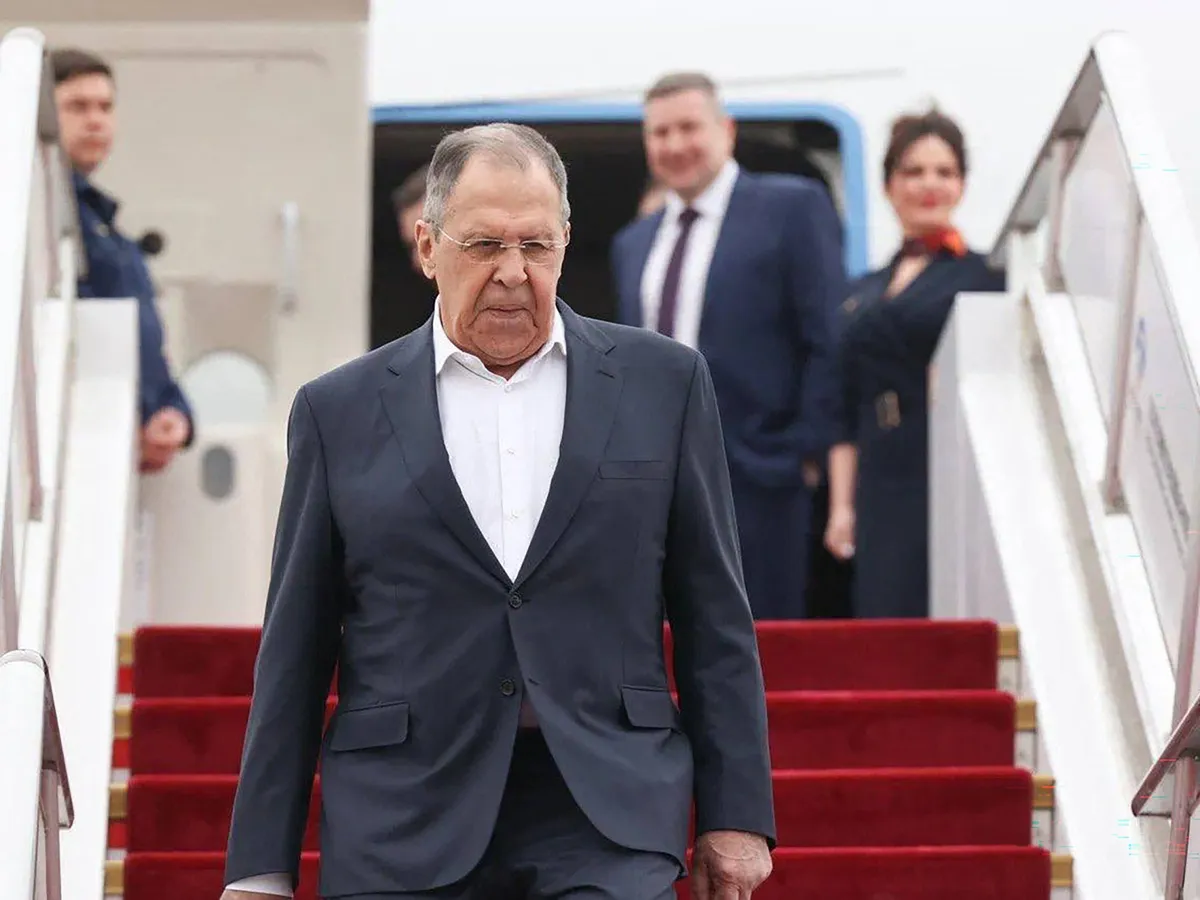
China and Russia have been vocal critics of the US-Israel war on Iran, an ally of both world powers.Russia's Foreign Minister Sergey Lavrov disembarks from a plane as he arrives in Beijing, on April 14, 2026 [Handout/Russian Ministry of Foreign Affairs via AFP]Published On 14 Apr 2026Russian Foreign Minister Sergey Lavrov has arrived in Beijing as the United States blocks the Strait of Hormuz, through which China imports about a third of its oil supplies.Lavrov received a red-carpet welcome on Tuesday, according to photos shared by Russia’s Ministry of Foreign Affairs.Recommended Stories list of 4 itemslist 1 of 4Trump’s threat to blockade Hormuz: Why it’s the latest major escalationlist 2 of 4Energy prices rise despite Jones Act suspension by Trumplist 3 of 4Lebanon to Strait of Hormuz, here’s what we know on day 46 of Iran warlist 4 of 4China dismisses Vice Minister of Foreign Affairs Sun Weidongend of listBeijing and Moscow have condemned the US and Israel over their war on Iran, with China also being economically affected by the energy crisis it has caused.China, a big importer of Iranian oil, also slammed a recently imposed US scheme to blockade vessels entering or departing Iranian ports and coastal areas, including in the Gulf and the Gulf of Oman.“The Strait of Hormuz is an important international trade route for goods and energy, and maintaining its security, stability, and unimpeded flow is in the common interest of the international community,” China’s Ministry of Foreign Affairs spokesman Guo Jiakun said on Monday.Lavrov speaks to AraghchiAl Jazeera’s Alan Fisher, reporting from Washington, DC, said the US’s goal is to choke Iran off by blocking everything coming in and out of Iranian ports.“What the US hopes is that there’ll be pressure on Iran from some of its main business partners, including China,” he said, adding that Beijing imports about a third of its oil from Iran. “The United States is hoping that pressure on China will mean China putting pressure on Iran and forcing Iran to get back to the negotiating table.”On Monday, Lavrov held a telephone conversation with his Iranian counterpart, Abbas Araghchi.The top Russian diplomat told Araghchi it was important to guard against any resumption of hostilities in the Middle East, and said Russia stood ready to help with a settlement, according to a statement by the Russian Foreign Ministry.“S Lavrov emphasised the importance of preventing a recurrence of armed confrontation and once again confirmed Russia’s unwavering readiness to assist in resolving the crisis, which has no military solution,” the ministry said.It added Araghchi related to Lavrov details of US-Iran talks in Pakistan at the weekend, which failed to reach a breakthrough.Beijing and Moscow are close economic and political partners, and the relationship has deepened further since Russia’s full-scale invasion of Ukraine in 2022.Wang also held a call with Lavrov on April 5, when they agreed that Beijing and Moscow would work together to de-escalate tensions in the Middle East.Diplomacy traffic in BeijingChina welcomed a string of leaders of countries that have been affected by the war and its economic fallout this week, including Spanish Prime Minister Pedro Sanchez and United Arab Emirates President Mohamed bin Zayed Al Nahyan, also known as MBZ.Chinese President Xi Jinping met MBZ and Sanchez on Tuesday morning, and Vietnamese President To Lam is expected in China for a four-day trip.“I think what this really speaks to is that many people around the world have been surprised that China has not played a more active role in the Iran war, given it has such strong ties with Tehran, including as Iran’s largest trading partner and buyer of crude oil,” Al Jazeera’s Katrina Yu, reporting from Beijing, said.“But what China has been doing, besides calling for restraint and more negotiation, is taking advantage of this moment to really look at states that may be a little disenchanted with the US or looking to diversify from reliance on Washington,” Yu said.“China has presented itself as the opposite of Washington – a reliable, stable and predictable partner. For many states, that message really appeals.”Trump’s threats after ‘fabricated’ reportsTrump, who is scheduled to visit Beijing next month for talks with Xi, said on Sunday he would hit China’s goods with a 50 percent tariff if it provided military assistance to Tehran.His comments came the same day CNN reported that US intelligence indicated China was preparing to deliver new air defence systems to Iran within the next few weeks, quoting three people familiar with the assessments.On Tuesday, Chinese Foreign Ministry spokesman Guo said those reports were “completely fabricated”.“If the US insists on using this as an excuse to impose additional tariffs on China, China will definitely take resolute countermeasures,” he said.
SRCAl Jazeera
LANGEN
LEANCenter
WORDS779
ENT11
TUE · 2026-04-14 · 09:08 GMTBRIEF NSR-2026-0414-67122
NSR-2026-0414-67122News Report·EN·Conflict
Russia’s Lavrov visits China as US pressures Iran with Hormuz blockade
Russian Foreign Minister Sergey Lavrov visited Beijing on April 14, 2026, amid rising tensions due to a US blockade of the Strait of Hormuz. This blockade, aimed at pressuring Iran, is disrupting China's oil imports, as a third of its supply passes through the strait.
By AFP and ReutersAl JazeeraFiled 2026-04-14 · 09:08 GMTLean · CenterRead · 4 min
Al JazeeraFIG 01
Reading time
4min
Word count
779words
Sources cited
4cited
Entities identified
11entities
Quality score
100%
§ 01
Briefing Summary
AI-generatedNEWSAR · AI
Russian Foreign Minister Sergey Lavrov visited Beijing on April 14, 2026, amid rising tensions due to a US blockade of the Strait of Hormuz. This blockade, aimed at pressuring Iran, is disrupting China's oil imports, as a third of its supply passes through the strait. Both Russia and China have criticized the US-Israel war on Iran and the US blockade, with China emphasizing the importance of maintaining the Strait's security for international trade. Lavrov spoke with his Iranian counterpart, stressing the need to prevent further conflict and offering Russia's assistance in reaching a settlement. The US hopes that economic pressure on China will lead them to pressure Iran to return to negotiations.
Confidence 0.90Sources 4Claims 5Entities 11
§ 02
Article analysis
Model · rule-basedFraming
Conflict
Economic Impact
Tone
Measured
AI-assessed
CalmNeutralAlarmist
Factuality
0.70 / 1.00
Factual
LowHigh
Sources cited
4
Well sourced
FewMany
§ 03
Key claims
5 extracted01
The Strait of Hormuz is an important international trade route for goods and energy.
quoteChina’s Ministry of Foreign Affairs spokesman Guo Jiakun
Confidence
1.00
02
Beijing and Moscow have condemned the US and Israel over their war on Iran.
factualArticle
Confidence
1.00
03
China imports about a third of its oil supplies through the Strait of Hormuz.
factualArticle
Confidence
1.00
04
Russia's Foreign Minister Sergey Lavrov has arrived in Beijing as the United States blocks the Strait of Hormuz.
factualArticle
Confidence
1.00
05
The US hopes that pressure on China will mean China putting pressure on Iran.
quoteAl Jazeera’s Alan Fisher
Confidence
0.80
§ 04
Full report
4 min read · 779 words§ 05
Entities
11 identifiedKey playerOppositionContextPositiveNeutralNegative
People3
Organizations1
§ 06
Keywords & salience
10 termsstrait of hormuz
0.90
us-iran war
0.90
china
0.80
russia
0.80
oil supplies
0.70
us blockade
0.70
energy crisis
0.60
international trade
0.50
sergey lavrov
0.50
middle east
0.40
§ 07
Topic connections
Interactive graph Network visualization showing 51 related topics
View Full Graph Person Organization Location Event|Click node to navigate|Edge numbers = shared articles