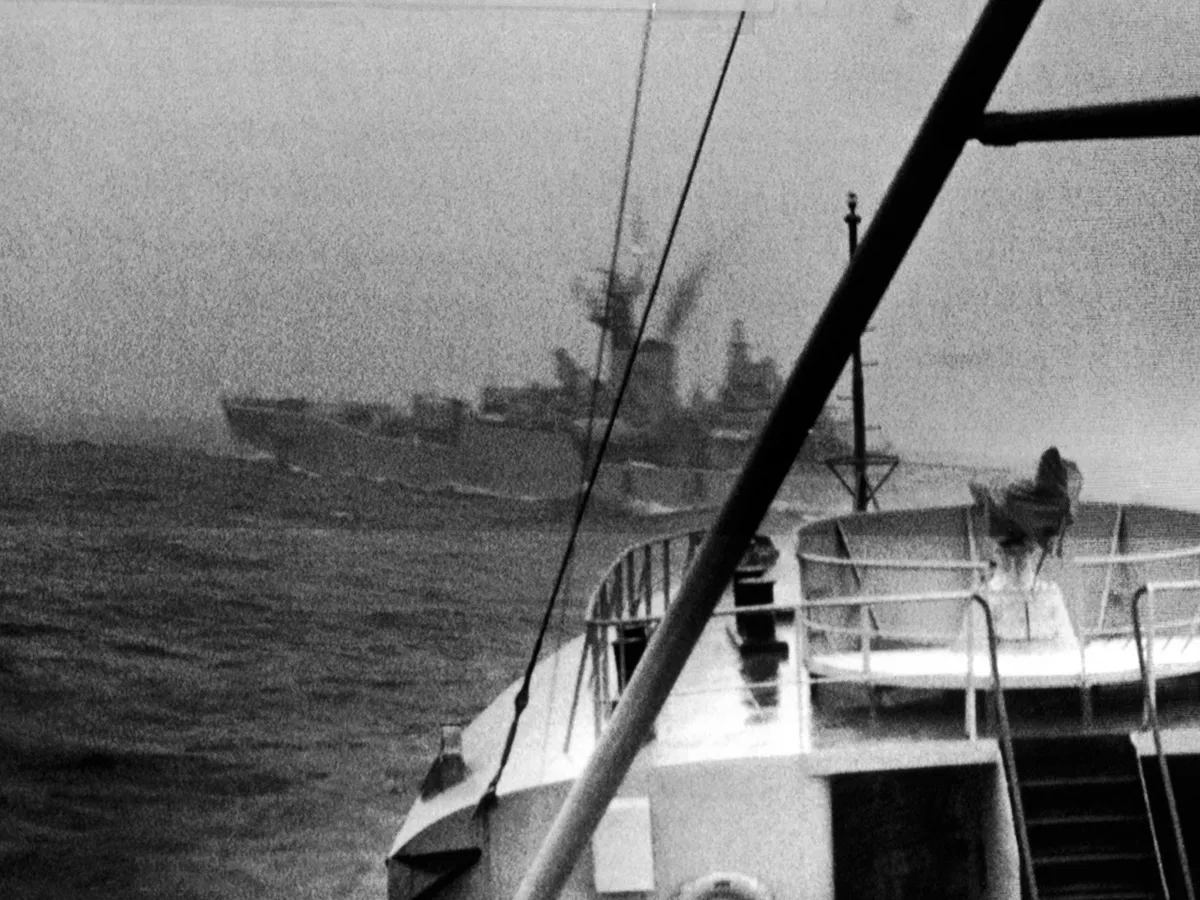
EXPLAINERThe US is considering military action to seize Greenland, in a move that could cause divisions within the NATO alliance.Royal Navy frigate HMS Brighton criss-crosses in front of gunboat Thor off the coast of Iceland during an incident where Thor cut the trawling wires of a British trawler which occurred dispute known as the 'Cod Wars'. Date unknown [AP Photo]Published On 10 Jan 2026The Trump administration has once again threatened to take control of Greenland either by acquiring it or through the use of military force to “deter our adversaries in the Arctic region.”Greenland, which is a semi-autonomous territory of Denmark, already hosts the Pituffik Space Base, which the US operates in coordination with Danish authorities. Both the US and Denmark are founding members of NATO, the most powerful military alliance.European and Canadian leaders have jumped to support Denmark and Greenland, saying they are working on a plan in the event the United States follows through with its threats.Analysts have said that any attempt by the US to seize Greenland would be an unprecedented move in NATO’s history and raise serious questions about the survival of the alliance and the limits of Article 5, which was designed to defend against an external aggressor.What happens if one NATO member attacks another?Collective defence is NATO’s governing principle, where Article 5 of the North Atlantic Treaty states that an armed attack against one NATO member is considered an attack against all.This has been a binding pledge since 1949, when the alliance came together and one that has forged solidarity between North America and Europe.Because Article 5 requires unanimous agreement from all members to be invoked, a conflict between two members would lead to an impasse, as the alliance cannot vote to go to war against itself.The only time Article 5 has been invoked was following the September 11, 2001, attacks in the US.[Al Jazeera]In this timeline, Al Jazeera examines the closest instances when NATO members have faced potential conflict with each other.(Al Jazeera)Limited military confrontations1958–1976 – The UK and Iceland fishing disputeThe Cod Wars (1958–1976) were a series of escalating disputes between the UK and Iceland over North Atlantic fishing rights.While the conflict never became a full-scale confrontation, it did involve a series of naval confrontations, including the ramming of ships and diplomatic friction between the two NATO members.Fearing the loss of the Keflavik airbase in Iceland, which was essential for monitoring Soviet submarines in the northern Atlantic Ocean, NATO and the US pressured the UK to concede. The dispute ended in 1976 with a key diplomatic win for Iceland, establishing the 200-mile (322km) limit that remains the global standard today.Royal Navy frigate HMS Brighton criss-crosses in front of gunboat Thor off the coast of Iceland during an incident where Thor cut the trawling wires of a British trawler, which occurred during a dispute known as the ‘Cod Wars’. Date unknown [AP Photo]1974 – Greece and Turkiye over CyprusThe 1974 Turkish invasion of Cyprus is the closest NATO has come to its members engaging in full-scale war. Following a Greek-sponsored coup in Cyprus, Turkiye launched a military intervention that nearly sparked a direct conflict between the two NATO members.In protest of NATO’s perceived failure to restrain Turkiye, Greece withdrew from the alliance’s military structure from 1974 until 1980.Given that this was during the Cold War, both members were imperative to NATO’s collective front against the Soviet Union. Despite some military action between Greece and Turkiye, the alliance was able to prevent a direct war.Turkish Cypriots hurling stones against Greek Cypriots entering the buffer zone in Derinya, while the Turkish Cypriot police using shields try to stop them during a clash between Turkish and Greek Cypriots [Reuters]1995 – Canada and Spain fishing disputeIn 1995, Canada and Spain came close to a naval conflict during the “Turbot War”. Canada had imposed restrictions to protect fish stocks, including a species of fish named turbot, leading to accusations that EU boats were overfishing just outside Canada’s exclusive economic zone.Tensions escalated when Canadian Coast Guard vessels fired warning shots over a Spanish trawler and arrested its crew. Europe threatened sanctions, but the UK vetoed them, siding with Canada alongside Ireland. In response, Spain deployed naval patrols, and Canada authorised its navy to fire on trespassing vessels, bringing NATO members dangerously close to conflict.The crisis ended following EU mediation, resulting in Canada withdrawing its enforcement actions and the establishment of a joint regulatory framework.Turbot is a flatfish known for its delicate flavour and firm white flesh, often considered a culinary delicacy [File: Bas Czerwinski/AP Photo]Disputes over war engagementsNATO has also faced internal divisions over when and how to engage militarily, with some members often wanting to avoid direct military action.1956 – France, UK and US over the Suez CrisisDuring the 1956 Suez Crisis, France and the UK formed a secret alliance with Israel to invade Egypt following Egyptian President Gamal Abdel Nasser’s nationalisation of the Suez Canal.This operation caused a severe crisis within NATO, as the United States, fearing Soviet intervention and the alienation of the Arab world, strongly opposed the military action. Despite the lack of agreement, France and the UK went ahead with operations anyway.The conflict was ultimately resolved by the UN’s first-ever armed peacekeeping mission, the United Nations Emergency Force (UNEF), which established the blueprint for future UN peacekeeping operations.Israeli soldiers in foxholes as they clean their light weapons at a base at the Milta Pass during Operation Kadesh in the 1956 Middle East war. In October 1956, Israel, under continued cross-border commando raids from Egypt, crossed into the Sinai in an audacious plan to take control of the Suez Canal with France and the UK [Reuters]1960s-1970s – US and European allies over Vietnam WarThe Vietnam War saw a significant disagreement between NATO members over US military interventions, where Washington viewed Vietnam as a key front in the Cold War, but key European allies, such as France and the UK, opposed direct military involvement.France openly condemned the war and ended up leaving NATO’s military command in 1966 to avoid being dragged into future US conflicts. France eventually rejoined the military structure 43 years later in 2009.The UK opposed sending British troops despite pressure from the US, as the war was widely unpopular with the British public. However, it did provide logistical and intelligence support for the US. Interestingly, given its usual close alliance with the UK, and despite not being a member of NATO, Australia committed troops to the war.These differences led to tensions among the biggest players in NATO and resulted in the Vietnam War not being mandated under NATO command. It also resulted in NATO’s headquarters moving from France to Belgium, where it remains today.US Huey helicopters fly in formation over a landing zone in South Vietnam during the Vietnam War, date unknown [AP Photo]1999 – Greece’s opposition to Kosovo air campaignIn 1999, NATO launched an air campaign in response to the ethnic cleansing carried out by Serbian forces in Kosovo.The alliance conducted an air campaign against Yugoslavia, but met serious reservations from NATO members, such as Greece, which shared close cultural and religious ties with Serbia. Greek protesters physically blocked and targeted British troops and tanks that were travelling to join allied forces.Greece became the first NATO member to call for a halt to the bombing.A British military helicopter, painted with tiger stripes, lands near the US Army camp at the Tirana, Albania airbase, Friday, April 30, 1999 [Reuters]2003 – European allies split over Iraq WarThe 2003 Iraq War caused one of the deepest rifts in NATO’s history.While the alliance supported UNSC Resolution 1441, which gave Iraq “a final opportunity to comply with its disarmament obligations”, three NATO members: France, Germany and Belgium rejected the US claim that it authorised immediate military action, leading to a deadlock.
SRCAl Jazeera
LANGEN
LEANCenter
WORDS1 294
ENT8
SAT · 2026-01-10 · 06:05 GMTBRIEF NSR-2026-0110-6715
NSR-2026-0110-6715Analysis·EN·National Security
Greenland claims: How close have NATO members come to fighting each other?
In 2026, the US government under the Trump administration is considering military action to seize Greenland from Denmark to deter adversaries in the Arctic. Both the US and Denmark are founding members of NATO, creating a potential conflict within the alliance.
Hanna DuggalAl JazeeraFiled 2026-01-10 · 06:05 GMTLean · CenterRead · 6 min
Al JazeeraFIG 01
Reading time
6min
Word count
1 294words
Sources cited
1cited
Entities identified
8entities
Quality score
100%
§ 01
Briefing Summary
AI-generatedNEWSAR · AI
In 2026, the US government under the Trump administration is considering military action to seize Greenland from Denmark to deter adversaries in the Arctic. Both the US and Denmark are founding members of NATO, creating a potential conflict within the alliance. European and Canadian leaders are supporting Denmark and Greenland, raising concerns about NATO's future and the limits of Article 5. Article 5, NATO's collective defense principle, requires unanimous agreement to be invoked, making conflict resolution between member states difficult. Historically, the Cod Wars between the UK and Iceland (1958-1976) represent a past instance of conflict between NATO members over fishing rights, involving naval confrontations but stopping short of full-scale war.
Confidence 0.90Sources 1Claims 5Entities 8
§ 02
Article analysis
Model · rule-basedFraming
National Security
Diplomatic
Tone
Mixed Tone
AI-assessed
CalmNeutralAlarmist
Factuality
0.70 / 1.00
Factual
LowHigh
Sources cited
1
Limited
FewMany
§ 03
Key claims
5 extracted01
The Cod Wars (1958–1976) were a series of escalating disputes between the UK and Iceland over North Atlantic fishing rights.
factualAl Jazeera
Confidence
1.00
02
The only time Article 5 has been invoked was following the September 11, 2001, attacks in the US.
factualAl Jazeera
Confidence
1.00
03
Article 5 of the North Atlantic Treaty states that an armed attack against one NATO member is considered an attack against all.
factualAl Jazeera
Confidence
1.00
04
The US is considering military action to seize Greenland.
factualAl Jazeera
Confidence
0.90
05
Any attempt by the US to seize Greenland would raise serious questions about the survival of the NATO alliance.
predictionAnalysts
Confidence
0.70
§ 04
Full report
6 min read · 1 294 words§ 05
Entities
8 identifiedKey playerOppositionContextPositiveNeutralNegative
§ 06
Keywords & salience
8 termsnato
1.00
greenland
0.90
military action
0.80
article 5
0.70
us
0.60
cod wars
0.50
denmark
0.50
collective defence
0.40
§ 07
Topic connections
Interactive graph Network visualization showing 51 related topics
View Full Graph Person Organization Location Event|Click node to navigate|Edge numbers = shared articles