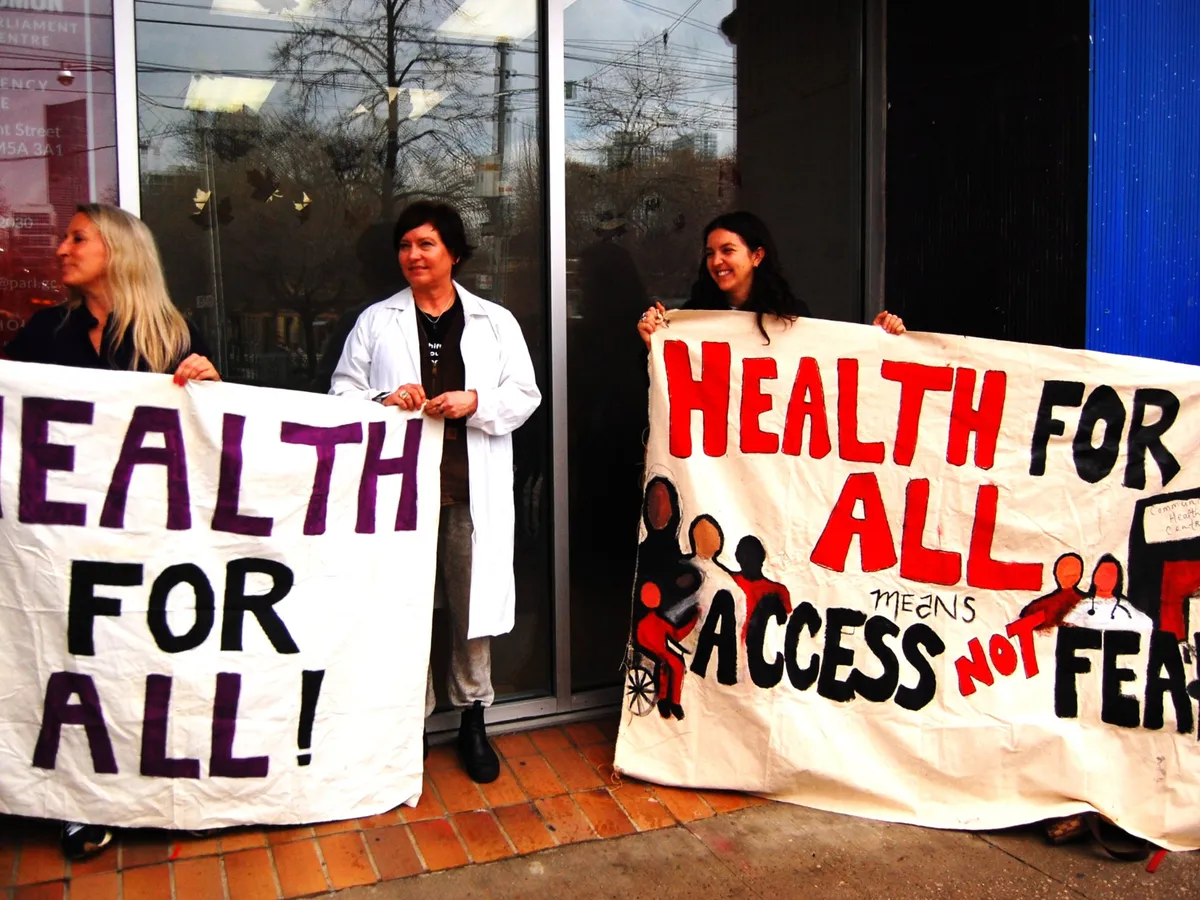
Health workers and rights advocates say co-payments, set to take effect on May 1, amount to 'de facto denial of care'.Published On 14 Apr 2026Toronto, Canada – Rallies have been held across Canada urging the government to reverse planned cuts to a healthcare programme for refugees and asylum seekers.Dozens of people demonstrated in Toronto on Tuesday as part of a national day of action against cuts to the Interim Federal Health Program (IFHP), which are set to come into effect on May 1. Critics say the curbs put vulnerable people at risk and will lead to higher costs down the line.Recommended Stories list of 3 itemslist 1 of 3Canada’s Bill C-12 an ‘attack on refugee, migrant rights’: Advocateslist 2 of 3Beaten, left to die, robbed: Refugees tell of violence on Croatian borderlist 3 of 3In Ghana Town, a ‘stateless’ future for hundreds born and raised in Gambiaend of list“We want to make sure that we have a universal healthcare system, and we also don’t want a system that punches down against vulnerable people and migrants,” Dr Ritika Goel told Al Jazeera at the protest in downtown Toronto.“We want to support a system that provides care to everyone,” she said.The Canadian government announced in late January that it would be making changes to the IFHP, which provides basic health coverage to refugees, asylum claimants, and others not covered by other healthcare programmes in Canada.As of next month, people receiving IFHP coverage will have to pay $4 per eligible prescription medication, as well as 30 percent of the cost of supplemental services such as dental and vision care, and counselling.“Introducing co-payments for supplemental health products and services helps manage growing demand, keeping the IFHP sustainable over the long term,” a spokesperson for Canada" class="entity-link entity-organization" data-entity-id="118713" data-entity-type="organization">Immigration, Refugees and Citizenship Canada (IRCC) told Al Jazeera in an email.“This approach will allow the government to continue supporting eligible beneficiaries while keeping the program fair and consistent with other publicly funded health insurance programs that provide supplemental benefits, including those available to many social assistance recipients.”Toronto-based family doctor Ritika Goel speaks during the rally in Toronto, Canada, on April 14, 2026 [Jillian Kestler-D’Amours/Al Jazeera]Major spending cutsWhile the new co-payments may appear modest, doctors and refugee rights advocates say they can be prohibitively expensive for newcomers struggling to rebuild their lives in Canada amid soaring costs.
SRCAl Jazeera
LANGEN
LEANCenter
WORDS387
ENT6
TUE · 2026-04-14 · 21:02 GMTBRIEF NSR-2026-0414-68198
NSR-2026-0414-68198News Report·EN·Human Rights
Canada faces calls to rescind planned cuts to refugee healthcare scheme
In April 2026, rallies were held across Canada protesting planned cuts to the Interim Federal Health Program (IFHP), a healthcare program for refugees and asylum seekers. Set to take effect on May 1, the changes will require IFHP recipients to pay $4 per prescription and 30% of the cost of supplemental services like dental, vision, and counseling.
Jillian Kestler-D'AmoursAl JazeeraFiled 2026-04-14 · 21:02 GMTLean · CenterRead · 2 min
Al JazeeraFIG 01
Reading time
2min
Word count
387words
Sources cited
3cited
Entities identified
6entities
Quality score
100%
§ 01
Briefing Summary
AI-generatedNEWSAR · AI
In April 2026, rallies were held across Canada protesting planned cuts to the Interim Federal Health Program (IFHP), a healthcare program for refugees and asylum seekers. Set to take effect on May 1, the changes will require IFHP recipients to pay $4 per prescription and 30% of the cost of supplemental services like dental, vision, and counseling. Health workers and rights advocates argue these co-payments will effectively deny care to vulnerable populations. The government defends the changes, stating they are necessary to manage growing demand and ensure the program's long-term sustainability, aligning it with other publicly funded health insurance programs. Critics contend that the co-payments, while seemingly small, will be prohibitively expensive for newcomers.
Confidence 0.90Sources 3Claims 5Entities 6
§ 02
Article analysis
Model · rule-basedFraming
Human Rights
Economic Impact
Tone
Measured
AI-assessed
CalmNeutralAlarmist
Factuality
0.70 / 1.00
Factual
LowHigh
Sources cited
3
Well sourced
FewMany
§ 03
Key claims
5 extracted01
The changes to IFHP include a $4 co-pay for prescriptions and 30% of supplemental services.
factualAl Jazeera
Confidence
1.00
02
Co-payments for refugees' healthcare are set to take effect on May 1.
factualAl Jazeera
Confidence
1.00
03
Introducing co-payments helps manage growing demand and keeps the IFHP sustainable.
quoteIRCC spokesperson
Confidence
0.90
04
Co-payments amount to 'de facto denial of care'.
quoteHealth workers and rights advocates
Confidence
0.80
05
The curbs put vulnerable people at risk and will lead to higher costs down the line.
quoteCritics
Confidence
0.80
§ 04
Full report
2 min read · 387 words§ 05
Entities
6 identifiedKey playerOppositionContextPositiveNeutralNegative
Organizations3
§ 06
Keywords & salience
8 termsrefugee healthcare
0.90
healthcare cuts
0.80
interim federal health program
0.70
co-payments
0.70
asylum seekers
0.60
healthcare programme
0.50
vulnerable people
0.50
universal healthcare
0.40
§ 07
Topic connections
Interactive graph Network visualization showing 51 related topics
View Full Graph Person Organization Location Event|Click node to navigate|Edge numbers = shared articles