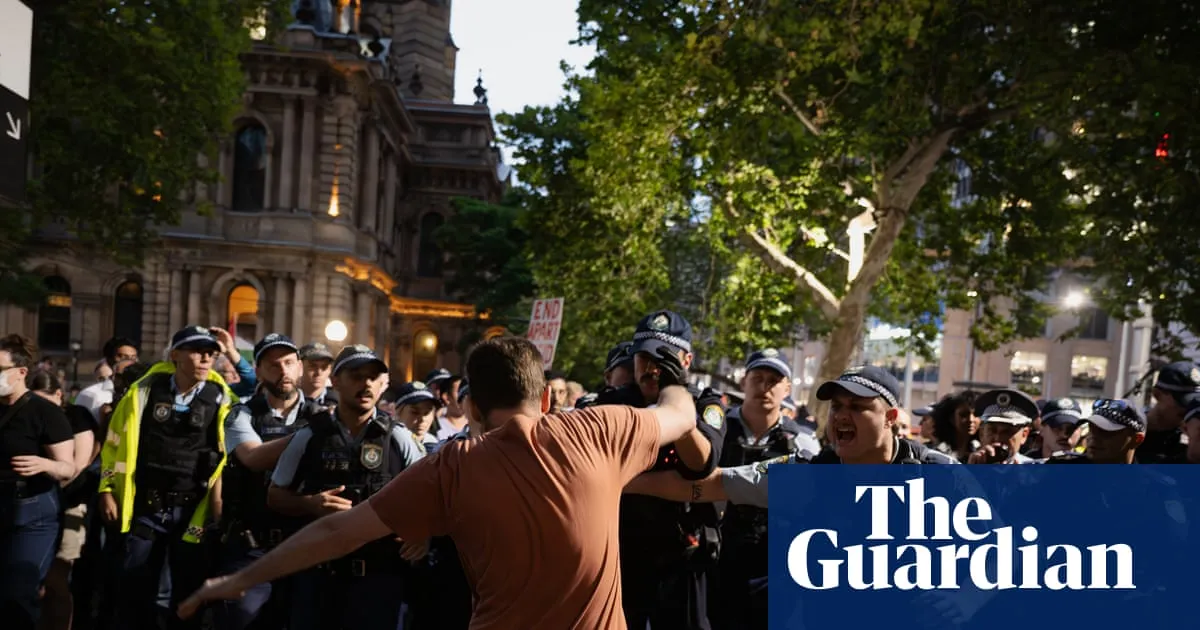
1:40 Palestine Action Group celebrates after NSW supreme court strikes down anti-protest law – video NSW’s highest court strikes down anti-protest law introduced in wake of Bondi beach terror attack Court finds law – which effectively meant protesters could not march without risk of arrest – is unconstitutional Follow our Australia news live blog for latest updates Get our breaking news email, free app or daily news podcast New South Wales’ highest court has struck down an anti-protest law brought in after the Bondi beach terror attack which gave police the power to restrict marches, including at the anti-Herzog rally earlier this year. The court of appeal handed down its findings on Thursday after three activist groups – the Blak Caucus, the Palestine Action Group and Jews Against the Occupation ’48 – filed a constitutional challenge in early January against the legislation. The law, known as the public assembly restriction declaration or Pard, was passed in the wake of the Bondi beach terror attack in which 15 people were killed. It meant protesters could not use the form 1 system – a notice of intention to the police to hold a public assembly - in areas designated by police for up to three months after a terrorist attack, effectively meaning protesters could not march without the risk of arrest. In a major loss for the Minns government, the law will be struck down after the court found the law does impermissibly burden the implied constitutional right to freedom of communication on government and political matters. It is the second time in six months an anti-protest law passed by the Minns government has been found unconstitutional by a court. The restriction was in place in parts of Sydney’s CBD during the rally against the Israeli president Isaac Herzog’s visit in early February, which turned violent and triggered a police watchdog investigation into allegations of widespread police misconduct. The police commissioner, Mal Lanyon, extended the restriction several times over the summer. He ended the restriction after Herzog had left the country. The outcome has triggered calls from Greens spokesperson for justice Sue Higginson for the charges laid against 26 people in the aftermath of the protest to be dropped. Outside court, Higginson said the result would pose “an entirely new question that the [Law Enforcement Conduct Commission (Lecc)] has never been asked to investigate before”. “The idea that the police responded with the violence they did is an enormous problem in and of itself. The fact that they did so on Chris Minns’s unconstitutional laws … I think this will set a major precedent in terms of what the Lecc is looking at and what it finds.” The case was overseen by the full bench of the court of appeal – chief justice Andrew Bell, justice Julie Ward, and justice Stephen Free. All three agreed that the law was invalid. “The PARD scheme is a blunt tool,” they wrote in their judgment. “It does not require, or even allow for, consideration of the purpose, characteristics or conduct of any particular public assembly caught by a PARD or the nature or severity of any threat to the community that could be said to arise from any particular assembly. “Perhaps most paradoxically of all, it would apply to a proposed public assembly in support of social cohesion. “It is not enough that the legislature perceived the need for strong action to preserve the cohesion and safety of the community in the wake of an exceptionally traumatic public event,” they wrote, adding the constitution does not allow such a sweeping and indiscriminate restriction on all protests. Police also used the laws to stop Paul Silva, a member of Blak Caucus and one of the plaintiffs in the case, from organising a march against Indigenous deaths in custody starting from Hyde Park, a regular protest site in the city. Days after preventing Silva from organising a march, the police amended the area covered by the restriction and carved out Hyde Park ahead of a planned march for Invasion Day. After Thursday’s decision, the NSW premier, Chris Minns, said the government was “obviously disappointed” by the outcome. Earlier in the day, he said the legislation had been enacted after “the worst terrorism event the country’s ever seen, one of the worst crimes NSW has ever seen”. “I’m not saying there wasn’t clashes, and I’m not saying it wasn’t difficult. I don’t regret moving that legislation at all,” he said. Minns said irrespective of the result, he still planned to outlaw the contested phrase “globalise the intifada”, but was looking to how a ban in Queensland played out. Asked if he would retract his comments that protesters put police in “an impossible situation” during a protest against Herzog, Minns said: “Absolutely not. “The government made a decision around a special event designation, which had absolutely nothing to do with the Pard laws or the challenges in the [supreme] court, that gave the minister and the police the power to direct people in the interest of public safety.” The premier said he did not know what impact the result would have on a Lecc investigation into police actions during February’s protest. The outcome was greeted by smiles and embraces in the courtroom among Palestine Action Group members and their legal team, followed by cheers outside the court. “Today we’ve had a really resounding win in the court of appeal to strike down Chris Minns’s latest batch of anti-protest laws as unconstitutional,” said the group’s spokesperson Josh Lees. “This is a big win for everyone who cares about the right to protest, who cares about democracy in New South Wales and, of course, who cares about a free Palestine.” Explore more on these topics Sydney Breaking News Australia New South Wales Bondi beach terror attack Protest Chris Minns New South Wales politics news Share Reuse this content
SRCThe Guardian - World News
LANGEN
LEANCenter-Left
WORDS977
ENT11
THU · 2026-04-16 · 05:06 GMTBRIEF NSR-2026-0416-69897
NSR-2026-0416-69897News Report·EN·Legal & Judicial
NSW’s highest court strikes down anti-protest law introduced in wake of Bondi beach terror attack
New South Wales' highest court struck down an anti-protest law introduced following the Bondi beach terror attack. The law, known as the public assembly restriction declaration, allowed police to restrict marches in designated areas for up to three months after a terrorist attack.
Jordyn BeazleyThe Guardian - World NewsFiled 2026-04-16 · 05:06 GMTLean · Center-LeftRead · 4 min
The Guardian - World NewsFIG 01
Reading time
4min
Word count
977words
Sources cited
3cited
Entities identified
11entities
Quality score
100%
§ 01
Briefing Summary
AI-generatedNEWSAR · AI
New South Wales' highest court struck down an anti-protest law introduced following the Bondi beach terror attack. The law, known as the public assembly restriction declaration, allowed police to restrict marches in designated areas for up to three months after a terrorist attack. Activist groups challenged the law, arguing it was unconstitutional. The court of appeal agreed, finding the law impermissibly burdened the implied constitutional right to freedom of communication on government and political matters. This is the second time in six months an anti-protest law passed by the Minns government has been found unconstitutional. The law was in place during a rally against Israeli President Isaac Herzog's visit in early February, which resulted in violence and a police watchdog investigation.
Confidence 0.90Sources 3Claims 5Entities 11
§ 02
Article analysis
Model · rule-basedFraming
Legal & Judicial
Political Strategy
Tone
Measured
AI-assessed
CalmNeutralAlarmist
Factuality
0.80 / 1.00
Factual
LowHigh
Sources cited
3
Well sourced
FewMany
§ 03
Key claims
5 extracted01
The outcome has triggered calls for charges laid against 26 people in the aftermath of the protest to be dropped.
factual
Confidence
1.00
02
It is the second time in six months an anti-protest law passed by the Minns government has been found unconstitutional.
factual
Confidence
1.00
03
The law meant protesters could not march without the risk of arrest in designated areas.
factual
Confidence
1.00
04
The court found the law impermissibly burdens the implied constitutional right to freedom of communication.
factual
Confidence
1.00
05
NSW's highest court struck down an anti-protest law introduced after the Bondi beach terror attack.
factual
Confidence
1.00
§ 04
Full report
4 min read · 977 words§ 05
Entities
11 identifiedKey playerOppositionContextPositiveNeutralNegative
Organizations5
§ 06
Keywords & salience
9 termsanti-protest law
1.00
constitutional challenge
0.80
freedom of communication
0.70
bondi beach terror attack
0.60
court of appeal
0.60
minns government
0.50
police misconduct
0.50
public assembly
0.50
palestine action group
0.40
§ 07
Topic connections
Interactive graph Network visualization showing 51 related topics
View Full Graph Person Organization Location Event|Click node to navigate|Edge numbers = shared articles