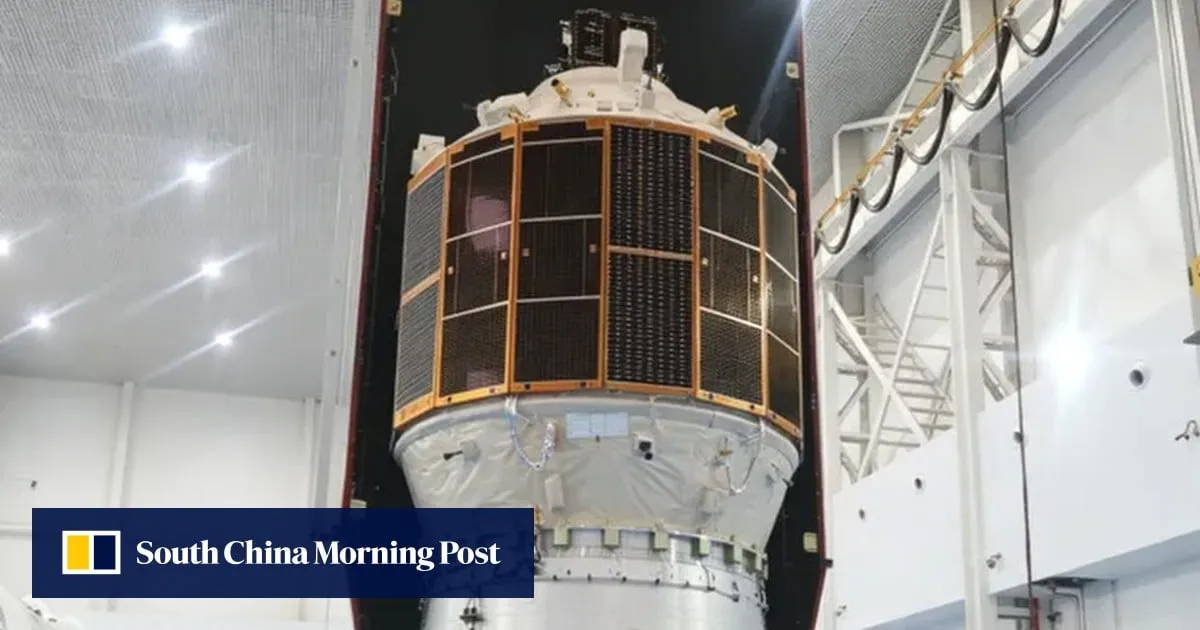
Science ChinaScience China’s Qingzhou robotic craft tests space debris capture and clean-up Robotic cargo spacecraft reported to have also conducted a suite of in-orbit experiments designed to sustain long-duration missions China’s prototype Qingzhou robotic cargo spacecraft successfully conducted capture and towing operations on “non-cooperative” space targets, state broadcaster CCTV reported on Thursday. The progress paves the way for so-called orbital tow trucks capable of clearing space debris and derelict satellites. The prototype spacecraft launched last month also conducted a suite of in-orbit experiments designed to sustain long-duration missions, according to CCTV. These included automated metal production, moss cultivation and the electrolytic production of hydrogen and oxygen. The Chinese Academy of Sciences’ Innovation Academy for Microsatellites (IAMCAS), which developed the spacecraft, said the test flight validated key technologies for future launches and would bolster China’s commercial space programme. “The Qingzhou cargo spacecraft will continue to iterate and optimise, striving to build a reliable bridge for space-to-ground cargo transport,” IAMCAS said in a social media post on Wednesday, releasing the first test results. The prototype Qingzhou cargo spacecraft and two small satellites blasted off from the Jiuquan launch centre in northwestern China aboard a Kinetica-2 carrier rocket on March 30. The race for the moon’s south pole: can China beat NASA’s 2028 deadline? The race for the moon’s south pole: can China beat NASA’s 2028 deadline? The single-module vehicle is smaller and lighter than the Tianzhou cargo spacecraft currently used to supply China’s space station. It weighs 4.2 tonnes and carries a 1-tonne scientific experimental payload, including more than 20 sets of experimental equipment. With a projected in-orbit lifespan of three years, the Qingzhou is designed to serve as a cargo transport vessel for the Tiangong space station, and will also be able to function as an in-orbit test platform for space materials and technologies, according to IAMCAS. After launching into orbit, the spacecraft completed a series of flight control manoeuvres to raise it to an orbit of 600km (373 miles) above the Earth, where it will remain to conduct experiments and technology verification. A few days after launch, the Qingzhou successfully deployed two small satellites and conducted a long-distance approach and retreat test with one of them, IAMCAS said in its social media post. Further Reading Can China commercial satellite’s ‘octopus tentacle’ pass low-orbit refuel test? China watching ‘like a hawk’ as US Artemis 2 crew embarks on moon trip China launches heavyweight rocket to challenge SpaceX’s Falcon 9. It fails The spacecraft also used an adhesion device to demonstrate capture-and-tow procedures for “non-cooperative targets” – such as defunct satellites or space debris, according to the CCTV report. There are millions of pieces – thousands of tonnes – of space debris in low Earth orbit. These are mainly defunct spacecraft and fragments of rockets and satellites, which pose a collision risk to operational objects in orbit. US space agency NASA has flagged the lack of any international law governing orbital debris removal as well as the prohibitive costs of such clean-up efforts. In November last year, China’s Shenzhou-20 was hit by a small piece of debris while the spacecraft was docked at Tiangong, resulting in a cracked window and delaying the return of its three-person crew. They transferred to the newly docked Shenzhou-21 for a safe evacuation and landing several days later. FULL EVENT: Stranded Chinese astronauts to return to Earth aboard new crew’s spacecraft FULL EVENT: Stranded Chinese astronauts to return to Earth aboard new crew’s spacecraft The Qingzhou has conducted several critical technology tests, according to CCTV, including in-orbit 3D metal printing, closed-loop energy production utilising water electrolysis and fuel cell technology, and a therapeutic device designed to maintain bone health in microgravity. The Qingzhou features a “plug-and-play” payload platform allowing for a range of experimental and technological payloads in a single launch, according to IAMCAS. It said the spacecraft’s development was supported by several technological breakthroughs, including a new communication module that enables data transmission over more than 450km. By integrating advanced materials and 3D printing, the project reduced manufacturing time and costs, IAMCAS added. It also employed foldable ultrathin solar cells, which cost just one-tenth as much as traditional spacecraft cells. Victoria Bela FOLLOW FOLLOW Prior to joining SCMP in 2023, Victoria received her Bachelor’s degrees in Environmental Health and Environmental Studies from the University of Rochester, where she also worked in a Biochemistry lab. She holds a Master's in Public Policy from Peking University. Science | Mainland China | CCTV Before you go 3 Conversations scmp poll Discover MORE stories on Science FOLLOW Beijing tried to reduce desertification. Now it battles ‘snowstorm’ of allergens China defies US curbs with 60,000-chip AI research hub in self-reliance push China tests submarine cable cutter at 3,500-metre depth Select Voice Select Speed 0.8x 0.9x1.0x 1.1x 1.2x 1.5x 1.75x 00:0000:00 1.00x
SRCSouth China Morning Post
LANGEN
LEANCenter-Right
WORDS800
ENT8
THU · 2026-04-16 · 12:00 GMTBRIEF NSR-2026-0416-70031
NSR-2026-0416-70031News Report·EN·Technology
China’s Qingzhou robotic craft tests space debris capture and clean-up
China's Qingzhou robotic cargo spacecraft, launched in late March from Jiuquan, has successfully tested space debris capture and towing of non-cooperative targets. This prototype aims to develop orbital tow trucks for clearing space debris and defunct satellites.
Victoria BelaSouth China Morning PostFiled 2026-04-16 · 12:00 GMTLean · Center-RightRead · 4 min
South China Morning PostFIG 01
Reading time
4min
Word count
800words
Sources cited
2cited
Entities identified
8entities
Quality score
100%
§ 01
Briefing Summary
AI-generatedNEWSAR · AI
China's Qingzhou robotic cargo spacecraft, launched in late March from Jiuquan, has successfully tested space debris capture and towing of non-cooperative targets. This prototype aims to develop orbital tow trucks for clearing space debris and defunct satellites. The Qingzhou also conducted in-orbit experiments, including automated metal production, moss cultivation, and hydrogen/oxygen production via electrolysis, to support long-duration missions. Developed by the Chinese Academy of Sciences' IAMCAS, the 4.2-tonne spacecraft carries a 1-tonne scientific payload and is designed for cargo transport to the Tiangong space station and in-orbit technology testing. The mission validates key technologies for future launches and strengthens China's commercial space program.
Confidence 0.90Sources 2Claims 5Entities 8
§ 02
Article analysis
Model · rule-basedFraming
Technology
National Security
Tone
Measured
AI-assessed
CalmNeutralAlarmist
Factuality
0.80 / 1.00
Factual
LowHigh
Sources cited
2
Limited
FewMany
§ 03
Key claims
5 extracted01
The single-module vehicle weighs 4.2 tonnes and carries a 1-tonne scientific experimental payload.
statistic
Confidence
1.00
02
The Qingzhou cargo spacecraft will continue to iterate and optimise, striving to build a reliable bridge for space-to-ground cargo transport.
quoteIAMCAS
Confidence
1.00
03
The test flight validated key technologies for future launches and would bolster China’s commercial space programme.
quoteChinese Academy of Sciences’ Innovation Academy for Microsatellites (IAMCAS)
Confidence
1.00
04
The prototype Qingzhou robotic cargo spacecraft successfully conducted capture and towing operations on “non-cooperative” space targets.
factualCCTV
Confidence
1.00
05
China’s Qingzhou robotic craft tests space debris capture and clean-up.
factual
Confidence
1.00
§ 04
Full report
4 min read · 800 words§ 05
Entities
8 identifiedKey playerOppositionContextPositiveNeutralNegative
Organizations5
§ 06
Keywords & salience
9 termsspace debris
0.90
spacecraft
0.80
qingzhou
0.80
china
0.70
robotic craft
0.70
space technology
0.60
in-orbit experiments
0.60
space station
0.50
cargo transport
0.50
§ 07
Topic connections
Interactive graph Network visualization showing 51 related topics
View Full Graph Person Organization Location Event|Click node to navigate|Edge numbers = shared articles