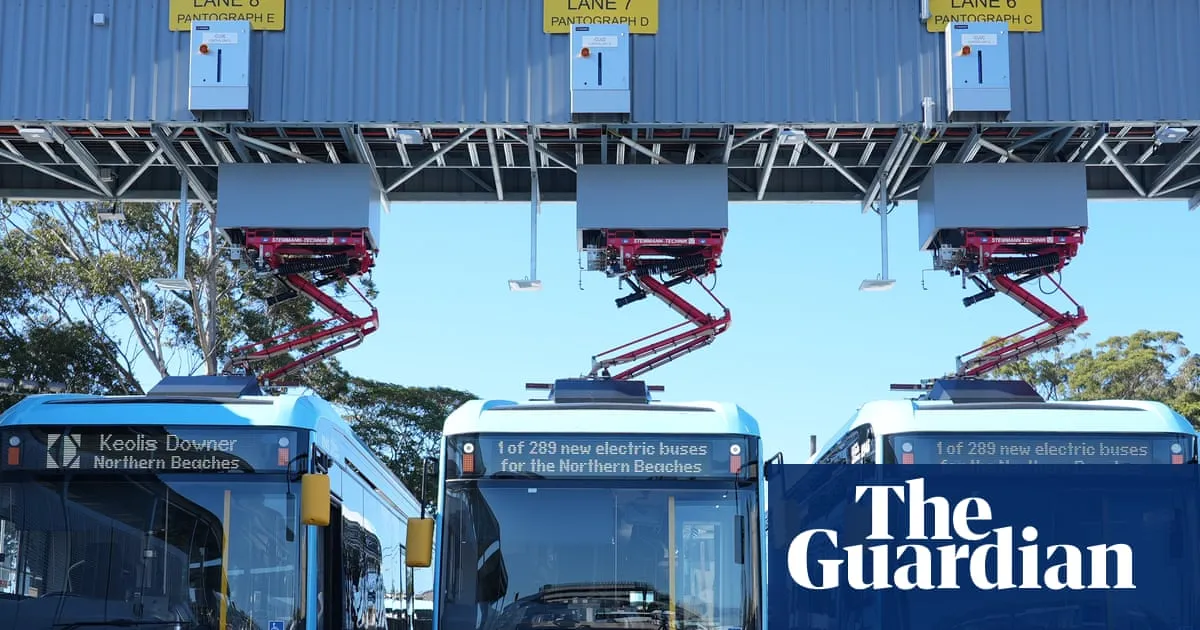
Electric buses charging at Sydney’s Brookvale bus depot. NSW public transport will run on fully renewable energy from July 2027, the state government says. Photograph: NSW government View image in fullscreen Electric buses charging at Sydney’s Brookvale bus depot. NSW public transport will run on fully renewable energy from July 2027, the state government says. Photograph: NSW government NSW electric buses, trains and light rail services to run entirely on renewable energy from 2027 in $1.9bn deal Exclusive: Minns government announces contract with Snowy Energy to power public transport in seven-year contract Get our breaking news email, free app or daily news podcast Electric bus, train and light rail services in New South Wales will run on fully renewable energy from next year under a new $1.9bn deal, the state government says. The Minns government on Friday announced it had signed a contract with Snowy Energy to bring all public transport operations in the state under a single renewable energy agreement for the first time. The seven-year deal comes into effect from July 2027 and will last until 2034. The NSW minister for transport, John Graham, said it would reduce costs at a time when fuel uncertainty was seeing more Australians cut back on driving in favour of public transport. “Cost of living pressures are real for household and government budgets,” he said. “This contract reduces costs and moves us towards better environmental outcomes while we deliver a reliable public transport network.” The NSW government, which has rejected calls to follow other states by making public transport free during the fuel crisis, said savings of $130m on transport power bills would be reinvested into services. It said Snowy Energy, the retail brand of the commonwealth-owed Snowy Hydro, was awarded the contract after a competitive two-year process. Prior to the deal, Transport for NSW was already Snowy Energy’s largest customer, contributing more than 10% of its energy sales. The Snowy Hydro CEO, Dennis Barnes, said the deal would see public transport’s consumption of energy matched to wind, solar and hydroelectric generators in its network through the issue renewable energy “certificates”. “What this deal does is match the consumption of [Transport for NSW] to the production of renewable energy somewhere, but it isn’t a physical connection. It’s a financially traceable connection through certificates.” He said in the future this would include assets such as the Snowy Uungala wind farm, under construction near Dubbo. Snowy Hydro operates three gas-fired power stations, with fossil fuels contributing 5%-10% of the power it generates annually. The state government has said the deal will lead to “significant emissions reductions”, avoiding the equivalent of more than 800,000 tonnes of CO2 annually compared with conventional power. Transport for NSW, which uses almost as much power as all other NSW public agencies combined, has a target to reduce operational emissions by 65% by 2030 and reaching net zero by 2035. Fossil fuels are still used on most of the state’s public buses, as well as on diesel-powered ferries and intercity and regional trains. The new regional rail fleet, which is bimodal and runs on diesel and electricity, due to replace diesel-powered XPT trains, is several years late. The state government has said electric ferries will fully replace diesel-powered vessels by 2035. The government has ordered more than 500 electric buses, of which hundreds are already in operation, with 7,500 more expected to fully replace the 8,000-strong fleet of diesel-powered vehicles. Last month, the NSW Anti-Slavery Commissioner found Transport for NSW had not taken reasonable steps to engage with groups affected by the potential use of forced labor in Xinjiang in China and the Democratic Republic of Congo in the supply chains for lithium-ion batteries. Explore more on these topics New South Wales Transport New South Wales politics Renewable energy news Share Reuse this content
SRCThe Guardian - World News
LANGEN
LEANCenter-Left
WORDS634
ENT10
THU · 2026-04-16 · 15:00 GMTBRIEF NSR-2026-0416-70054
NSR-2026-0416-70054News Report·EN·Environmental
NSW electric buses, trains and light rail services to run entirely on renewable energy from 2027 in $1.9bn deal
From July 2027, electric buses, trains, and light rail services in New South Wales (NSW) will operate entirely on renewable energy. The Minns government announced a $1.9 billion, seven-year contract with Snowy Energy to power all public transport operations in the state with renewable energy until 2034.
Penry BuckleyThe Guardian - World NewsFiled 2026-04-16 · 15:00 GMTLean · Center-LeftRead · 3 min
The Guardian - World NewsFIG 01
Reading time
3min
Word count
634words
Sources cited
3cited
Entities identified
10entities
Quality score
100%
§ 01
Briefing Summary
AI-generatedNEWSAR · AI
From July 2027, electric buses, trains, and light rail services in New South Wales (NSW) will operate entirely on renewable energy. The Minns government announced a $1.9 billion, seven-year contract with Snowy Energy to power all public transport operations in the state with renewable energy until 2034. This deal aims to reduce costs and improve environmental outcomes, with projected savings of $130 million to be reinvested into transport services. Snowy Energy will match public transport's energy consumption to renewable energy generation through renewable energy certificates. The contract was awarded after a two-year competitive process.
Confidence 0.90Sources 3Claims 5Entities 10
§ 02
Article analysis
Model · rule-basedFraming
Environmental
Economic Impact
Tone
Measured
AI-assessed
CalmNeutralAlarmist
Factuality
0.80 / 1.00
Factual
LowHigh
Sources cited
3
Well sourced
FewMany
§ 03
Key claims
5 extracted01
The deal will lead to significant emissions reductions, avoiding the equivalent of more than 800,000 tonnes of CO2 annually.
factualstate government
Confidence
1.00
02
This contract reduces costs and moves us towards better environmental outcomes.
quoteJohn Graham, NSW minister for transport
Confidence
1.00
03
Savings of $130m on transport power bills would be reinvested into services.
factualNSW government
Confidence
1.00
04
The Minns government signed a $1.9bn contract with Snowy Energy.
factualnull
Confidence
1.00
05
NSW public transport will run on fully renewable energy from July 2027.
factualNSW government
Confidence
1.00
§ 04
Full report
3 min read · 634 words§ 05
Entities
10 identifiedKey playerOppositionContextPositiveNeutralNegative
Organizations5
§ 06
Keywords & salience
10 termsrenewable energy
1.00
public transport
0.90
electric buses
0.70
train services
0.60
light rail
0.60
nsw
0.60
snowy energy
0.60
energy contract
0.50
fuel uncertainty
0.40
cost of living
0.40
§ 07
Topic connections
Interactive graph Network visualization showing 51 related topics
View Full Graph Person Organization Location Event|Click node to navigate|Edge numbers = shared articles