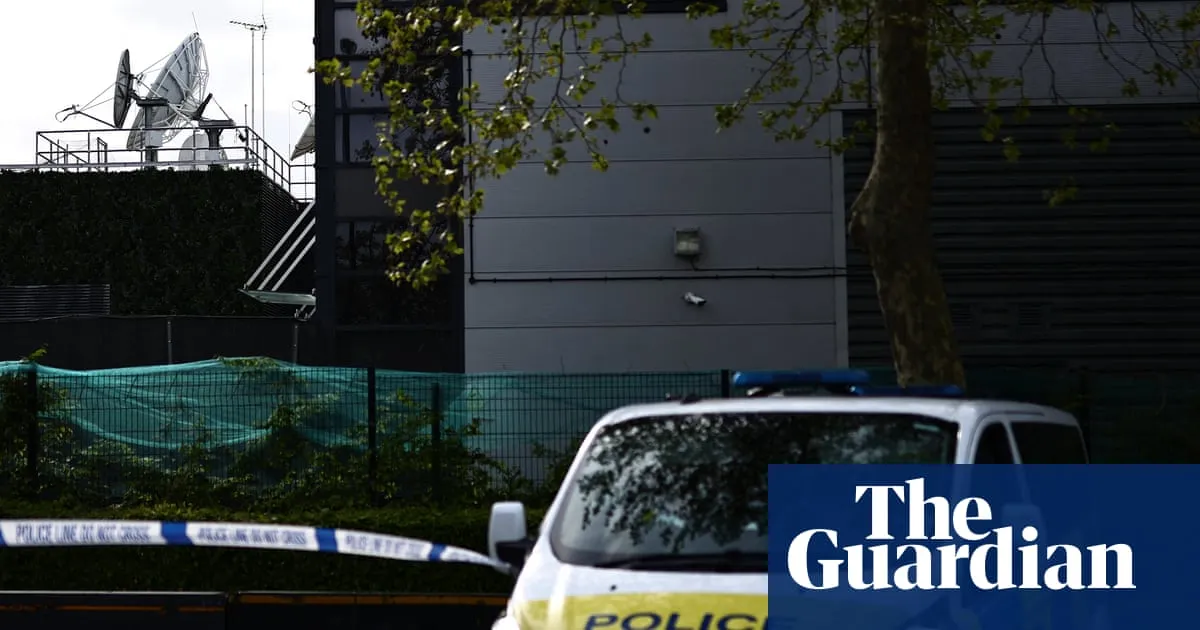
Counter-terrorism investigators are examining three separate arson attacks in London against an Iranian dissident and Jewish targets amid fears the Iranian state may be behind them.The latest attack happened at about 8.30pm on Wednesday, outside the offices of Iran-international" class="entity-link entity-organization" data-entity-id="7729" data-entity-type="organization">Iran International, a Persian-language news channel that opposes the regime in Tehran.The Metropolitan Police said an “ignited container” had been thrown at a car park at the company’s offices in Wembley. The fire immediately went out. After a police pursuit involving an armed response vehicle, a 16-year-old boy and two men, aged 19 and 21, were arrested on suspicion of arson endangering life.It followed an attempted firebomb attack on Finchley Reform Synagogue on Wednesday morning, and an arson attack last month on four ambulances in Golders Green run by a Jewish charity.Forensic police officers attend a reported incident at Finchley Reform Synagogue on Wednesday. Photograph: Leon Neal/Getty ImagesA 47-year-old woman and a 46-year-old man remain in custody in connection with the attempted attack on the synagogue.On Thursday, Scotland Yard said two 18-year-olds had been arrested at two separate addresses in east London where searches were carried out in relation to the ambulance attack. One was arrested on suspicion of committing arson with intent to endanger life, the other on suspicion of conspiracy to commit arson with intent to endanger life. Three men have already been charged over that attack and another man remains on bail.The Met confirmed all three incidents were being investigated by London’s counter-terrorism unit. The deputy commissioner for the Met, Matt Jukes, said they were being treated as separate incidents and it was too early to speculate on the motives.Investigators believe some of the suspects for the attacks have criminal pasts. Counter-terrorism experts have spoken before of foreign states using criminal proxies to carry out violence in the UK.In a briefing on Thursday about the incidents, Jukes made a pointed warning to those carrying out attacks for foreign states: “For the people who think you can make quick and easy money by committing crimes for others, we will show that they are fools. We will show that they’re wrong and they will face consequences.”Jukes added: “I make no specific comment about these cases, which are still under very live investigation. But to individuals who think there is quick and easy money to be made here – those who have paid for it will drop them like a stone and they’ll face justice on their own.”He cited the case of Dylan Earl who is serving 17 years in prison as the ringleader of a Russian-ordered arson attack on London. “You can turn to other cases driven by other actors like that of Dylan Earl,” said Jukes, “convicted and serving a long prison sentence as a result of not understanding that risk and acting in the way he did.”Asked if police were investigating the possibility that Iran had paid proxies to carry out the attacks, Jukes said: “We cannot and won’t reach definitive conclusions about those cases which are live and still being investigated. But it’s an important part of the current global picture.”The Met said it was too early to speculate on the motive for the recent attempted attacks. Photograph: Lucy North/PAThe deputy assistant commissioner, Vicki Evans, who is a national coordinator for counter-terrorism policing, was asked why none of the three incidents had been classed as terrorist attacks.Evans said: “We’re in the early stages of all of these investigations and are open minded, and we will consider all offences when we are considering charges or further investigation into the individuals.“They have not been declared terrorist incidents at this stage, but they are being led by counter-terrorism policing in London. It means that we are able to put all of our specialist capabilities to those investigations.”The militant group Harakat Ashab al-Yamin al-Islamia has claimed responsibility for the ambulance attack and suggested it was behind this week’s attack on the synagogue, as well as a number of attacks across Europe.Evans said: “We are clearly aware of that group. Naturally, that is one of our many lines of inquiry and there are many others.” Evans added that a fifth of the workload of counter-terrorism policing was currently focused on “hostile state activity”.In a statement on the attack on its office, Iran-international" class="entity-link entity-organization" data-entity-id="7729" data-entity-type="organization">Iran International’s editorial board said: “At this stage, the motives and intentions of those involved have not been established, and we will not speculate while inquiries continue. But this was a serious incident, and it comes at a time of growing threats and intimidation directed at Iran-international" class="entity-link entity-organization" data-entity-id="7729" data-entity-type="organization">Iran International and those connected to its journalists.“In recent months, especially following the recent military operation in Iran, there has been a sharp rise in harassment targeting the relatives of Iran-international" class="entity-link entity-organization" data-entity-id="7729" data-entity-type="organization">Iran International journalists inside Iran. These actions are part of a wider effort to restrict the free flow of information and deny the Iranian people access to independent news.”
SRCThe Guardian - World News
LANGEN
LEANCenter-Left
WORDS813
ENT10
THU · 2026-04-16 · 18:20 GMTBRIEF NSR-2026-0416-70117
NSR-2026-0416-70117News Report·EN·National Security
Counter-terror police investigate London arson attacks on Iranian and Jewish targets
Counter-terrorism police in London are investigating three separate arson attacks targeting an Iranian dissident media outlet and Jewish institutions. The incidents include an attack on Iran International's offices in Wembley on Wednesday, an attempted firebombing of Finchley Reform Synagogue on Wednesday morning, and an arson attack on ambulances belonging to a Jewish charity in Golders Green last month.
Matthew Weaver and Vikram DoddThe Guardian - World NewsFiled 2026-04-16 · 18:20 GMTLean · Center-LeftRead · 4 min
The Guardian - World NewsFIG 01
Reading time
4min
Word count
813words
Sources cited
2cited
Entities identified
10entities
Quality score
100%
§ 01
Briefing Summary
AI-generatedNEWSAR · AI
Counter-terrorism police in London are investigating three separate arson attacks targeting an Iranian dissident media outlet and Jewish institutions. The incidents include an attack on Iran International's offices in Wembley on Wednesday, an attempted firebombing of Finchley Reform Synagogue on Wednesday morning, and an arson attack on ambulances belonging to a Jewish charity in Golders Green last month. Several arrests have been made in connection with all three incidents, with suspects ranging in age from 16 to 47. While the investigations are ongoing, authorities are exploring potential links between the attacks and the possibility of foreign states using criminal proxies to carry out violence in the UK. Police have warned individuals against committing crimes for foreign entities, emphasizing that they will face consequences.
Confidence 0.90Sources 2Claims 5Entities 10
§ 02
Article analysis
Model · rule-basedFraming
National Security
Legal & Judicial
Tone
Measured
AI-assessed
CalmNeutralAlarmist
Factuality
0.80 / 1.00
Factual
LowHigh
Sources cited
2
Limited
FewMany
§ 03
Key claims
5 extracted01
Two 18-year-olds had been arrested at two separate addresses in east London in relation to the ambulance attack.
factualScotland Yard
Confidence
1.00
02
A 47-year-old woman and a 46-year-old man remain in custody in connection with the attempted attack on the synagogue.
factual
Confidence
1.00
03
An “ignited container” had been thrown at a car park at the offices of Iran International in Wembley.
factualMetropolitan police
Confidence
1.00
04
Counter-terrorism investigators are examining three separate arson attacks in London against an Iranian dissident and Jewish targets.
factual
Confidence
1.00
05
Investigators believe some of the suspects for the attacks have criminal pasts.
factual
Confidence
0.80
§ 04
Full report
4 min read · 813 words§ 05
Entities
10 identifiedKey playerOppositionContextPositiveNeutralNegative
Organizations3
§ 06
Keywords & salience
10 termsarson attacks
1.00
counter-terrorism
0.90
iranian state
0.80
london
0.70
jewish targets
0.70
iran international
0.60
criminal proxies
0.60
metropolitan police
0.50
endangering life
0.50
foreign states
0.40
§ 07
Topic connections
Interactive graph Network visualization showing 51 related topics
View Full Graph Person Organization Location Event|Click node to navigate|Edge numbers = shared articles