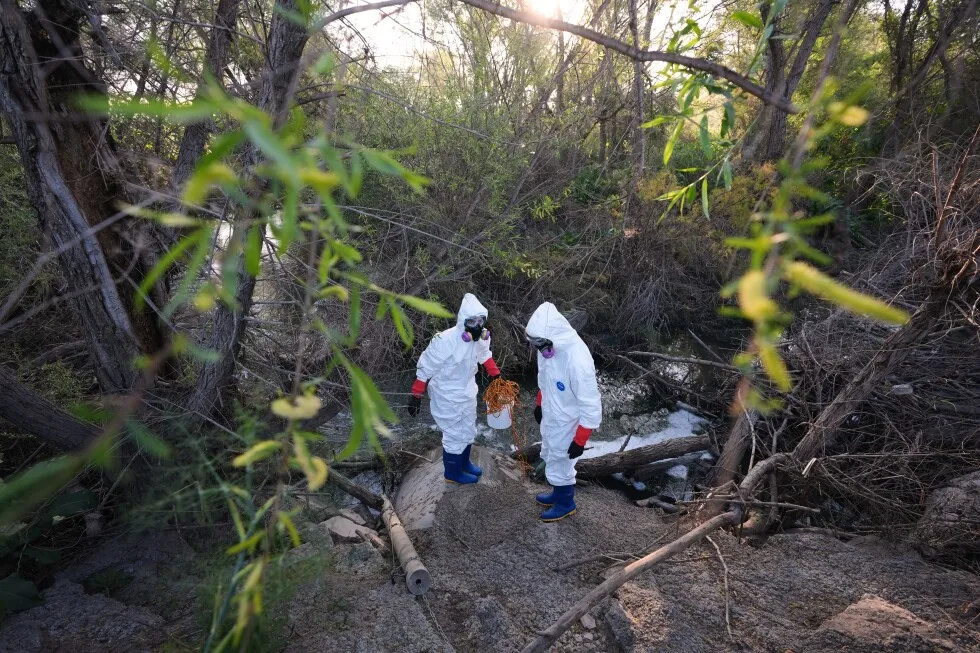
Trent Fry, right, and Leila El Masri collect a water sample of the Tijuana River, as part of a research team from the University of California, San Diego, Wednesday, March 11, 2026, in San Diego. (AP Photo/Gregory Bull) 2026-04-16T13:01:44Z San Diego (AP) — The smell of rotten eggs permeates Steve Egger’s Southern California home, especially at night as the nearby Tijuana River foams up with sewage from Mexico before emptying into the Pacific Ocean. Egger, 72, says he and his wife have frequent headaches and wake up congested and coughing up phlegm. Their home is outfitted with a hospital-grade filtration system that cycles the air every 15 minutes. Despite those measures, “most nights we breathe in a horrible stench,” he said. “It’s awful.” Since 2018, more than 100 billion gallons (378 billion liters) of raw sewage laden with industrial chemicals and trash have poured into the Tijuana River, according to the International Boundary and Water Commission. The river traverses land where three generations of the Egger family once raised dairy cows. The United States and Mexico signed an agreement last year to clean up the longstanding problem by upgrading wastewater plants to keep up with Tijuana’s population growth and industrial waste from factories, many owned by U.S. companies. Steve Egger stands near what scientists call “the Saturn hot spot,” a section of the Tijuana River where the contaminated water splashes out of pipes and creates pools of foam near his home Friday, March 6, 2026, in San Diego. (AP Photo/Gregory Bull) Steve Egger stands near what scientists call “the Saturn hot spot,” a section of the Tijuana River where the contaminated water splashes out of pipes and creates pools of foam near his home Friday, March 6, 2026, in San Diego. (AP Photo/Gregory Bull) --> Add AP News on Google Add AP News as your preferred source to see more of our stories on Google. --> Share Share Facebook Copy Link copied Email X LinkedIn Bluesky Flipboard Pinterest Reddit Steve Egger looks out from his door where the outer doorknob has turned black at his home Friday, March 6, 2026, in San Diego. (AP Photo/Gregory Bull) Steve Egger looks out from his door where the outer doorknob has turned black at his home Friday, March 6, 2026, in San Diego. (AP Photo/Gregory Bull) --> Add AP News on Google Add AP News as your preferred source to see more of our stories on Google. --> Share Share Facebook Copy Link copied Email X LinkedIn Bluesky Flipboard Pinterest Reddit Steve Egger looks over what scientists call "the Saturn hot spot," a section of the Tijuana River where the contaminated water splashes out of pipes and creates pools of foam near his home Friday, March 6, 2026, in San Diego. (AP Photo/Gregory Bull) Steve Egger looks over what scientists call "the Saturn hot spot," a section of the Tijuana River where the contaminated water splashes out of pipes and creates pools of foam near his home Friday, March 6, 2026, in San Diego. (AP Photo/Gregory Bull) --> Add AP News on Google Add AP News as your preferred source to see more of our stories on Google. --> Share Share Facebook Copy Link copied Email X LinkedIn Bluesky Flipboard Pinterest Reddit In the meantime, tens of thousands of people are being exposed to the sewage. Environmental Protection Agency Administrator Lee Zeldin said during a February visit to San Diego that it will take about two years to resolve one of the nation’s worst and longest-running environmental crises, which affects a largely poor, Latino population. Raw sewage doesn’t just smell bad. It emits hydrogen sulfide, a toxic gas that can erode neurons in the nose and trigger asthma attacks. It can cause headaches, nausea, delirium, tremors, cough, shortness of breath, skin and eye irritation and even death , according to the Centers for Disease Control and Prevention . Its long-term health problems are only starting to be understood. There is no federal safety standard for hydrogen sulfide except for workers at sites where the risk is extreme, such as wastewater treatment plants or manure pits. A few states set standards decades ago, but those are outdated. A California proposal would require the state’s 56-year-old standard reflect the health risks of the gas. In Texas, lawmakers are also considering updating its law. (
SRCAssociated Press (AP)
LANGEN
LEANCenter
WORDS719
ENT10
THU · 2026-04-16 · 20:53 GMTBRIEF NSR-2026-0416-70151
NSR-2026-0416-70151News Report·EN·Public Health
Tijuana River sewage is making the air toxic and sickening thousands in California
Raw sewage from the Tijuana River, totaling over 100 billion gallons since 2018, is polluting the air in Southern California and sickening residents. The sewage, containing industrial chemicals and trash, flows from Mexico into the Pacific Ocean.
Associated Press (AP)Filed 2026-04-16 · 20:53 GMTLean · CenterRead · 3 min
Associated Press (AP)FIG 01
Reading time
3min
Word count
719words
Sources cited
2cited
Entities identified
10entities
Quality score
100%
§ 01
Briefing Summary
AI-generatedNEWSAR · AI
Raw sewage from the Tijuana River, totaling over 100 billion gallons since 2018, is polluting the air in Southern California and sickening residents. The sewage, containing industrial chemicals and trash, flows from Mexico into the Pacific Ocean. Residents like Steve Egger report frequent headaches, congestion, and coughing due to the toxic air, despite using air filtration systems. The Tijuana River traverses land where the Egger family once raised dairy cows. The United States and Mexico signed an agreement last year to address the problem by upgrading wastewater plants to manage Tijuana's growing population and industrial waste.
Confidence 0.90Sources 2Claims 4Entities 10
§ 02
Article analysis
Model · rule-basedFraming
Public Health
Environmental
Tone
Mixed Tone
AI-assessed
CalmNeutralAlarmist
Factuality
0.80 / 1.00
Factual
LowHigh
Sources cited
2
Limited
FewMany
§ 03
Key claims
4 extracted01
The United States and Mexico signed an agreement last year to clean up the Tijuana River.
factual
Confidence
1.00
02
Since 2018, more than 100 billion gallons of raw sewage have poured into the Tijuana River.
statisticInternational Boundary and Water Commission
Confidence
1.00
03
Steve Egger and his wife have frequent headaches and wake up congested and coughing up phlegm.
quoteSteve Egger
Confidence
0.90
04
Tijuana River sewage is making the air toxic and sickening thousands in California.
factual
Confidence
0.70
§ 04
Full report
3 min read · 719 words§ 05
Entities
10 identifiedKey playerOppositionContextPositiveNeutralNegative
Organizations2
§ 06
Keywords & salience
8 termstijuana river sewage
1.00
water pollution
0.80
air quality
0.70
public health
0.70
industrial waste
0.60
us-mexico agreement
0.50
wastewater treatment
0.50
san diego
0.40
§ 07
Topic connections
Interactive graph No topic relationship data available yet. This graph will appear once topic relationships have been computed.