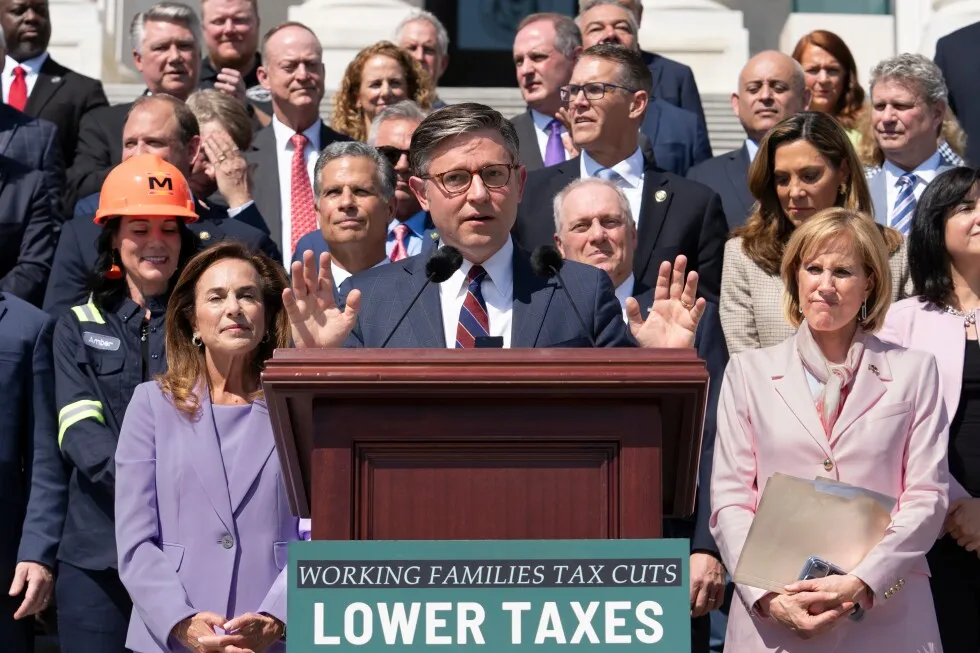
Speaker of the House Mike Johnson, R-La., and fellow Republicans celebrate GOP tax policies at an event outside the Capitol in Washington, Wednesday, April 15, 2026. (AP Photo/J. Scott Applewhite) Updated [hour]:[minute] [AMPM] [timezone], [monthFull] [day], [year] Washington (AP) — The House early Friday approved a short-term renewal until April 30 of a controversial surveillance program used by U.S. spy agencies in a post-midnight vote after Republicans revolted and refused President Donald Trump’s push for a longer extension.GOP leaders rushed lawmakers back into session to late Thursday with a series of back-to-back votes that collapsed in dramatic failure, before they quickly pushed ahead the stopgap measure as they race to keep the surveillance program running past Monday’s expiration date. First they unveiled a new plan that would have extended the program for five years, with revisions. Then they tried to salvage a shorter 18-month renewal that Trump had demanded and Speaker Mike Johnson had previously backed. Some 20 Republicans joined most Democrats in blocking its advance.Shortly after 2 a.m. they quickly agreed to the 10-day extension, which was agreed to on a voice vote without a formal roll call. It next goes to the Senate, which is gaveling for a rare Friday session, as Congress races to keep the surveillance program running. “We were very close tonight,” said Johnson after the late-night action. But Democrats blasted the middle-of-the-night voting as amateur hour. “Are you kidding me? Who the hell is running this place?” said Rep. Jim McGovern, D-Mass., during a fiery floor debate. At the center of the standoff that has stretched throughout the week is Section 702 of the Foreign Intelligence Surveillance Act, which permits the CIA, National Security Agency, FBI and other agencies to collect and analyze vast amounts of overseas communications without a warrant. In doing so, they can incidentally sweep up communications involving Americans who interact with foreign targets.U.S. officials say the authority is critical to disrupting terrorist plots, cyber intrusions and foreign espionage. Surveillance program fight is a debate over privacy and security Its path to passage has teetered all week in a familiar fight, as lawmakers weigh civil liberties concerns against intelligence officials’ warnings about national security risks. Opponents of the surveillance tool point to past misuses. FBI officials repeatedly violated their own standards when searching intelligence related to the Jan. 6, 2021, attack on the Capitol and racial justice protests in 2020, according to a 2024 court order.Trump and his allies had lobbied aggressively all week for a clean renewal of the program, without changes. A group of Republicans traveled to the White House on Tuesday, and on Wednesday CIA Director John Ratcliffe spoke directly with GOP lawmakers. House Majority Leader Steve Scalise said Thursday there had “been negotiations late into the night with the White House and some of our members.”“I am asking Republicans to UNIFY, and vote together on the test vote to bring a clean Bill to the floor,” Trump wrote on Truth Social this week. “We need to stick together.” The result of days of negotiationsThursday’s proceedings came to a standstill as lawmakers retreated behind closed doors and Johnson reached for an agreement to resolve the standoff.Shortly before midnight GOP leaders announced a new proposal, a five-year extension, with revisions. The changes were designed to win over skeptics of the surveillance program who have demanded greater oversight to protect Americans’ privacy. Among the changes are new provisions to ensure that only FBI attorneys can authorize queries on U.S. persons, and to require the Office of the Director of National Intelligence to review such cases, said Rep. Austin Scott, R-Ga., during the debate.But the final product, a 14-page amendment, did not go far enough for some holdouts in either party.With Johnson controlling a slim majority, he has little room for dissent. As the Republicans fell short on both efforts before the short extension, a handful of Democrats stepped in to try to help them advance the longer extensions, but most Democrats were opposed.“We just defeated Johnson’s efforts to sneak through a 5-year FISA authorization tonight,” said Democratic Rep, Ro Khanna of California. “Now, they will have to fight in daylight.” Cappelletti covers Congress for The Associated Press. He previously reported on Michigan politics for AP.
SRCAssociated Press (AP)
LANGEN
LEANCenter
WORDS705
ENT12
FRI · 2026-04-17 · 06:23 GMTBRIEF NSR-2026-0417-70245
NSR-2026-0417-70245News Report·EN·National Security
House rushes to overnight vote to renew key surveillance tool used by US spy agencies
The House of Representatives narrowly approved a short-term extension of a controversial surveillance program early Friday morning. The program, authorized under Section 702 of the Foreign Intelligence Surveillance Act, allows U.S.
By
JOEY CAPPELLETTI and LISA MASCAROAssociated Press (AP)Filed 2026-04-17 · 06:23 GMTLean · CenterRead · 3 min
Associated Press (AP)FIG 01
Reading time
3min
Word count
705words
Sources cited
6cited
Entities identified
12entities
Quality score
100%
§ 01
Briefing Summary
AI-generatedNEWSAR · AI
The House of Representatives narrowly approved a short-term extension of a controversial surveillance program early Friday morning. The program, authorized under Section 702 of the Foreign Intelligence Surveillance Act, allows U.S. spy agencies to collect overseas communications without a warrant, potentially including those of Americans. The last-minute vote followed Republican infighting and the rejection of both a five-year extension and an 18-month extension demanded by former President Trump. The approved measure extends the program only until April 30th. The bill now moves to the Senate, which convened a rare Friday session to consider the extension before the program's expiration date on Monday. The debate centers on balancing national security interests with civil liberties concerns regarding potential misuse of the surveillance tool.
Confidence 0.90Sources 6Claims 5Entities 12
§ 02
Article analysis
Model · rule-basedFraming
National Security
Political Strategy
Tone
Measured
AI-assessed
CalmNeutralAlarmist
Factuality
0.70 / 1.00
Factual
LowHigh
Sources cited
6
Well sourced
FewMany
§ 03
Key claims
5 extracted01
Democrats blasted the middle-of-the-night voting as amateur hour.
factualAP
Confidence
1.00
02
FBI officials repeatedly violated their own standards when searching intelligence related to Jan. 6.
factual2024 court order
Confidence
1.00
03
Section 702 of FISA permits agencies to collect overseas communications without a warrant.
factualAP
Confidence
1.00
04
The House approved a short-term renewal until April 30 of a controversial surveillance program.
factualAP
Confidence
1.00
05
U.S. officials say the authority is critical to disrupting terrorist plots and cyber intrusions.
quoteU.S. officials
Confidence
0.90
§ 04
Full report
3 min read · 705 words§ 05
Entities
12 identifiedKey playerOppositionContextPositiveNeutralNegative
People3
Organizations7
HO
House of Representatives
GovernmentKey Player
90
RP
Republican Party
Political PartyKey Player
2x
80
DP
Democratic Party
Political PartyOpposition
70
FB
Federal Bureau of Investigation (FBI)
GovernmentContext
2x
60
S
Senate
GovernmentKey Player
60
NS
National Security Agency (NSA)
organizationContext
60
CI
Central Intelligence Agency (CIA)
organizationContext
60
§ 06
Keywords & salience
9 termssurveillance program
1.00
section 702
0.90
foreign intelligence surveillance act
0.80
u.s. spy agencies
0.70
civil liberties
0.60
national security
0.60
house vote
0.50
donald trump
0.40
mike johnson
0.40
§ 07
Topic connections
Interactive graph Network visualization showing 51 related topics
View Full Graph Person Organization Location Event|Click node to navigate|Edge numbers = shared articles