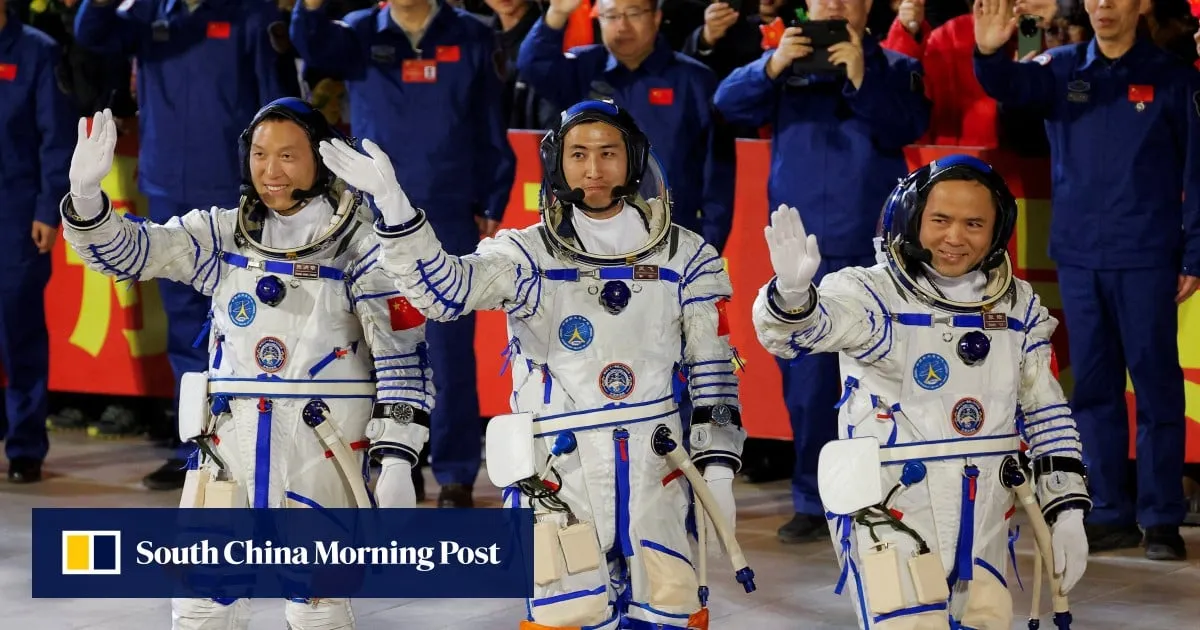
The three astronauts stationed on China’s Tiangong space station will extend their stay by around a month, state broadcaster CCTV said on Friday.The crew lifted off from the Jiuquan Satellite Launch Centre on October 31 on board the Shenzhou-21 vessel and were expected to return to Earth at the end of this month after a standard six-month mission.In November, a crack was discovered in a window of the Shenzhou-20 spacecraft, forcing the space station’s previous crew to extend their stay for a further nine days before using their replacements’ Shenzhou-21 vessel to return to Earth.As part of the rescue mission, the uncrewed Shenzhou-22 capsule was sent to the space station to help the current crew return to Earth safely.“To further validate technologies related to long-term human habitation in orbit and to maximise the comprehensive benefits of using the Shenzhou-22 spacecraft as an emergency launch vehicle to resupply the space station, it has been decided, after careful evaluation and assessment, that the crew’s stay in orbit will be extended by approximately one month,” CCTV reported.The Shenzhou-22 astronauts were originally going to blast off this month, but are now expected to travel to the space station in May on the Shenzhou-23 vessel.
SRCSouth China Morning Post
LANGEN
LEANCenter-Right
WORDS200
ENT8
FRI · 2026-04-17 · 10:02 GMTBRIEF NSR-2026-0417-70310
NSR-2026-0417-70310News Report·EN·Technology
China’s space station crew to ‘maximise opportunities’ with extra month in orbit
China's current Tiangong space station crew, who launched on October 31st aboard Shenzhou-21, will extend their mission by approximately one month. The decision, announced by CCTV, aims to further validate technologies related to long-term space habitation and maximize the use of the Shenzhou-22 spacecraft, which was sent as an emergency resupply vehicle after a window crack was discovered on Shenzhou-20.
Holly Chik,Victoria BelaSouth China Morning PostFiled 2026-04-17 · 10:02 GMTLean · Center-RightRead · 1 min
South China Morning PostFIG 01
Reading time
1min
Word count
200words
Sources cited
1cited
Entities identified
8entities
Quality score
100%
§ 01
Briefing Summary
AI-generatedNEWSAR · AI
China's current Tiangong space station crew, who launched on October 31st aboard Shenzhou-21, will extend their mission by approximately one month. The decision, announced by CCTV, aims to further validate technologies related to long-term space habitation and maximize the use of the Shenzhou-22 spacecraft, which was sent as an emergency resupply vehicle after a window crack was discovered on Shenzhou-20. This extension follows a previous delay caused by the window issue, which forced the prior crew to extend their stay. The Shenzhou-22 astronauts, originally scheduled to launch this month, will now travel to Tiangong in May aboard the Shenzhou-23 vessel.
Confidence 0.90Sources 1Claims 5Entities 8
§ 02
Article analysis
Model · rule-basedFraming
Technology
National Security
Tone
Measured
AI-assessed
CalmNeutralAlarmist
Factuality
0.90 / 1.00
Factual
LowHigh
Sources cited
1
Limited
FewMany
§ 03
Key claims
5 extracted01
The Shenzhou-22 astronauts are now expected to travel to the space station in May on the Shenzhou-23 vessel.
factual
Confidence
1.00
02
The Shenzhou-22 capsule was sent to the space station to help the current crew return to Earth safely.
factual
Confidence
1.00
03
A crack was discovered in a window of the Shenzhou-20 spacecraft in November.
factual
Confidence
1.00
04
The crew lifted off from the Jiuquan Satellite Launch Centre on October 31 on board the Shenzhou-21 vessel.
factual
Confidence
1.00
05
The three astronauts on China’s Tiangong space station will extend their stay by around a month.
factualCCTV
Confidence
1.00
§ 04
Full report
1 min read · 200 words§ 05
Entities
8 identifiedKey playerOppositionContextPositiveNeutralNegative
Organizations1
Locations3
§ 06
Keywords & salience
9 termsspace station
1.00
china
0.80
astronauts
0.80
orbit
0.70
shenzhou spacecraft
0.70
space mission
0.60
emergency launch vehicle
0.50
long-term habitation
0.50
tiangong
0.40
§ 07
Topic connections
Interactive graph Network visualization showing 6 related topics
View Full Graph Person Organization Location Event|Click node to navigate|Edge numbers = shared articles