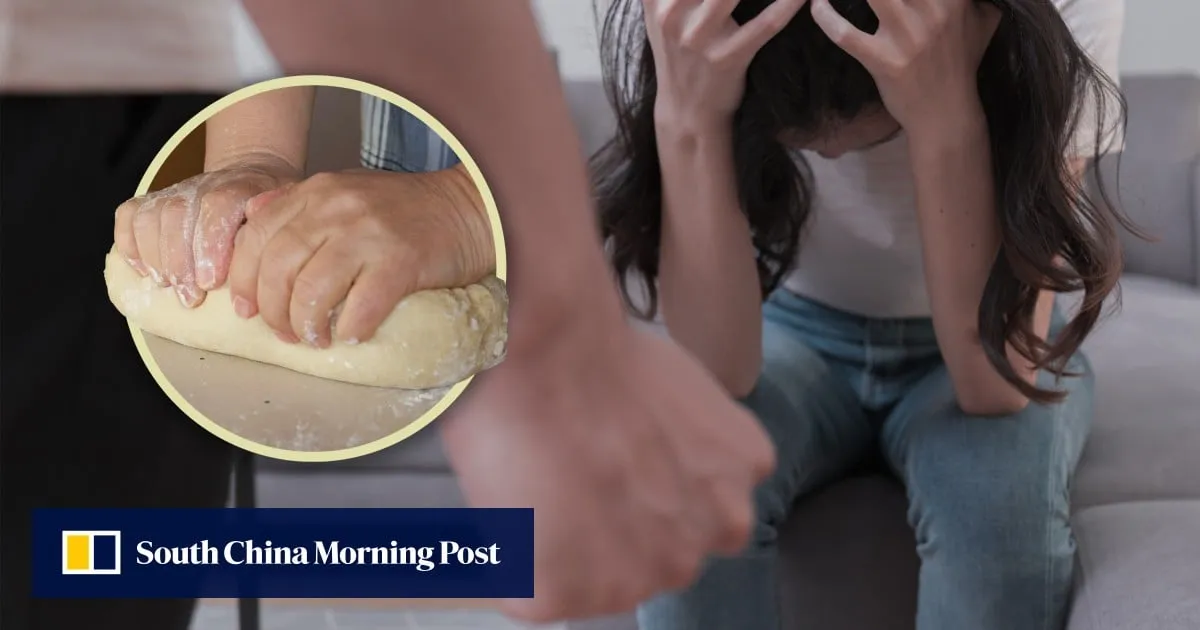
A Chinese noodle restaurant has come under fire for displaying a slogan that appears to condone domestic violence.The restaurant in Xining, northwestern China’s Qinghai province put up a banner which read “beaten wife, kneaded dough”.The slogan refers to an old saying from the Guanzhong plain region, which goes “the more a dough is kneaded the better the noodles taste, the more a wife is beaten the more docile she gets.”The restaurant’s offensive banner, above, has sparked widespread anger. Photo: DouyinThe shop was slammed across mainland social media for trying to rationalise domestic violence and objectify women.“Noodles get tastier when they are kneaded, but women get wounds and fear when they are beaten,” one online observer said.On April 13, the local market supervision administration demanded the eatery to take down and destroy the banner.The authorities also educated its responsible person. It said the shop had violated the Advertising Law.Some comments expressed shock over the fact that such an outdated slogan is still used publicly today.The banner’s reference to kneading dough refers to an old Chinese saying. Photo: ShutterstockIt is not the only idiom that encourages domestic violence.Other offensive sayings circulate in less-developed areas, such as “a wife is a horse that one can ride and beat however he wants”, and “a wife cannot be beaten to death and peppers cannot burn in the sun”.Such sayings were also used as slogans at restaurants in northwestern China.An online observer said a restaurant had put up a slogan that says “a mother’s hard work leads to the whole family’s happiness”.Further Reading“It is a horror story,” said artist Qiu Taozi.A traditional noodle shop in a street food night market in China. Photo: ShutterstockQiu, a graduate from the Xian Academy of Fine Arts in northwestern China’s Shaanxi province, created an art project that invites rural women to make huamo, or flower steamed buns, that re-enact scenes of domestic violence.She said the work was inspired by the ‘kneaded dough’ saying and she was told that all of those taking part had heard the saying when they were young.In 2016, China enacted its first national anti-domestic violence law.According to China’s Supreme People’s Court, the country had issued 33,000 personal safety protection orders in the past decade.Statistics from the China-womens-federation" class="entity-link entity-organization" data-entity-id="64799" data-entity-type="organization">All-China Women’s Federation and the National Bureau of Statistics in 2011 showed that 24.7 per cent of women experienced domestic violence.This includes physical and mental violence, economic control and forced sexual intercourse during marital life.In 2021, that dropped to 8.6 per cent, which was reportedly calculated according to the definition included in the Anti-Domestic Violence Law.A family sitting down playing cards in a rural village in Hunan province, southern China. Photo: ShutterstockSome online observers said that the law’s definition of domestic violence is incomplete, and in some cases vague, such as in terms of economic violence. It also fails to include violence against unmarried partners.On a practical level, some women were also coerced into believing that their husbands’ violence is normal, or were afraid of retaliation and did not report their plight to the officials.“Such slogans are nothing but cultural dregs and should be ditched,” said one person online.“We are what we say. If we keep letting these slogans circulate it will be harder for women to realise domestic violence is wrong,” said another.
SRCSouth China Morning Post
LANGEN
LEANCenter-Right
WORDS544
ENT12
SAT · 2026-04-18 · 06:00 GMTBRIEF NSR-2026-0418-70483
NSR-2026-0418-70483News Report·EN·Human Rights
China eatery sparks outrage for ‘beating wife’ sales slogan hinting domestic violence approval
A noodle restaurant in Xining, China, sparked outrage for displaying a sales slogan that appeared to condone domestic violence. The banner read "beaten wife, kneaded dough," referencing an old saying linking the treatment of dough to the treatment of wives.
Fran LuSouth China Morning PostFiled 2026-04-18 · 06:00 GMTLean · Center-RightRead · 3 min
South China Morning PostFIG 01
Reading time
3min
Word count
544words
Sources cited
3cited
Entities identified
12entities
Quality score
100%
§ 01
Briefing Summary
AI-generatedNEWSAR · AI
A noodle restaurant in Xining, China, sparked outrage for displaying a sales slogan that appeared to condone domestic violence. The banner read "beaten wife, kneaded dough," referencing an old saying linking the treatment of dough to the treatment of wives. The slogan drew widespread criticism on social media for rationalizing domestic violence and objectifying women. On April 13th, local authorities ordered the restaurant to remove the banner, citing violations of advertising law and educating the person in charge. The incident highlights the persistence of outdated and offensive sayings in some regions, despite China's 2016 anti-domestic violence law and efforts to protect women.
Confidence 0.90Sources 3Claims 5Entities 12
§ 02
Article analysis
Model · rule-basedFraming
Human Rights
Social Justice
Tone
Mixed Tone
AI-assessed
CalmNeutralAlarmist
Factuality
0.70 / 1.00
Factual
LowHigh
Sources cited
3
Well sourced
FewMany
§ 03
Key claims
5 extracted01
The country had issued 33,000 personal safety protection orders in the past decade.
statisticChina’s Supreme People’s Court
Confidence
1.00
02
China enacted its first national anti-domestic violence law in 2016.
factualArticle itself
Confidence
1.00
03
The local market supervision administration demanded the eatery to take down the banner, citing violation of the Advertising Law.
factualArticle itself
Confidence
1.00
04
A Chinese noodle restaurant in Xining displayed a slogan that appears to condone domestic violence.
factualArticle itself
Confidence
1.00
05
In 2021, 8.6 per cent of women experienced domestic violence in China, calculated according to the Anti-Domestic Violence Law.
statisticArticle itself, citing statistics
Confidence
0.90
§ 04
Full report
3 min read · 544 words§ 05
Entities
12 identifiedKey playerOppositionContextPositiveNeutralNegative
Organizations5
Locations5
§ 06
Keywords & salience
8 termsdomestic violence
1.00
china
0.80
offensive slogan
0.70
restaurant
0.60
anti-domestic violence law
0.50
sexism
0.50
social media outrage
0.40
women's rights
0.40
§ 07
Topic connections
Interactive graph Network visualization showing 51 related topics
View Full Graph Person Organization Location Event|Click node to navigate|Edge numbers = shared articles