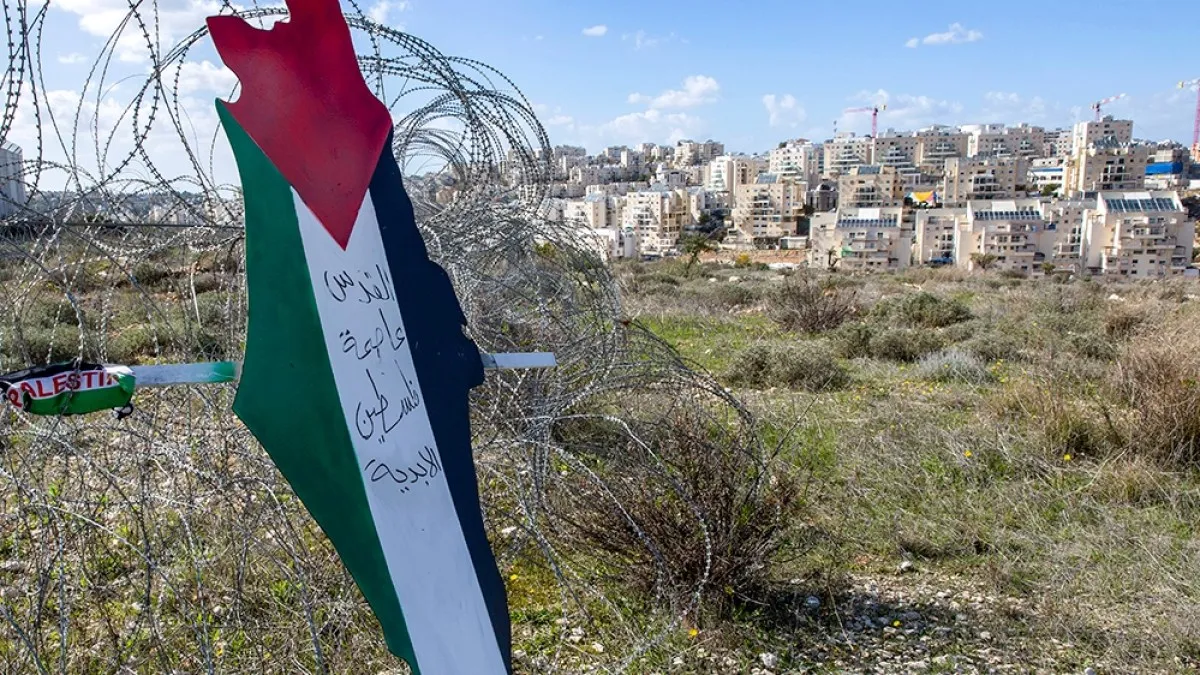
Israel’s plan for 9,000 units at Jerusalem airport is a move to sever the city from the West Bank, analyst says.Protesters post a placard with the colours of the Palestinian flag and Arabic text that reads 'Jerusalem is the eternal capital of Palestine' at barbed wire surrounding the Israeli separation wall and the illegal Israeli settlement of Modiin Illit during a protest in the occupied West Bank village of Bilin, near Ramallah, January 31, 2020 [Nasser Nasser/AP Photo]Published On 12 Jan 2026Israel is set to advance two major illegal settlement plans for occupied East Jerusalem, which Palestinian officials and experts warn will serve as the final blow to hopes for a contiguous Palestinian state.The Jerusalem governorate announced on Sunday that Israeli authorities will discuss approving 9,000 settlement units on the ruins of the Qalandiya airport, also known as Atarot, and a separate project in Sheikh Jarrah to displace 40 families.To understand the strategic implications of these moves, Al Jazeera spoke to Suhail Khalilieh, a political analyst and expert on illegal Israeli settlements.The Trump factorThe Atarot plan was briefly shelved in December 2025 but has now returned to the table. According to Khalilieh, the timing is directly linked to the shifting geopolitical landscape following the recent meeting between Israeli Prime Minister Benjamin Netanyahu and United States President Donald Trump.“The meeting … served as a green light for continued settlement expansion,” Khalilieh told Al Jazeera.“The American position, which treats Jerusalem as being outside any negotiation process … has encouraged the occupation to put this project into direct implementation,” he added, noting that international criticism has been reduced to mere “verbal objections without any deterrence”.Severing the northThe airport project is not just about housing; it is a strategic chokehold, Khalilieh said.He explained that the Atarot settlement is one of the three major axes designed to complete the “Greater Jerusalem” vision: North: The Atarot project will link East Jerusalem with the Givat Zeev settlement bloc, effectively severing the city from Ramallah. East: The E1 plan aims to create a bridge between East Jerusalem and the Maale Adumim bloc. South: Expansions in Har Gilo and the new Nahal Heletz settlement will connect the city to the Gush Etzion bloc. “This will increase the area of Jerusalem … by adding 175sq km [68sq miles],” Khalilieh said.“The current area of East Jerusalem, according to the Israeli definition, is 71sq km [27sq miles]. With these additions, Greater Jerusalem under Israeli control will reach 246sq km [95sq miles], 4.5 percent … of the West Bank’s area, aiming to abort any possibility of establishing a Palestinian capital in East Jerusalem.”Encirclement of the Old CityIn parallel, the “Nahalat Shimon” plan in Sheikh Jarrah targets the historic “Holy Basin” area north of the Old City.“This falls under the old-new Israeli efforts to expand the settlement ring around the Old City,” Khalilieh said.The goal, he argued, is to dismantle geographical continuity between Palestinian neighbourhoods like Silwan, the Mount of Olives, and Sheikh Jarrah, transforming them into “isolated population islands”.“Today, the takeover of the Old City has begun through this ring … aiming to empty these areas gradually through intensified demolitions.”‘Silent transfer’Khalilieh warned that Israel is using neutral planning terms like “urban renewal” and “land settlement” to camouflage a policy of forced displacement.“Development for Israelis means demolishing Palestinian homes under the guise of ‘building without a permit’,” he said, noting that more than 300 Palestinian homes were demolished in East Jerusalem in 2025 alone.He also pointed to the unification of the “Arnona” property tax, which forces residents of neglected Palestinian neighbourhoods to pay the high rates as those in affluent Israeli areas.“This puts them under cumulative pressure to leave Jerusalem … it constitutes a silent forced transfer.”Is it too late?Khalilieh stressed that legal and diplomatic intervention must happen “before construction begins”, as reversing facts on the ground is politically “nearly impossible”.He called for activating provisional measures at the International Court of Justice (ICJ) and targeting international companies involved in the projects.“The problem, first and last, is a political dilemma, not a legal one,” he concluded. “Early intervention is crucial … to freeze these projects until the political situation can be addressed.”
SRCAl Jazeera
LANGEN
LEANCenter
WORDS687
ENT8
MON · 2026-01-12 · 12:13 GMTBRIEF NSR-2026-0112-7053
NSR-2026-0112-7053News Report·EN·Political Strategy
Israel advances ‘fatal’ settlement plan for occupied East Jerusalem
In January 2026, Israel is set to advance plans for 9,000 settlement units in occupied East Jerusalem, specifically at the site of the former Qalandiya (Atarot) airport and in the Sheikh Jarrah neighborhood. Palestinian officials and experts warn these plans will undermine the possibility of a contiguous Palestinian state.
Mohammad MansourAl JazeeraFiled 2026-01-12 · 12:13 GMTLean · CenterRead · 3 min
Al JazeeraFIG 01
Reading time
3min
Word count
687words
Sources cited
1cited
Entities identified
8entities
Quality score
100%
§ 01
Briefing Summary
AI-generatedNEWSAR · AI
In January 2026, Israel is set to advance plans for 9,000 settlement units in occupied East Jerusalem, specifically at the site of the former Qalandiya (Atarot) airport and in the Sheikh Jarrah neighborhood. Palestinian officials and experts warn these plans will undermine the possibility of a contiguous Palestinian state. According to analyst Suhail Khalilieh, the Atarot project aims to sever Jerusalem from Ramallah by linking East Jerusalem with the Givat Zeev settlement bloc. Khalilieh suggests the advancement of these plans is linked to a recent meeting between the Israeli Prime Minister and the U.S. President, signaling a green light for settlement expansion and a weakening of international deterrence. The project is part of a broader strategy to expand Jerusalem's area and solidify Israeli control.
Confidence 0.90Sources 1Claims 5Entities 8
§ 02
Article analysis
Model · rule-basedFraming
Political Strategy
Conflict
Tone
Mixed Tone
AI-assessed
CalmNeutralAlarmist
Factuality
0.60 / 1.00
Mixed
LowHigh
Sources cited
1
Limited
FewMany
§ 03
Key claims
5 extracted01
Israeli authorities will discuss approving 9,000 settlement units on the ruins of the Qalandiya airport.
factualThe Jerusalem governorate
Confidence
1.00
02
With these additions, Greater Jerusalem under Israeli control will reach 246sq km, 4.5 percent of the West Bank’s area.
statisticSuhail Khalilieh
Confidence
0.90
03
Israel is set to advance two major illegal settlement plans for occupied East Jerusalem.
factual
Confidence
0.90
04
The meeting served as a green light for continued settlement expansion.
quoteSuhail Khalilieh
Confidence
0.80
05
The Atarot project will link East Jerusalem with the Givat Zeev settlement bloc, effectively severing the city from Ramallah.
predictionSuhail Khalilieh
Confidence
0.70
§ 04
Full report
3 min read · 687 words§ 05
Entities
8 identifiedKey playerOppositionContextPositiveNeutralNegative
§ 06
Keywords & salience
8 termsisraeli settlements
1.00
east jerusalem
0.90
settlement plan
0.80
occupied territory
0.70
palestinian state
0.60
qalandiya airport
0.50
geopolitical landscape
0.40
contiguous state
0.40
§ 07
Topic connections
Interactive graph Network visualization showing 51 related topics
View Full Graph Person Organization Location Event|Click node to navigate|Edge numbers = shared articles