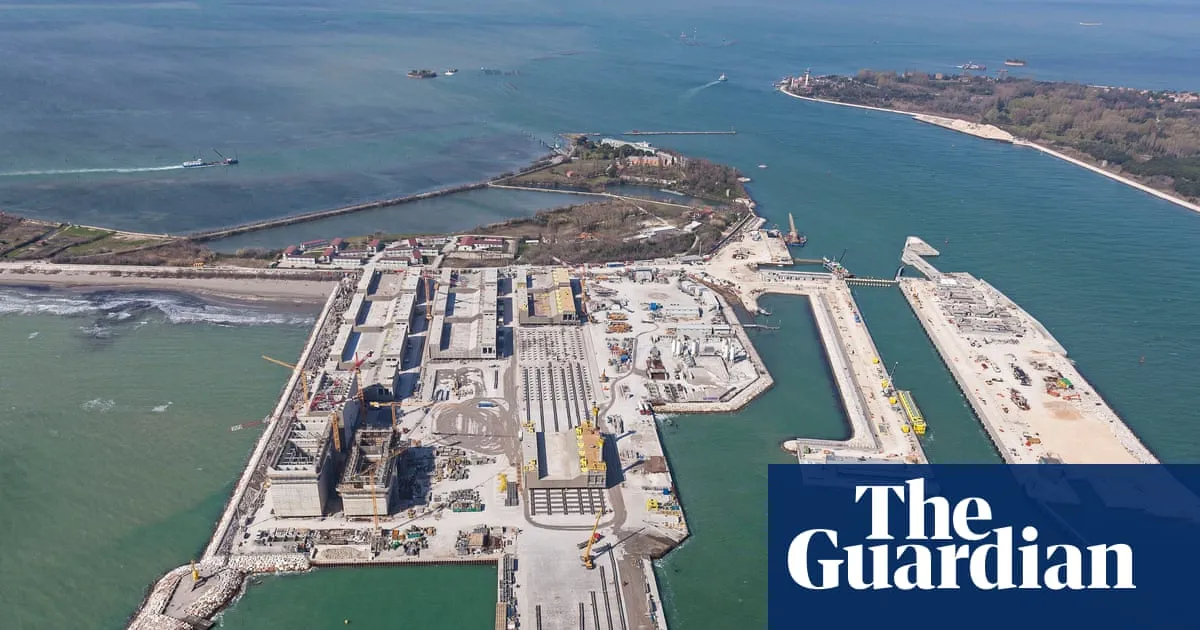
The Arsenale, the colossal shipyard that was the engine of the Venetian Republic’s domination for seven centuries, remains the nucleus of the city’s control over the water. Its northern section is made up of cavernous brick warehouses called capannoni, which in the 16th century could produce a warship a day through a rigorously ordered assembly line.Now, one of them houses the operations centre of the Mose, the sprawling flood defence system that protects the city.The name stands for modulo sperimentale elettromeccanico (experimental electromechanic module) and is a nod to the biblical character who parted the seas. For Venetians who have seen their city devastated by storm surges they call acque alte, there is something miraculous about it: the massive, luridly coloured flood barriers sunk into the seabed at three inlets between the lagoon and the Adriatic have saved Venice from potential flooding 154 times since they were inaugurated in 2020.But, despite the Mose having been in operation for only five years, city authorities are already looking for a plan B. Rising sea levels due to the climate crisis mean engineers are forced to raise the flood barriers more frequently, which damages the lagoon’s ecosystem.The San Marco basin in Venice. Closing the flood barriers costs the city upwards of €200,000 a time Photograph: Emanuele Cremaschi/Getty ImagesAn alarming acceleration in sea level rise – an estimated extra metre by the end of the century – represents a “death knell for the city”, says Andrea Rinaldo, the head of the scientific committee of the newly appointed Lagoon Authority, the organisation that manages the Mose and is now also charged with working out what could succeed it.“With a metre more, you would have to close the Mose barriers on average 200 times a year, which means it’s practically always closed,” Rinaldo says. “When this happens, the lagoon loses its nature of being a transitional environment. It would become a filthy pond.”The tides create a natural exchange of water and sediment between the Venice lagoon and the Adriatic. The raised flood barriers block the flow of water, which encourages an excess growth of algae. When the algae die, they decompose, sucking out all the oxygen in the water and killing off fish and other marine flora.Rinaldo insists the Mose is not poorly designed. It was envisioned as a project for the future, but that future came far sooner than its engineers expected. He is urging immediate action. “You won’t have a lagoon. You won’t have a city. And all of this could happen in a timeframe that is comparable with the time that we had to design and build the Mose. We can’t wait.”The Mose is keeping Venice dry but its frequent use is encouraging an excess growth of algae in the lagoon. Photograph: PR ImageIt took five decades for the Mose to be designed and brought into operation, after Venice suffered the worst flood in its history on 4 November 1966. The idea for flood barriers was fleshed out in the 1970s and the module was built in the 1980s, but bureaucracy and concerns over its environmental impact delayed its implementation.In 2014, the then mayor of Venice, Giorgio Orsoni, was arrested on suspicion of corruption. His arrest tugged on a thread that revealed a network of cronyism and bribery that had swelled the cost of the project by millions of euros. Many Venetians were initially against the Mose because of its ballooning budget, its impact on the lagoon, and a certain cynicism that it would ever work. But then it did – and Venice has stayed dry ever since.The inside of the Mose operations centre in the northern Arsenale looks like a Bond villain’s hideout, or perhaps a Silicon Valley tech startup: glass staircases, gleaming white walls and offices hidden in frosted Perspex cubes. The control room has the feel of a war room with its curving wall of screens, which display a panoply of meteorological conditions that could combine to create a storm surge.The control room of the Mose flood defence system. Photograph: PR ImageOne screen shows a satellite image of Venice, boats appearing as flecks of white spittle in the grey lagoon. Giovanni Zarotti, the Mose technical director, explains that the tides never go unmonitored. The control room even has an exact replica elsewhere in the Arsenale complex, in case of a power cut or another technical issue.It is a well-oiled operation but mistakes still happen. Zarotti says the decision is made to close the barriers three hours before the water level is expected to reach the height that would cause flooding.“We’re relying on God, statistically speaking. We have a margin of error of 10cm. If we forecast 110cm and order the closure, there could be a sudden drop in wind and the water only rises 98cm,” he says.Activating the Mose has a significant economic impact, not only because closing the barriers costs the city upwards of €200,000 (£175,000) each time, but also because it puts a halt to maritime traffic going through the Malamocco inlet on its way to the Marghera port. During the Venice carnival this year, the barriers were raised 26 times in just three weeks, costing the city more than €5m.The sea level in Venice is predicted to rise by a metre by the end of the century. Photograph: Giorgio Marcoaldi /CVNZarotti says the team is experimenting with raising the barriers at each inlet consecutively, to stagger the impact, and is considering raising the activation level to 130cm. He admits, however, that Venetians have grown accustomed to the Mose and are far less tolerant of even light flooding. The last devastating acqua alta the city experienced was in 2019, when the city was engulfed by 187cm of water, flooding 80% of the city.“Venetians now take the Mose for granted,” he says. “Many don’t even own waders any more. Imagine, if you’re six years old, you’ve never heard the sound of flood sirens.”What the next project will be still needs to be defined. Rinaldo is enthusiastic about the intellectual possibilities of the challenge at hand. He plans to put out a global call for ideas from leading thinkers across a variety of different disciplines, from art and economics to history and science. Each group of experts would be given a grant and a year to devise a proposal, which would then be assessed by a scientific advisory board. The chosen projects would then be given to city authorities to put into action.“Venice is a test bed for how we cope with these systems in the future,” he says, adding that it is a problem that can’t be solved by science and engineering alone.He believes it is vital the city is entirely reimagined, in particular redirecting Venice’s economy away from its reliance on tourism, which is just as much a threat to the city as rising waters. Otherwise, what he calls a jewel of artistic heritage would be lost. He lets out a laugh. “Over my dead body!”
SRCThe Guardian - World News
LANGEN
LEANCenter-Left
WORDS1 158
ENT8
SAT · 2026-04-18 · 13:00 GMTBRIEF NSR-2026-0418-70534
NSR-2026-0418-70534News Report·EN·Environmental
‘We can’t wait’: Venice already seeking floods plan B five years after barriers’ launch
Venice, Italy, is already seeking a "plan B" for flood protection, despite the MOSE flood barrier system only being operational for five years. The MOSE, designed to protect Venice from storm surges, has been deployed 154 times since 2020.
Catherine BennettThe Guardian - World NewsFiled 2026-04-18 · 13:00 GMTLean · Center-LeftRead · 5 min
The Guardian - World NewsFIG 01
Reading time
5min
Word count
1 158words
Sources cited
1cited
Entities identified
8entities
Quality score
100%
§ 01
Briefing Summary
AI-generatedNEWSAR · AI
Venice, Italy, is already seeking a "plan B" for flood protection, despite the MOSE flood barrier system only being operational for five years. The MOSE, designed to protect Venice from storm surges, has been deployed 154 times since 2020. However, rising sea levels, accelerated by climate change, are forcing more frequent closures of the barriers. Experts estimate a potential sea level rise of one meter by the end of the century. This could lead to the MOSE being closed approximately 200 times per year, disrupting the lagoon's ecosystem and potentially turning it into a stagnant pond. The Lagoon Authority, which manages the MOSE, is now tasked with developing alternative solutions to safeguard Venice.
Confidence 0.90Sources 1Claims 5Entities 8
§ 02
Article analysis
Model · rule-basedFraming
Environmental
Economic Impact
Tone
Mixed Tone
AI-assessed
CalmNeutralAlarmist
Factuality
0.70 / 1.00
Factual
LowHigh
Sources cited
1
Limited
FewMany
§ 03
Key claims
5 extracted01
Closing the flood barriers costs the city upwards of €200,000 a time.
statisticnull
Confidence
1.00
02
The Mose flood barriers have saved Venice from potential flooding 154 times since 2020.
factualnull
Confidence
1.00
03
An estimated extra metre of sea level rise by the end of the century represents a “death knell for the city”.
quoteAndrea Rinaldo
Confidence
0.90
04
Rising sea levels mean engineers are forced to raise the flood barriers more frequently, which damages the lagoon’s ecosystem.
factualnull
Confidence
0.90
05
With a metre more sea level rise, the Mose barriers would have to close on average 200 times a year.
predictionAndrea Rinaldo
Confidence
0.80
§ 04
Full report
5 min read · 1 158 words§ 05
Entities
8 identifiedKey playerOppositionContextPositiveNeutralNegative
Organizations3
§ 06
Keywords & salience
9 termsvenice
1.00
mose
0.90
flooding
0.90
sea level rise
0.80
flood barriers
0.70
climate crisis
0.70
lagoon ecosystem
0.60
acque alte
0.50
lagoon authority
0.50
§ 07
Topic connections
Interactive graph Network visualization showing 7 related topics
View Full Graph Person Organization Location Event|Click node to navigate|Edge numbers = shared articles