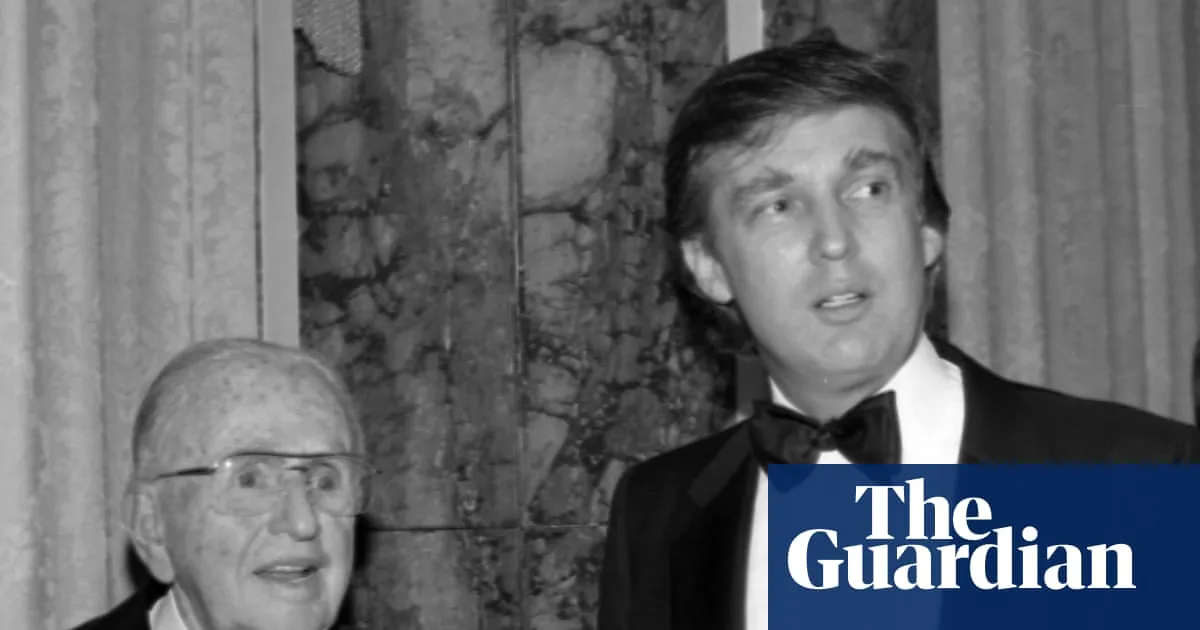
Donald Trump’s attacks this week on Pope Leo, for his criticism of the US attack on Iran and the US president’s decision to post an image of himself as Jesus Christ on social media, make a good deal more sense considering Trump attended services as a young man at the Protestant Marble Collegiate Church in Manhattan, which was led at the time by an anti-Catholic pastor.That church’s pastor in Trump’s youth, Norman Vincent Peale, who would later officiate at Trump’s first wedding, is best-known today as the author of the Christian self-help book The Power of Positive Thinking, but when Trump was 14, Peale made national headlines as the leader of a group of Protestant churchmen who loudly objected to the presidential candidacy of John F Kennedy, on the grounds that he was a Catholic.As Time magazine reported in September 1960, Peale, “a longstanding Republican whose Protestant following rivals Billy Graham’s as the largest in the US”, was one of the most prominent leaders of a group of “150 Protestant clergymen and laymen, calling themselves the Citizens for Religious Freedom”, who met that month in Washington’s Mayflower Hotel to agree on a statement objecting to the notion that a Catholic could be president.Peale presided over the meeting, according to two reporters from the Washington Post and Long Island’s Newsday. “Our American culture is at stake,” Peale warned his colleagues. “I don’t say it won’t survive, but it won’t be what it was.”“At the close of their session,” Time reported, “they issued a 2,000-word manifesto that more than any other statement thus far in the campaign served to make religion the most emotional issue of the 1960 election.”That statement, which was printed in the New York Times, along with Peale’s photograph, on 8 September 1960, is a reminder of how recently virulent anti-Catholic sentiment was entirely acceptable for the nation’s Protestant establishment.From the perspective of today, what is most interesting is that the anti-Kennedy screed issued by Peale and other Protestant clergymen in 1960 focused mainly on their claim that a Catholic would refuse to uphold the separation of church and state.“Brotherhood in a pluralistic society like ours depends on a firm wall of separation between church and state. We feel that the American hierarchy of the Roman Catholic Church can only increase religious tensions and political-religious problems by attempting to break down this wall,” Peale’s group wrote. “Much depends upon strong support for this well tested wall of separation by Americans of all faiths.”Kennedy responded to the objections of the Protestant clergymen by delivering a speech on religion and politics to a group of Baptist ministers in Houston, Texas, the following week.“I believe in an America where the separation of church and state is absolute; where no Catholic prelate would tell the President – should he be Catholic – how to act, and no Protestant minister would tell his parishioners for whom to vote; where no church or church school is granted any public funds or political preference, and where no man is denied public office merely because his religion differs from the President who might appoint him, or the people who might elect him,” Kennedy said in the address.The central concern expressed in the statement from Peale’s group was the same one spread by anti-Catholic conspiracy theorists in 1928, when Al Smith was the first Catholic nominee for president: the idea that the pope would secretly control a Catholic president.As the historian Robert Slayton has explained, in 1928: “The Ku Klux Klan became actively involved in preventing a Catholic from ever getting near the White House, going all out to defeat Smith. One Klan leader mailed thousands of postcards after Democrats nominated the New Yorker, stating firmly, ‘We now face the darkest hour in American history. In a convention ruled by political Romanism, anti-Christ has won.’”The year before that election, Donald Trump’s father, Fred Trump, was arrested at a Memorial Day parade in Queens, where 1,000 robed members of the Ku Klux Klan rioted after the Irish American-led police force tried to prevent them from marching. The focus of the Klan’s anger at the time in New York was rage at the Irish Catholic police force.A Klan flyer passed around Jamaica, Queens, after the riot, included in contemporary reports, featured the headline: “Americans Assaulted by Roman Catholic Police of New York City!” The text flyer began: “Native-born Protestant Americans clubbed and beaten when they exercise their rights in the country of their birth.”
SRCThe Guardian - World News
LANGEN
LEANCenter-Left
WORDS744
ENT12
SAT · 2026-04-18 · 13:00 GMTBRIEF NSR-2026-0418-70541
NSR-2026-0418-70541Analysis·EN·Political Strategy
Trump’s antipathy for Pope may have roots in childhood Protestant church
Donald Trump's recent criticism of Pope Leo may stem from his early exposure to anti-Catholic sentiment. As a young man, Trump attended Marble Collegiate Church in Manhattan, led by Norman Vincent Peale, who officiated Trump's first wedding.
Robert MackeyThe Guardian - World NewsFiled 2026-04-18 · 13:00 GMTLean · Center-LeftRead · 3 min
The Guardian - World NewsFIG 01
Reading time
3min
Word count
744words
Sources cited
5cited
Entities identified
12entities
Quality score
100%
§ 01
Briefing Summary
AI-generatedNEWSAR · AI
Donald Trump's recent criticism of Pope Leo may stem from his early exposure to anti-Catholic sentiment. As a young man, Trump attended Marble Collegiate Church in Manhattan, led by Norman Vincent Peale, who officiated Trump's first wedding. In 1960, Peale, a prominent Protestant figure, spearheaded the "Citizens for Religious Freedom," a group of clergymen opposing John F. Kennedy's presidential candidacy due to his Catholic faith. The group argued that a Catholic president would threaten the separation of church and state. Their manifesto, published in the New York Times, highlighted concerns about the influence of the Catholic Church on American politics and culture. This historical context suggests Trump's upbringing may have influenced his current views on the Pope and the Catholic Church.
Confidence 0.90Sources 5Claims 5Entities 12
§ 02
Article analysis
Model · rule-basedFraming
Political Strategy
Human Interest
Tone
Measured
AI-assessed
CalmNeutralAlarmist
Factuality
0.70 / 1.00
Factual
LowHigh
Sources cited
5
Well sourced
FewMany
§ 03
Key claims
5 extracted01
Peale warned that American culture was at stake if Kennedy was elected.
quotePeale
Confidence
1.00
02
Peale led a group called the Citizens for Religious Freedom who objected to the notion that a Catholic could be president.
factual
Confidence
1.00
03
Norman Vincent Peale, who officiated at Trump’s first wedding, objected to John F Kennedy's presidential candidacy because he was Catholic.
factual
Confidence
1.00
04
The anti-Kennedy screed issued by Peale focused on the claim that a Catholic would refuse to uphold the separation of church and state.
factual
Confidence
0.90
05
Trump attended services at the Protestant Marble Collegiate church in Manhattan, led by an anti-Catholic pastor.
factual
Confidence
0.90
§ 04
Full report
3 min read · 744 words§ 05
Entities
12 identifiedKey playerOppositionContextPositiveNeutralNegative
People5
Organizations5
§ 06
Keywords & salience
9 termsanti-catholicism
0.90
donald trump
0.80
john f kennedy
0.70
norman vincent peale
0.70
protestant
0.60
separation of church and state
0.60
religious freedom
0.60
religious tensions
0.50
marble collegiate church
0.40
§ 07
Topic connections
Interactive graph Network visualization showing 51 related topics
View Full Graph Person Organization Location Event|Click node to navigate|Edge numbers = shared articles