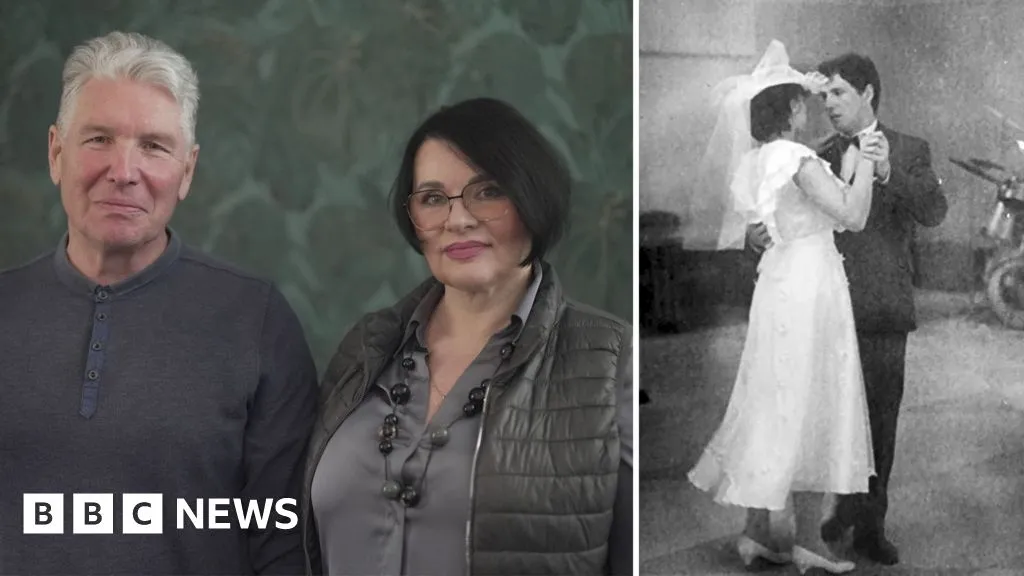
But on the morning of 26 April 1986, Serhiy remembers waking around 6am, full of excitement, to find his wedding day had dawned gloriously sunny.He had errands to do - bed linen to take to a friend's apartment where he and Iryna planned to sleep that night, and flowers to buy.Sovfoto/Universal Images Group/ShutterstockWorkers at the Chernobyl-nuclear-power-plant" class="entity-link entity-location" data-entity-id="77937" data-entity-type="location">Chernobyl Nuclear Power Plant pictured in 1983He says he saw soldiers in gas masks outside, and men washing the street with a foamy solution. Some men he knew from his work at the nuclear plant told him they had been called in urgently because "something happened", but they did not know what.As he looked out from the friend's high-rise apartment, he spotted smoke rising from reactor four.It would later become clear that firefighters and power plant workers had spent the night risking lethal doses of radiation to tackle a huge toxic blaze."I felt a bit anxious," he says. Drawing on his training, he took some fabric, wet it and put it across the apartment entrance as a precaution to catch radioactive dust, he adds.He then rushed to the market. Unusually for a Saturday morning, it was deserted, so he picked five tulips for the bouquet.Iryna, who was staying with her mother in the family's apartment, says the phone kept ringing overnight. Her mother sounded "alarmed", she says, by neighbours calling to say "something terrible" had happened. But there was little detail.Information was strictly controlled in the Soviet Union. They turned on the radio, but there was no mention of any incident.In the morning, her mother rang the authorities: "They told her not to panic, all planned events in the city should go ahead."Officially, everything carried on as usual. Children were sent to school.SuppliedIryna and Serhiy describe feeling tense and uncertain during their weddingViewers in the UK can watch What Happened at Chernobyl at 20:30 on Monday 20 April on BBC One, and on Iplayer from 06:00.The Last Dance Floor in Chernobyl podcast, telling the story of a wedding against the backdrop of disaster and a much-loved disco suddenly consigned to history, will be available here.Later in the day, the bride, groom and guests drove in a line of cars to the Palace of Culture, known for hosting both ceremonial events and popular discos.They made their vows standing on a cloth embroidered with their names, then moved with their guests to a nearby café.But the wedding banquet felt "sad", not celebratory, says Serhiy. "Everyone understood that something had happened, but no one knew the details".For their first dance, they had practised a traditional waltz. But with the growing realisation that a tragedy was unfolding, "from the first steps we went out of rhythm", recalls Iryna. "We just hugged each other and moved in the hug."SuppliedConcern about what had happened overshadowed the couple's first danceThen - exhausted but finally man and wife - they returned to the friend's apartment.But, Serhiy says, in the early hours of Sunday morning, another friend knocked on the door, telling them to rush to an evacuation train, due to leave at 5am.The only extra clothing Iryna had with her was a flimsy dress for the second day of the celebrations, so she put her wedding dress back on to hurry back to her mother's apartment to change. Also, her shoes had given her blisters. "I was in a wedding dress and I was running barefoot through the puddles," says Iryna.It was still dark as they saw the glow of the collapsed reactor from the train. It was "as if you were looking into the eye of a volcano," says Serhiy.The official announcement, when it came, described the evacuation as "temporary".SERGEI SUPINSKY/AFP via Getty Images)Large numbers of "liquidators" were brought in to clear radioactive debrisExtreme radiation levels caused machines to break down, so some work had to be done by hand.Jaan Krinal and Rein Klaar were deployed from Estonia, then part of the Soviet Union, and were part of a group sent to clear debris from the roof of reactor three."You wore lead plates - one in front, one on your back, and one between your legs. It was heavy, 20kg or more," says Jaan."On your head: a standard Soviet construction helmet - goggles, gloves and a dosimeter [to measure radiation] in your pocket," he says.Rein recalls being sent to work in bursts of a single minute to limit their exposure. "Nobody could tell what was what… There was no time to think," he says.Rein Klaar (left) and Jaan Krinal were sent to work in short bursts on the roof of reactor threeAs the clean-up began, Iryna and Serhiy were staying with her grandmother, about 300km away in the Poltava region, east of Kyiv.A few days after they arrived, doctors monitoring the evacuees for radiation gave them unexpected news - Iryna was three months pregnant.She remembers weeping as she discovered doctors were warning that radiation exposure may have affected unborn babies, and advising women who had been exposed to have abortions: "I was scared to have a baby, and scared to have an abortion."But a sympathetic female doctor encouraged her to proceed with the pregnancy, and Iryna gave birth to a healthy girl, Katya. Decades on, she has become a mother herself and Serhiy and Iryna now have a 15-year-old granddaughter.SuppliedIryna discovered she was pregnant a few days after the evacuation, and gave birth to Katya later in 1986The couple feel the nuclear accident has affected their health, though this has not been confirmed by doctors.Iryna has had to have both knees replaced, and believes radiation may have weakened her bones. They think radiation may be a factor in a heart attack Serhiy had in 2016, a week after visiting his old home town, Pripyat.Jaan, who leads an organisation for Estonian former liquidators, says some have had health problems, but they have not seen "cancers everywhere" as they initially feared. He says in 1991, 51 Estonian liquidators died, including 17 who took their own lives.Nikolai, the turbine engineer, was married with two sons at the time of the accident. He returned to work at the plant and retired recently. His younger son joined Ukraine's military in the wake of Russia's full-scale invasion in 2022, but has been missing in action since September 2023.The Palace of Culture where the wedding took place is now abandoned and derelictThe nuclear plant itself needs constant monitoring and maintenance.A concrete sarcophagus over reactor four was completed in just seven months after the accident. But it became unstable and, in 2016, a new £1.3bn ($1.8bn) metal shield was rolled over the top to contain leaks.Radiation in much of the "exclusion zone" around the plant is now at levels low enough to be safe to visit for limited periods, but no one is allowed to live there legally. There are still hotspots with dangerously high levels of radiation, both in and near the destroyed reactor, and in places such as the "Red Forest", which was heavily contaminated.The buildings of Pripyat – once considered a beacon of youthful optimism and Soviet technology – now stand crumbling and abandoned, including the Palace of Culture where Serhiy and Iryna made their vows.Inside the new dome, the chimney of reactor four is a haunting ruin, coated with a crude grey concrete shell, under the shiny metal dome tall enough to house the Statue of Liberty.IAEA HANDOUT/EPA-EFE/REX/ShutterstockThe drone set the shield over reactor four on fire when it struck it in 2025In 2022, Russian forces rolled into the power plant complex in tanks, taking staff hostage for five weeks, laying mines and digging trenches.
SRCBBC News - World
LANGEN
LEANCenter
WORDS1 259
ENT8
SAT · 2026-04-18 · 23:05 GMTBRIEF NSR-2026-0419-70641
NSR-2026-0419-70641News Report·EN·Human Interest
Chernobyl's last wedding: The couple who married as a nuclear disaster unfolded
On April 26, 1986, Serhiy and Iryna proceeded with their wedding in Pripyat, Ukraine, near the Chernobyl Nuclear Power Plant, despite an unfolding disaster. Early that morning, Serhiy noticed unusual activity, including soldiers and street cleaning, and saw smoke rising from the reactor.
BBC News - WorldFiled 2026-04-18 · 23:05 GMTLean · CenterRead · 6 min
BBC News - WorldFIG 01
Reading time
6min
Word count
1 259words
Sources cited
2cited
Entities identified
8entities
Quality score
100%
§ 01
Briefing Summary
AI-generatedNEWSAR · AI
On April 26, 1986, Serhiy and Iryna proceeded with their wedding in Pripyat, Ukraine, near the Chernobyl Nuclear Power Plant, despite an unfolding disaster. Early that morning, Serhiy noticed unusual activity, including soldiers and street cleaning, and saw smoke rising from the reactor. While information was scarce due to Soviet control, rumors and concerned neighbors alerted Iryna's family to a potential incident. Authorities advised against panic and allowed scheduled events to continue. The wedding ceremony took place at the Palace of Culture, but the banquet was somber due to the uncertain situation and awareness of a potential catastrophe.
Confidence 0.90Sources 2Claims 5Entities 8
§ 02
Article analysis
Model · rule-basedFraming
Human Interest
Environmental
Tone
Mixed Tone
AI-assessed
CalmNeutralAlarmist
Factuality
0.70 / 1.00
Factual
LowHigh
Sources cited
2
Limited
FewMany
§ 03
Key claims
5 extracted01
Authorities told Iryna's mother not to panic and that all planned events should go ahead.
quoteIryna
Confidence
1.00
02
Serhiy and Iryna got married on April 26, 1986, the day of the Chernobyl disaster.
factualArticle
Confidence
1.00
03
Firefighters and power plant workers risked lethal doses of radiation to tackle the blaze.
factualArticle
Confidence
0.90
04
Information was strictly controlled in the Soviet Union at the time.
factualArticle
Confidence
0.90
05
Workers at the Chernobyl plant were called in urgently because 'something happened'.
quoteMen Serhiy knew from work
Confidence
0.90
§ 04
Full report
6 min read · 1 259 words§ 05
Entities
8 identifiedKey playerOppositionContextPositiveNeutralNegative
Organizations1
Locations4
§ 06
Keywords & salience
8 termschernobyl disaster
1.00
wedding
0.90
nuclear power plant
0.70
radiation
0.60
soviet union
0.60
information control
0.50
pripyat
0.40
reactor four
0.40
§ 07
Topic connections
Interactive graph No topic relationship data available yet. This graph will appear once topic relationships have been computed.