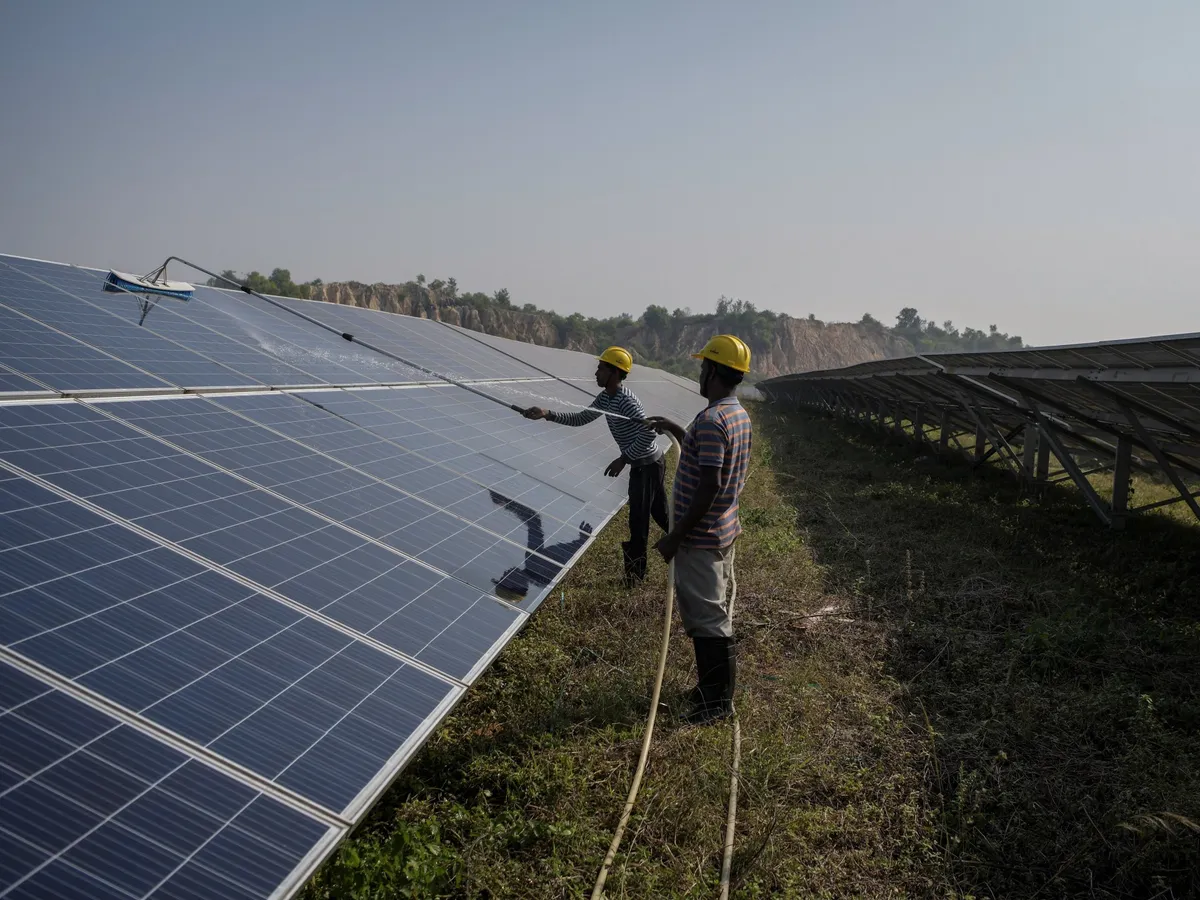
2025 was the beginning of the end for coal and gas power, says leading think tank, but the world is still warming too fast.Workers clean installed solar panels at a power plant in Surajpur, India [File: Avijit Ghosh/Reuters]Published On 21 Apr 2026Low-emissions energy sources met all new global electricity demand for the first time last year, leaving no room for fossil fuels to grow, the energy think tank Ember has found.Solar power led the charge, meeting three-quarters of the 849 TWh in new demand. Wind power met almost all the rest.Recommended Stories list of 3 itemslist 1 of 3How Pakistan’s solar boom is shielding it from worst of Iran war crisislist 2 of 3Oil prices surge amid mixed signals on US-Iran peace talkslist 3 of 3Renewables muscle fossil fuels out of EU electricity market, says researchend of listAll low-emissions sources, which also include biofuels – generated from decaying agricultural and food waste – hydro-electricity and nuclear power, provided a record 42.6 percent of the 31,779 TWh of electricity the world consumed in 2025, said Ember.Fossil fuels provided the majority, but Ember believes 2025 marked a turning point after which their share will shrink.“Clean power deployment is now at such a high level that it can structurally meet the increase in demand,” Ember’s senior energy and climate data analyst Nicolas Fulghum told Al Jazeera. “In the next few years, we expect it to meet all the growth in electricity demand and start to push for a decline in fossil generation.”By about 2035, Ember expects fossil fuels’ share of the electricity market to have dropped by 10-20 percent, losing its market dominance to clean energy.Not everyone is convinced.“In an average year, if clean resources are sufficient to meet extra demand for electricity, that doesn’t establish that this is going to be a permanent state,” said Rahmat Poudineh, head of electricity research at the Oxford Institute for Energy Studies (OIES).“If you want to establish a trend, it needs to prove in extreme conditions, in cold winters, hot summers, because the system is designed to meet peak demand, not average demand,” he told Al Jazeera.Ember said 2025 was not a year of extreme demand growth – 2.8 percent, in line with the average during the past decade.It acknowledged, too, that it expected 2024 to be the turning point, but a summer of record heat drove enormous demand for air conditioning, allowing fossil fuels to grow as well as renewables.Ember, however, pointed out that the world has outperformed expectations as it rises to meet an unprecedented set of energy challenges.Russia’s invasion of Ukraine in 2022, for example, led to annual 5 percent increases in the rollout of renewable energy in Europe.That meant Europe produced 71 percent of its electricity from clean sources last year.Others seem to be following suit.Last year’s global tipping point was reached because China and India – two of the world’s biggest emitters – scaled back fossil-generated electricity, the first time this century they have done so together.The International Energy Agency, an intergovernmental think tank, also found on Monday that oil and gas demand slowed in 2025 compared with 2024 – not just in electricity generation but in the overall energy mix.The current war threatening the Gulf may further lower demand for fossil fuels, if governments heed the International Monetary Fund’s advice to shield only the most vulnerable households from price rises or risk inflation.“2022 was a turning point for Europe … We’re now seeing the same thing again but for a much larger group of countries,” said Fulghum.The Centre for Research on Energy and Clean Air, a think tank based in Helsinki, found that fossil electricity fell in March, the first month of the closure of the Strait of Hormuz, because gas-fired electricity was replaced by renewables rather than coal, which also fell.And Ember points out that growth in renewables is accelerating in this century. The past decade has seen 81 percent of all wind and solar generation growth since 2000, versus 27 percent of fossil fuel growth.Some hydrocarbon analysts insist that repeated shocks in the fossil fuel market will not render it obsolete.“Renewables can meet new demand, but they cannot yet guarantee stability without flexible capacity storage and stronger grids,” said Yannis Bassias, a hydrocarbon industry veteran and consultant at Amphore Energy.“The Gulf crisis reveals that high prices do not eliminate the technical need for gas in power systems,” he told Al Jazeera, citing the continued use of coal and gas for baseload electricity. “The dependence remains structural in Europe, Japan and Korea, where imported LNG is essential for system stability.”The OIES is less certain of that. “Since the 1970s, these fossil fuel shocks played a major role in changing the direction of energy policy,” said Poudineh, “and this one has a high possibility [of doing the same], but we still don’t know 100 percent.”Clean energy’s march, though impressive, is still not enough to limit global warming to 1.5 degrees Celsius (2.7 degrees Fahrenheit), the goal 196 countries set themselves at the Paris Agreement a decade ago. For that to happen, fossil-generated electricity would have to drop by 25 percent by 2030, the International Energy Agency has said, not 10-20 percent by 2035, which is Ember’s current prediction.Still, Ember found that emissions per average kilowatt hour fell to 458g of CO2-equivalent in 2025, down from 543g/CO2e a decade ago. The IEA believes it will fall to about 400g next year.The IEA points out that overall emissions growth of 0.4 percent is well below economic growth of 3.1 percent in 2025, and says the economy is decoupling from CO2.Last year, the world pumped 38.4bn tonnes of CO2 into the atmosphere, said the IEA – but had solar and wind power not grown, said Ember, that figure would be 4 billion tonnes higher.
SRCAl Jazeera
LANGEN
LEANCenter
WORDS961
ENT5
TUE · 2026-04-21 · 10:11 GMTBRIEF NSR-2026-0421-71209
NSR-2026-0421-71209News Report·EN·Environmental
Clean electricity meets all new demand, curbing fossil fuels, says Ember
The energy think tank Ember reported that low-emissions energy sources met all new global electricity demand for the first time in 2025, leaving no room for fossil fuels to grow. Solar power accounted for three-quarters of the 849 TWh in new demand, while wind power met almost all the rest.
John T PsaropoulosAl JazeeraFiled 2026-04-21 · 10:11 GMTLean · CenterRead · 4 min
Al JazeeraFIG 01
Reading time
4min
Word count
961words
Sources cited
4cited
Entities identified
5entities
Quality score
100%
§ 01
Briefing Summary
AI-generatedNEWSAR · AI
The energy think tank Ember reported that low-emissions energy sources met all new global electricity demand for the first time in 2025, leaving no room for fossil fuels to grow. Solar power accounted for three-quarters of the 849 TWh in new demand, while wind power met almost all the rest. This marked a turning point, with clean power deployment now able to meet increased demand. By 2035, Ember expects fossil fuels' share of the electricity market to have dropped by 10-20 percent. The report suggests that 2025 was not an extreme year for demand growth, but rather a normal one. This shift is attributed to the increasing capacity of low-emissions sources to meet growing energy needs.
Confidence 0.90Sources 4Claims 3Entities 5
§ 02
Article analysis
Model · rule-basedFraming
Environmental
Tone
Measured
AI-assessed
CalmNeutralAlarmist
Factuality
0.80 / 1.00
Factual
LowHigh
Sources cited
4
Well sourced
FewMany
§ 03
Key claims
3 extracted01
Solar power led the charge, meeting three-quarters of the 849 TWh in new demand.
statisticEmber
Confidence
1.00
02
Low-emissions energy sources met all new global electricity demand for the first time last year, leaving no room for fossil fuels to grow.
factualEmber
Confidence
1.00
03
Fossil fuels provided the majority of electricity, but Ember believes 2025 marked a turning point after which their share will shrink.
prediction
Confidence
0.80
§ 04
Full report
4 min read · 961 words§ 05
Entities
5 identifiedKey playerOppositionContextPositiveNeutralNegative
Locations1
§ 06
Keywords & salience
10 termsclean electricity
0.80
low-emissions energy
0.80
climate change
0.80
electricity demand
0.70
fossil fuels
0.70
solar power
0.60
hydro-electricity
0.60
biofuels
0.50
wind power
0.50
nuclear power
0.40
§ 07
Topic connections
Interactive graph No topic relationship data available yet. This graph will appear once topic relationships have been computed.