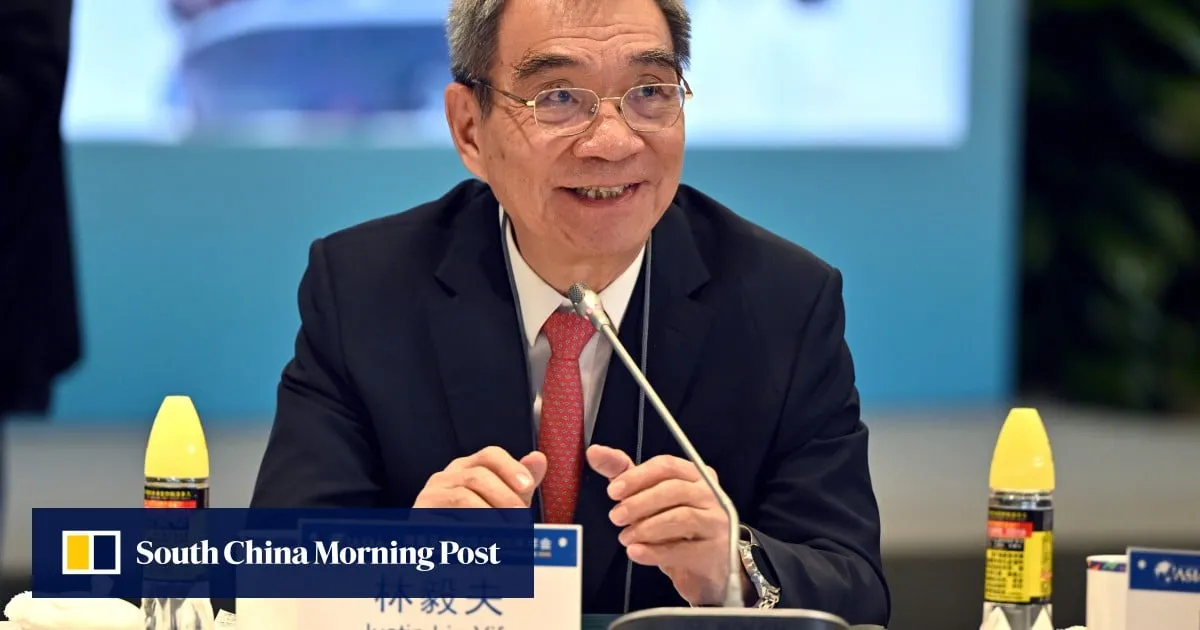
The West’s narrative of Chinese “overcapacity” is a double standard, said a former chief economist of the World Bank as he urged advanced economies to draw on “Eastern wisdom” rather than protectionism to navigate the rise of hi-tech competition.Justin Lin Yifu, a prominent advocate of Beijing’s industrial policy, dismissed claims that China’s auto-export surge was a sign of industrial imbalance. Speaking at Hong Kong Chu Hai College, Lin drew a contrast with Germany to expose a logical inconsistency in the current Western rhetoric.“[Western countries] say China became the world’s largest car exporter because of overcapacity, but if we look at which country has the highest share of auto exports – it is Germany,” Lin said during a question and answer session following his keynote speech at the college on Friday.He noted that Germany exports about 4 million vehicles a year, accounting for roughly 80 per cent of its total production. In contrast, he said, China exports around 7 million vehicles, representing about 20 per cent of its output, with the rest absorbed domestically.“If Germany’s ratio is taken as the benchmark, then China would be seen as having ‘undercapacity’, not overcapacity,” said Lin, who is now dean of the Institute of New Structural Economics at Peking University.Lin’s remarks underscore the persistent debate over China’s industrial policies, which he has championed for decades. While these state-backed efforts have cemented China’s dominance in green technology and other fields, they have also fuelled accusations of “overcapacity” and dumping from major trading partners such as the United States and the European Union.“A major issue for developing nations is that we often fall into the trap of adopting [Western] rhetoric,” he said, slamming the “overcapacity” talking point as a “complete double standard”.While China admitted that “overcapacity in some industries” was a problem during a high-level conference in 2023 – and frequent mention has been made of neijuan, the excessive industrial competition that can lead to redundancies in supply chains – officials and state media have refuted charges from the US and EU that Beijing was weaponising its vast manufacturing power to disrupt global trade.I think Western countries should learn from the wisdom of Eastern countries
SRCSouth China Morning Post
LANGEN
LEANCenter-Right
WORDS359
ENT7
TUE · 2026-04-21 · 13:00 GMTBRIEF NSR-2026-0421-71295
NSR-2026-0421-71295News Report·EN·Economic Impact
Economist Justin Lin urges West to adopt ‘Eastern wisdom’ as China moves up value chain
Economist Justin Lin Yifu, former World Bank chief economist, is urging Western nations to reconsider their narrative of Chinese "overcapacity" and instead adopt "Eastern wisdom" to address rising competition. Speaking at Hong Kong Chu Hai College, Lin refuted claims that China's increased auto exports signify industrial imbalance, highlighting Germany's higher export ratio as a benchmark.
Sylvia MaSouth China Morning PostFiled 2026-04-21 · 13:00 GMTLean · Center-RightRead · 2 min
South China Morning PostFIG 01
Reading time
2min
Word count
359words
Sources cited
1cited
Entities identified
7entities
Quality score
100%
§ 01
Briefing Summary
AI-generatedNEWSAR · AI
Economist Justin Lin Yifu, former World Bank chief economist, is urging Western nations to reconsider their narrative of Chinese "overcapacity" and instead adopt "Eastern wisdom" to address rising competition. Speaking at Hong Kong Chu Hai College, Lin refuted claims that China's increased auto exports signify industrial imbalance, highlighting Germany's higher export ratio as a benchmark. He argues that the "overcapacity" accusation is a double standard, as China consumes a larger portion of its own production compared to Germany. Lin, a long-time advocate of China's industrial policies, believes developing nations often fall into the trap of adopting Western rhetoric. His remarks come amid ongoing debate over China's state-backed industrial efforts and accusations of "dumping" from the US and EU.
Confidence 0.90Sources 1Claims 3Entities 7
§ 02
Article analysis
Model · rule-basedFraming
Economic Impact
Tone
Measured
AI-assessed
CalmNeutralAlarmist
Factuality
0.80 / 1.00
Factual
LowHigh
Sources cited
1
Limited
FewMany
§ 03
Key claims
3 extracted01
Germany exports about 4 million vehicles a year, accounting for roughly 80 per cent of its total production.
factualJustin Lin Yifu
Confidence
1.00
02
[Western countries] say China became the world’s largest car exporter because of overcapacity, but if we look at which country has the highest share of auto exports – it is Germany.
quoteJustin Lin Yifu
Confidence
1.00
03
China exports around 7 million vehicles, representing about 20 per cent of its output, with the rest absorbed domestically.
factualJustin Lin Yifu
Confidence
1.00
§ 04
Full report
2 min read · 359 words§ 05
Entities
7 identifiedKey playerOppositionContextPositiveNeutralNegative
§ 06
Keywords & salience
9 termsovercapacity
1.00
china
0.90
industrial policy
0.80
eastern wisdom
0.70
auto exports
0.60
trade
0.60
double standard
0.50
protectionism
0.50
western rhetoric
0.40
§ 07
Topic connections
Interactive graph Network visualization showing 51 related topics
View Full Graph Person Organization Location Event|Click node to navigate|Edge numbers = shared articles