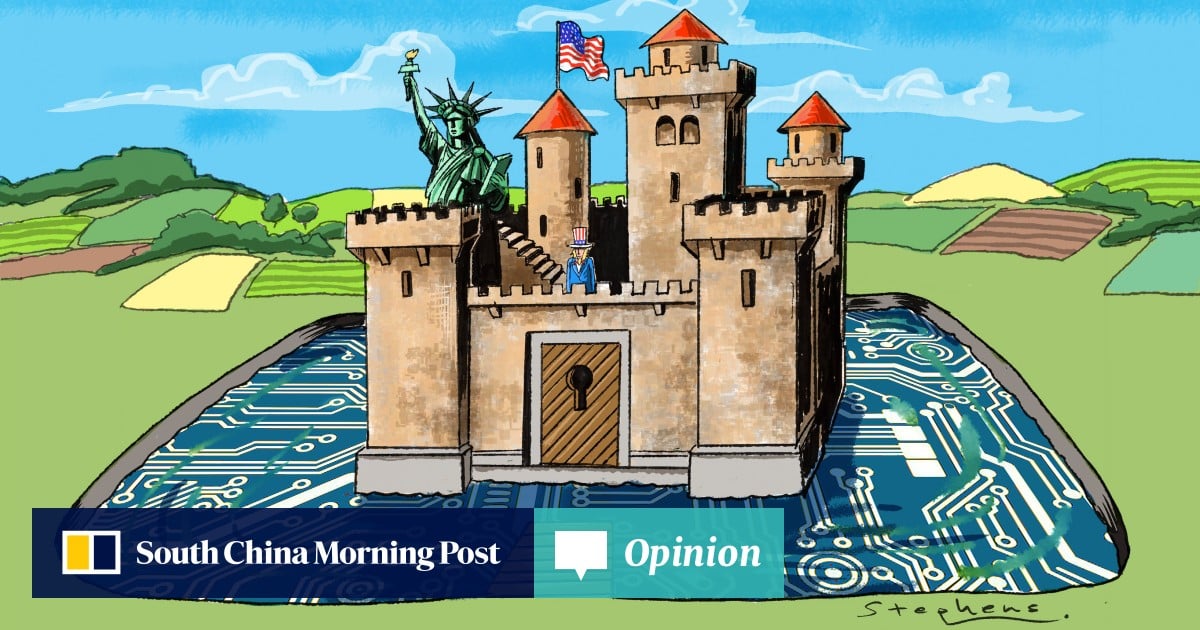
The China" class="entity-link entity-organization" data-entity-id="120172" data-entity-type="organization">United States House Select Committee on China recently released a report on artificial intelligence. Titled “Buy What It Can, Steal What It Must: China’s Campaign to Acquire Frontier AI Capabilities”, it captures a hardening view in Washington that Beijing’s artificial intelligence rise is closely tied to both market access and security concerns.Whether fully substantiated or not, such beliefs are increasingly shaping the policy lens through which technology competition between the two countries is understood in the US – less as a matter of innovation, and more as one of national security.Against this backdrop, recent controversy over model distillation involving leading US firms – including OpenAI, Anthropic and Alphabet – has drawn a great deal of attention. The coordination among these companies, coming soon after Washington’s push to build a “full-stack AI export” system, suggests that what appears to be a technical dispute is in fact part of a broader shift in how AI is governed – and contested – globally.
SRCSouth China Morning Post
LANGEN
LEANCenter-Right
WORDS161
ENT7
TUE · 2026-04-21 · 21:30 GMTBRIEF NSR-2026-0421-71374
NSR-2026-0421-71374Analysis·EN·National Security
US-China AI race must strike a balance between security and openness
The US House Select Committee on China recently released a report on artificial intelligence, titled "Buy What It Can, Steal What It Must: China's Campaign to Acquire Frontier AI Capabilities". The report highlights concerns in Washington that Beijing's rise in AI capabilities is linked to both market access and security issues.
Xiao QianSouth China Morning PostFiled 2026-04-21 · 21:30 GMTLean · Center-RightRead · 1 min
South China Morning PostFIG 01
Reading time
1min
Word count
161words
Sources cited
1cited
Entities identified
7entities
Quality score
100%
§ 01
Briefing Summary
AI-generatedNEWSAR · AI
The US House Select Committee on China recently released a report on artificial intelligence, titled "Buy What It Can, Steal What It Must: China's Campaign to Acquire Frontier AI Capabilities". The report highlights concerns in Washington that Beijing's rise in AI capabilities is linked to both market access and security issues. This shift in perspective is shaping US policy towards technology competition with China, viewing it as a matter of national security rather than innovation. Recent controversy over model distillation among leading US firms, including OpenAI and Alphabet, has drawn attention. The coordination among these companies suggests that the dispute may be part of a broader global governance shift for AI. The report underscores the growing importance of balancing security and openness in the US-China AI race.
Confidence 0.90Sources 1Claims 5Entities 7
§ 02
Article analysis
Model · rule-basedFraming
National Security
Political Strategy
Tone
Measured
AI-assessed
CalmNeutralAlarmist
Factuality
0.60 / 1.00
Mixed
LowHigh
Sources cited
1
Limited
FewMany
§ 03
Key claims
5 extracted01
Recent controversy over model distillation involving US firms has drawn attention.
factual
Confidence
1.00
02
The report is titled “Buy What It Can, Steal What It Must: China’s Campaign to Acquire Frontier AI Capabilities”.
factual
Confidence
1.00
03
The US House Select Committee on China released a report on artificial intelligence.
factual
Confidence
1.00
04
Washington increasingly views China's AI rise as tied to market access and security concerns.
factual
Confidence
0.90
05
Coordination among US AI companies suggests a shift in how AI is governed globally.
prediction
Confidence
0.70
§ 04
Full report
1 min read · 161 words§ 05
Entities
7 identifiedKey playerOppositionContextPositiveNeutralNegative
Organizations4
§ 06
Keywords & salience
10 termsus-china ai race
1.00
artificial intelligence
0.90
national security
0.80
technology competition
0.70
model distillation
0.60
ai governance
0.60
export controls
0.50
market access
0.50
openai
0.40
anthropic
0.40
§ 07
Topic connections
Interactive graph Network visualization showing 51 related topics
View Full Graph Person Organization Location Event|Click node to navigate|Edge numbers = shared articles