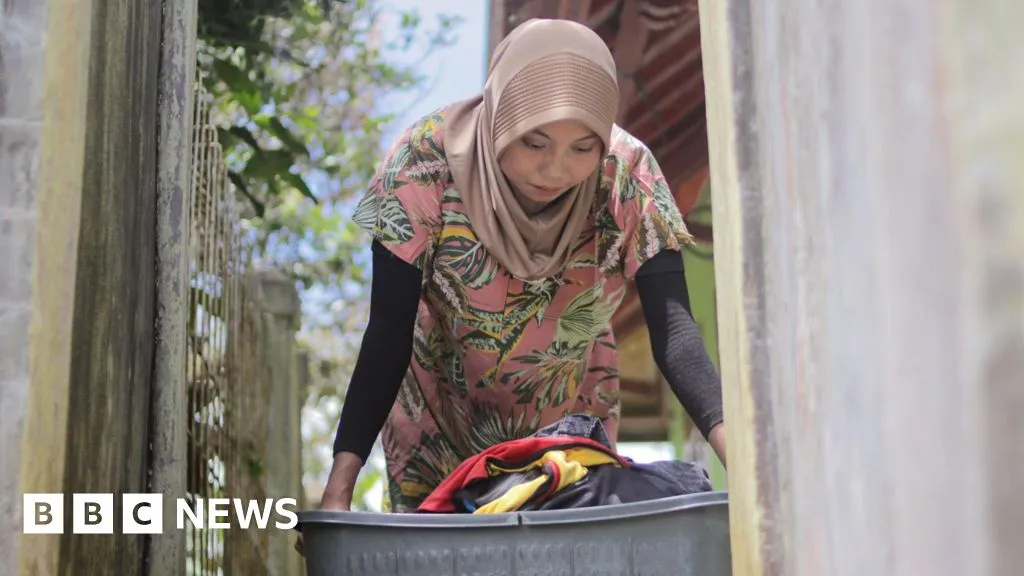
Indonesia's parliament has passed a law to protect the rights of domestic workers, more than 20 years after it was first introduced. The country is home to some 4.2 million domestic workers - of which almost 90% are women. They were previously not legally classified as workers. They will now be entitled to health insurance, rest days and pensions. Placement agencies will also no longer be allowed to implement wage deductions, and it will be illegal to hire children under the age of 18 as domestic workers.Some wept upon hearing that the law was passed, with one worker saying it was the culmination of a "22-year struggle to gain protection". The Domestic Workers Protection Law was first introduced in 2004 but repeatedly ran up against roadblocks. Discussions on the bill were stopped for years before being brought up again in parliament in 2020. Regulators will now have one year to draft detailed implementation policies.Despite their critical role in the economy, millions of Indonesia's domestic workers were unprotected under local labour laws. Many were employed informally without any legal contract. Some work long hours for little pay and some enter the profession from as young as 12. "It feels like a dream," Ajeng Astuti, one of the domestic workers told BBC Indonesian. "This is our 22-year struggle as marginalised women to gain protection."
SRCBBC News - World
LANGEN
LEANCenter
WORDS222
ENT5
WED · 2026-04-22 · 02:55 GMTBRIEF NSR-2026-0422-71384
NSR-2026-0422-71384News Report·EN·Human Rights
Domestic workers legally recognised in Indonesia after '22-year struggle'
After a 22-year struggle, Indonesia's parliament has passed a law legally recognizing and protecting the rights of its 4.2 million domestic workers, the majority of whom are women. Previously excluded from labor laws, domestic workers will now be entitled to health insurance, rest days, and pensions.
BBC News - WorldFiled 2026-04-22 · 02:55 GMTLean · CenterRead · 1 min
BBC News - WorldFIG 01
Reading time
1min
Word count
222words
Sources cited
2cited
Entities identified
5entities
Quality score
100%
§ 01
Briefing Summary
AI-generatedNEWSAR · AI
After a 22-year struggle, Indonesia's parliament has passed a law legally recognizing and protecting the rights of its 4.2 million domestic workers, the majority of whom are women. Previously excluded from labor laws, domestic workers will now be entitled to health insurance, rest days, and pensions. The new law also prohibits wage deductions by placement agencies and bans the employment of children under 18 as domestic workers. First introduced in 2004, the Domestic Workers Protection Law faced numerous obstacles before being revived in 2020. Regulators have one year to develop detailed implementation policies for the law, which aims to address the long hours, low pay, and lack of legal contracts faced by many domestic workers in Indonesia.
Confidence 0.90Sources 2Claims 5Entities 5
§ 02
Article analysis
Model · rule-basedFraming
Human Rights
Social Justice
Tone
Measured
AI-assessed
CalmNeutralAlarmist
Factuality
0.80 / 1.00
Factual
LowHigh
Sources cited
2
Limited
FewMany
§ 03
Key claims
5 extracted01
This is our 22-year struggle as marginalised women to gain protection.
quoteAjeng Astuti
Confidence
1.00
02
They will now be entitled to health insurance, rest days and pensions.
factual
Confidence
1.00
03
The country is home to some 4.2 million domestic workers - of which almost 90% are women.
statistic
Confidence
1.00
04
Indonesia's parliament has passed a law to protect the rights of domestic workers.
factual
Confidence
1.00
05
The Domestic Workers Protection Law was first introduced in 2004.
factual
Confidence
1.00
§ 04
Full report
1 min read · 222 words§ 05
Entities
5 identifiedKey playerOppositionContextPositiveNeutralNegative
Locations1
§ 06
Keywords & salience
8 termsdomestic workers
1.00
indonesia
0.90
workers' rights
0.80
labor law
0.70
legal protection
0.70
child labor
0.60
wage deductions
0.50
health insurance
0.50
§ 07
Topic connections
Interactive graph Network visualization showing 51 related topics
View Full Graph Person Organization Location Event|Click node to navigate|Edge numbers = shared articles