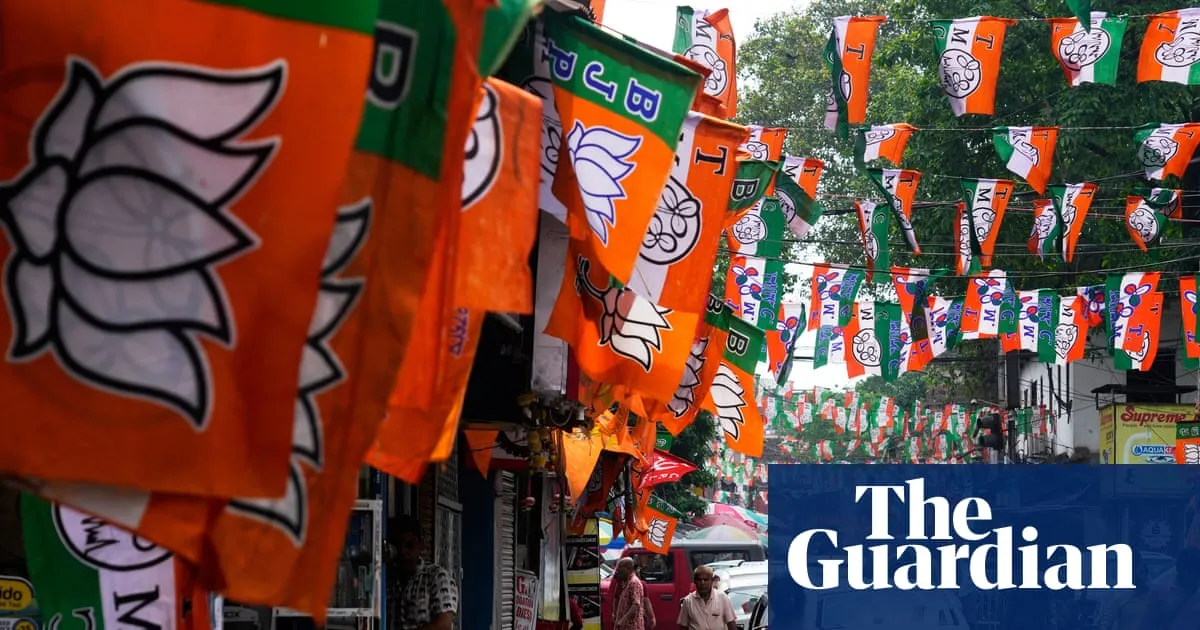
Millions of people in the Indian state of West Bengal have been stripped of their vote ahead of a critical state election this week, after a controversial electoral revision described by critics as a “bloodless political genocide” and mass disenfranchisement of minorities.In West Bengal, a total of 9.1 million names have been deleted from the register, more than 10% of the electorate. While many were dead or duplicates, about 2.7 million people have challenged their expulsions, but still been removed.The process of revising the electoral roll, known as Special Intensive Revision (SIR), has been taking place in states and territories across India, justified by the Narendra Modi government as a way to stop “infiltrators” – a pejorative term largely referring to illegal Muslim Bangladeshi immigrants – from voting.The divisive exercise by the central Bharatiya Janata party (BJP) government to “purify” the electoral roll – in the words of home minister Amit Shah – has led to a chorus of fury.The drawing up of a new electoral register has been carried out at unprecedented speed, ahead of the West Bengal state elections which will begin on Thursday. The BJP, led by prime minister Modi, is hoping to seize power from Trinamool Congress (TMC), the party that has ruled the state for 15 years.“What has happened in Bengal is a constitutional crime. It is a crime against the people of India, against the people of Bengal,” said Sagarika Ghose, an MP for TMC.“This will go down as a scandal in the history of post-independence India,” added Ghose. “One person, one vote is a great right given to the Indian people by the Constitution. However poor you are, however helpless you are, you have that right to vote. But that has been snatched away.”People stand in line to cast their votes at a polling station. Photograph: Sivaram Venkitasubramanian/NurPhoto/ShutterstockAccording to experts and organisations, Muslims and other religious minorities have been disproportionately expunged from the electoral roll in West Bengal, leading to allegations of deliberate targeting and persecution.“As per our research, religion has been the biggest differentiator,” said Sabir Ahamed, who leads Sabar institute which has been closely monitoring and documenting the cases based on official data. “Muslims have been disproportionately affected.”While the BJP has succeeded in gaining hegemony over most Indian state governments, it has failed to gain a foothold in West Bengal, in part because of it does not have the backing of state’s sizeable Muslim population, who are wary of their Hindu nationalist agenda.In some Muslim-majority constituencies, almost half the voters have been deleted, including those who have documents to show they are born and bred Indian citizens and either they, or their parents, were on the 2002 voter roll, the cut off point for voter eligibility.‘All those removed here are Muslims’In Sherpur village of Murshidabad district, near the Bangladesh border, among those deleted was 36-year-old Jaber Ali, who was one of the officials tasked with collecting documents for the voter roll revision.Over four months, Ali visited more than 700 households, checked documents and uploaded records late into the night. The work was relentless, he said. “I worked 12 hours in the field, then spent most nights on the computer. I barely slept.”But when the revised rolls were published in late February, Ali said most of those he verified were missing, including his own name. “People started calling me, saying I hadn’t done my job,” he said. “The irony is my own name, and my brothers’ were also removed.”Above: Mamata Banerjee, chief minister of West Bengal and leader of the All India Trinamool Congress, participates in a roadshow from on 18 April.Right: Bharatiya Janata Party (BJP) activists march during an election road show in Kolkata.Ali said there was now “panic” in the village, as lifelong Indian citizens feared being treated as illegal immigrants from Bangladesh and pushed out of the country. He believes the deletions in his area followed a pattern. “All those removed here are Muslims,” he said. “People feel they are being targeted and stripped of their voting rights.”Critics have legally challenged SIR as unconstitutional and described it an effort to manipulate and rig the electoral system to benefit the BJP. Political opposition and legal experts said the election commission, which is overseeing the exercise, can no longer be viewed as an independent and neutral body.SY Quraishi, the former election commissioner of India, was among those who raised concerns over the justification and the processes of SIR, both in West Bengal and other states, and said it raised serious questions over the election commission’s role.“I feel very awkward and hesitant about commenting on my successor, but as a citizen, I see what is happening and I must speak out,” he said. “The SIR is completely unnecessary, it is designed to harass. Administratively it is a disaster and the intentions are not noble.He added: “It took us 30 years to achieve 99% accuracy in the rolls. They expect to exceed this in three months. Why this frantic rush if the main objective is accuracy?”Quraishi was among those who raised concern over the election commission’s decision to deploy a new AI-assisted algorithm in West Bengal to flag so-called “logical discrepancies” in voter data, which led to millions of Bengalis having to prove their citizenship – including Indian Nobel laureate Amartya Sen – with many ending up on the list of 2.7 million deleted voters.Experts say the algorithm failed to take into account key cultural issues, including that there is no standard form of transcribing Bengali names into English script, and that Bengali surnames have been adapted over generations, leading to small spelling inconsistencies between family documents. It also flagged parents under 16 and more than five siblings as a “logical discrepancy” even though both were common in older generations.Quraishi said in his time, the election commission had been highly aware and sensitive to this. “If software is being used to delete voters on the basis of these minor discrepancies, then is it a weapon against citizens rights and not fit for purpose,” he said.Many of those who had spent their lives dedicated to serving the Indian state are among those suddenly disenfranchised. Sixty-two-year-old Senarul Haque, who retired two years ago from India’s paramilitary Central Reserve Police Force after 35 years of service, found his name missing from the voter rolls, even as his wife and two sons remained listed.Queues to cast votes at a polling centre during the Assam state election in early April. Photograph: Anupam Nath/AP“It is deeply disappointing. I served the country in some of the most difficult areas. Then when my name was missing from the voter list, I submitted my documents properly, and still my name is missing,” Haque said.“I have been on election duty across the country. Now I am being denied the right to vote, and no one is answerable. This feels like a mockery of the system. How can so many people be erased from the rolls just ahead of an election?” he added.While tribunals are ongoing for voters to challenge the removal of their vote, only a small number have taken place before voting begins in the state elections on Thursday. Himani Roy, 55, a government school teacher in Howrah district, is among those who has not had her case heard in time, meaning she will not be allowed to vote for the first time in her lifetime. Ironically, her name is still down to be a polling officer.“I met the concerned officials and they have no clear answer why my name is missing,” said Roy. “When we talk about democratic backsliding, this is what it looks like. These are very bad days for democracy and our nation’s independent institutions.”More than a dozen national and state BJP spokespeople declined to comment on the allegations when contacted by the Guardian.However, in past comments, BJP home minister Amit Shah has described SIR in states such as West Bengal as “not only necessary for the country’s security”, but also essential to “prevent infiltration in order to protect the country’s democratic system from being polluted”.Parakala Prabhakar, an Indian economist and author, emphasised that swathes of citizens being unilaterally removed from the electoral roll had grave implications that went far beyond just state elections.“After this is completed, it will create two classes of Indians: those who are allowed full participation in political society and the political process – and those who are shut out,” said Prabhakar. “This is about killing the citizenship of minorities. It is a bloodless political genocide.”
SRCThe Guardian - World News
LANGEN
LEANCenter-Left
WORDS1 411
ENT10
WED · 2026-04-22 · 04:13 GMTBRIEF NSR-2026-0422-71427
NSR-2026-0422-71427News Report·EN·Human Rights
Millions in India stripped of vote before critical state election, as government seeks to ‘purify’ electoral roll
Ahead of critical state elections in West Bengal, India, 9.1 million people have been removed from the electoral roll following a Special Intensive Revision (SIR) process. The Narendra Modi government justifies the revision as a means to prevent "infiltrators," often referring to illegal Muslim Bangladeshi immigrants, from voting.
Hannah Ellis-Petersen and Aakash Hassan in DelhiThe Guardian - World NewsFiled 2026-04-22 · 04:13 GMTLean · Center-LeftRead · 6 min
The Guardian - World NewsFIG 01
Reading time
6min
Word count
1 411words
Sources cited
4cited
Entities identified
10entities
Quality score
100%
§ 01
Briefing Summary
AI-generatedNEWSAR · AI
Ahead of critical state elections in West Bengal, India, 9.1 million people have been removed from the electoral roll following a Special Intensive Revision (SIR) process. The Narendra Modi government justifies the revision as a means to prevent "infiltrators," often referring to illegal Muslim Bangladeshi immigrants, from voting. Critics allege the BJP government is deliberately targeting Muslims and other religious minorities in an effort to "purify" the electoral roll. While some removals were due to death or duplicates, 2.7 million people challenged their expulsions. The BJP hopes to win power from the Trinamool Congress (TMC), which has governed the state for 15 years, in the upcoming elections. The TMC has condemned the revision as a "constitutional crime" and mass disenfranchisement.
Confidence 0.90Sources 4Claims 4Entities 10
§ 02
Article analysis
Model · rule-basedFraming
Human Rights
Tone
Measured
AI-assessed
CalmNeutralAlarmist
Factuality
0.90 / 1.00
Factual
LowHigh
Sources cited
4
Well sourced
FewMany
§ 03
Key claims
4 extracted01
Almost half the voters in some Muslim-majority constituencies have been deleted, including those who have documents to show they are born and bred Indian citizens.
statisticThe article itself
Confidence
1.00
02
Muslims and other religious minorities have been disproportionately expunged from the electoral roll in West Bengal.
quoteSabir Ahamed, leader of Sabar institute
Confidence
1.00
03
About 2.7 million people have challenged their expulsions, but still been removed from the electoral roll.
factualThe article itself
Confidence
1.00
04
9.1 million names have been deleted from the register in West Bengal, more than 10% of the electorate.
statisticThe article itself
Confidence
1.00
§ 04
Full report
6 min read · 1 411 words§ 05
Entities
10 identifiedKey playerOppositionContextPositiveNeutralNegative
People4
Organizations3
§ 06
Keywords & salience
7 termselectoral roll revision
0.80
voter disenfranchisement
0.70
minority rights
0.60
bjp government
0.50
india election
0.50
west bengal election
0.40
electoral purging
0.40
§ 07
Topic connections
Interactive graph Network visualization showing 9 related topics
View Full Graph Person Organization Location Event|Click node to navigate|Edge numbers = shared articles