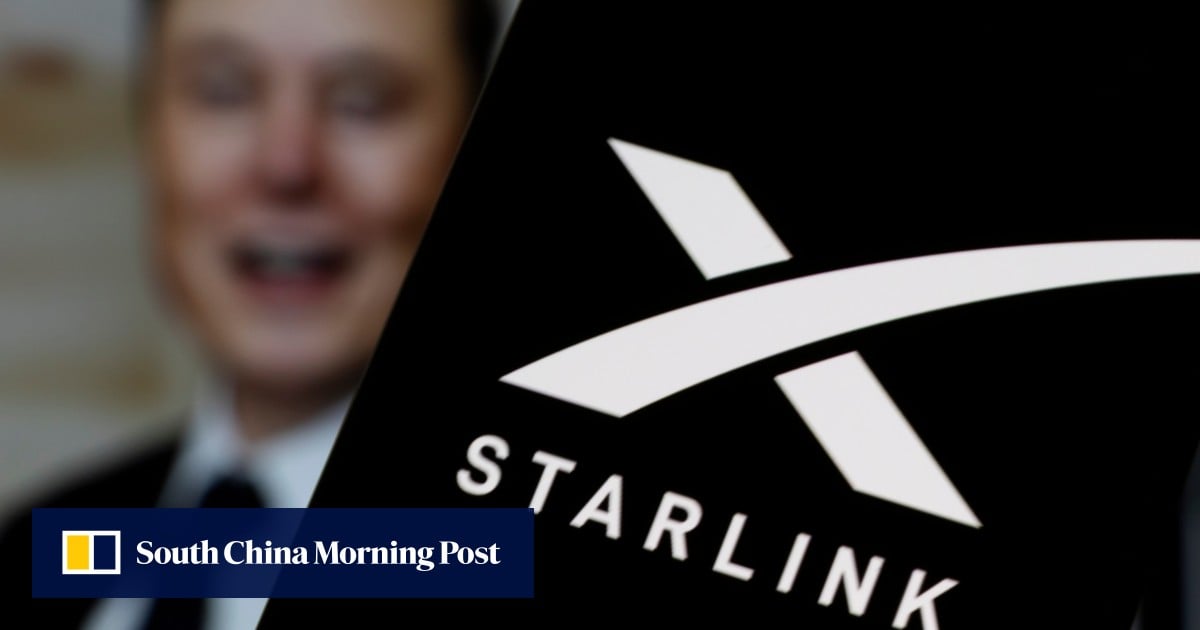
When US special forces raided Caracas and abducted president Nicolas Maduro and his wife in early January, the Venezuelan capital was hit by widespread power outages and communication blackouts.Yet, within hours of the attacks, connectivity began to return – not from paralysed ground infrastructure, but from space.Elon Musk’s Starlink, a subsidiary of SpaceX, activated communications services across Venezuela via its vast constellation of low Earth orbit (LEO) satellites on terminals residents acquired via informal channels.It was not merely a case of business operation, observers said, but an episode that underscored the disruptive potential and strategic implications of LEO satellite networks in future warfare and defence building.03:54The race for the moon’s south pole: can China beat Nasa’s 2028 deadline?The race for the moon’s south pole: can China beat Nasa’s 2028 deadline?For countries such as China, the growing role of LEO constellations as critical communications infrastructure during crises raises concerns – about information sovereignty, operational dependence, access to orbital resources and control over connectivity – as satellite networks are increasingly seen as a potential geopolitical game changer.LEO constellations typically comprise hundreds or thousands of satellites operating below 2,000km (1,250 miles), enabling faster data transmission and lower latency than traditional geostationary satellites positioned much farther away.Starlink’s deployment in Venezuela highlighted a “direct challenge to traditional telecommunications sovereignty”, according to an article published in the April issue of Aerospace Knowledge, a journal sponsored by a leading professional academic group, the Chinese Society of Aeronautics and Astronautics (CSAA).Venezuela was not an official Starlink market but the ability of a private company with US defence contracts to provide communications to another sovereign country without government approval showed how LEO constellations could bypass national regulation and directly project connectivity across borders, the article said.“What we are witnessing is the first large-scale stress test of information sovereignty in the space age,” it said.“Low Earth orbit constellations have evolved from a technological concept into a strategic weapon capable of reshaping a country’s communications landscape within 48 hours.”Venezuela is not the first conflict zone where Starlink has been deployed. The satellite service was rolled out in Ukraine in 2022 to replace internet and communication networks damaged by Russia’s invasion of the country, quickly becoming a critical tool for both civilian and military connectivity.Further ReadingWhile it became an important wartime asset for Kyiv, Russia also adopted the networks in its operations, although in February Musk reportedly denied it access, blunting Moscow’s advance.China’s pursuit of a proliferated LEO (pLEO) capability has become “more urgent” following Starlink-enabled operations by Ukrainian and Russian forces, according to Howard Wang, a political scientist at US think tank Rand.“The most important lesson that China is learning … is the resilience of a largely decentralised pLEO constellation bolstered by rapid reconstitution via affordable launch,” he said.Destroying a handful of satellites would have limited operational impact, while new satellites could be launched rapidly to replenish the network – a concept described as “swarm resilience”. This fundamentally changes the economics of space warfare and weakens traditional strategies aimed at disabling critical nodes.That resilience, Wang noted, challenged the People’s Liberation Army’s core operational concept of multi-domain precision warfare, which prioritised striking key nodes in an adversary’s network information system-of-systems, its military nervous system, to paralyse the enemy without the need to escalate to more destructive measures.It could also shake China’s long-held view that an attack on space assets guaranteed an easy win because, with the advent of Starlink, meaningful offensive effects might require riskier escalation, he said.China is accelerating its own constellation development – including the Guowang network and the Shanghai-government-backed Qianfan broadband network – and exploring options to counter Starlink, although Wang cautioned that “it’s not clear how successful either of these efforts will be”.As LEO satellites became deeply integrated into drone warfare, they might also introduce new vulnerabilities, including outages and dependence on private providers, warned Victoria Samson, chief director of space security and stability at the Secure World Foundation, a body aiming for peace in space.Several US Navy tests have been disrupted during Starlink outages, including one case in August that affected communications and temporarily interrupted operations, according to a Reuters report this month.While Starlink’s ability to provide connectivity in conflict zones has turned Musk into a geopolitical force, the CSAA article warned against “a new form of power” – the ability to grant or deny access to connectivity in real time, potentially creating strategic vulnerabilities when military operations depend on corporate decisions.This has prompted a number of governments to accelerate plans to develop domestic or regionally coordinated LEO constellations, most notably China and the European Union, to reduce reliance and bolster strategic autonomy.China could use its versions of Starlink as “soft power outreach” and make them available to potential allies or partners, Samson said.The CSAA article also highlighted the growing role of on-orbit computing. It noted that LEO satellites were beginning to evolve from communications relays into processing nodes capable of analysing data in real time.Such capabilities, once realised, could improve battlefield awareness by detecting troop movements or missile preparations, potentially compressing decision-making timelines, it said.“When artificial intelligence is integrated with low Earth orbit satellite constellations, we are facing an intelligent system capable of real-time global surveillance and autonomous decision-making, operating beyond the control of any single country,” the article said.It also warned of another layer of vulnerability: if adversaries gained on-orbit AI capabilities, they could manipulate data, causing commanders to act on distorted information rather than reality.It further warned of a growing “space land rush”, as countries and companies rapidly deploy constellations to secure orbital slots and spectrum resources under first-come, first-served rules. Once occupied, latecomers may have to rely on foreign-controlled networks.06:25Will Musk’s moon pivot put SpaceX on a collision course with China’s lunar ambitions?Will Musk’s moon pivot put SpaceX on a collision course with China’s lunar ambitions?Guowang and Qianfan – both aiming to deploy more than 10,000 internet satellites – have deployed around 300 active satellites combined, while there are already more than 10,000 active Starlink satellites.China “absolutely can catch up”, but the key bottleneck remains on price, reliability and speed of launch that would enable rapid reconstitution in LEO, Wang said.“That is in large part an innovation problem, not just a resource problem,” he said.“Whoever controls low Earth orbit will define the future world order,” the CSAA article said.“At present, the dominant position is held by Elon Musk. The outcome of this race will shape how power is distributed as humanity enters the era of digital civilisation.”
SRCSouth China Morning Post
LANGEN
LEANCenter-Right
WORDS1 074
ENT9
SAT · 2026-04-25 · 14:00 GMTBRIEF NSR-2026-0425-71590
NSR-2026-0425-71590Analysis·EN·National Security
Will the future world order be determined by who controls low Earth orbit?
The article discusses the growing strategic importance of Low Earth Orbit (LEO) satellite constellations, exemplified by Elon Musk's Starlink. During a crisis in Venezuela in early January, Starlink provided essential communications after ground infrastructure failed, bypassing national control and highlighting a challenge to telecommunications sovereignty.
Meredith ChenSouth China Morning PostFiled 2026-04-25 · 14:00 GMTLean · Center-RightRead · 5 min
South China Morning PostFIG 01
Reading time
5min
Word count
1 074words
Sources cited
1cited
Entities identified
9entities
Quality score
100%
§ 01
Briefing Summary
AI-generatedNEWSAR · AI
The article discusses the growing strategic importance of Low Earth Orbit (LEO) satellite constellations, exemplified by Elon Musk's Starlink. During a crisis in Venezuela in early January, Starlink provided essential communications after ground infrastructure failed, bypassing national control and highlighting a challenge to telecommunications sovereignty. LEO constellations, with their numerous satellites below 2,000km, offer faster data transmission and can reshape a country's communication landscape rapidly. This capability raises concerns for nations like China regarding information sovereignty, operational dependence, and control over orbital resources, suggesting LEO networks could become a significant factor in future warfare and global power dynamics.
Confidence 0.90Sources 1Claims 5Entities 9
§ 02
Article analysis
Model · rule-basedFraming
National Security
Technology
Tone
Mixed Tone
AI-assessed
CalmNeutralAlarmist
Factuality
0.70 / 1.00
Factual
LowHigh
Sources cited
1
Limited
FewMany
§ 03
Key claims
5 extracted01
Starlink was rolled out in Ukraine in 2022 to replace damaged internet networks.
factualnull
Confidence
0.90
02
Starlink activated communications services across Venezuela after widespread power outages.
factualnull
Confidence
0.90
03
China's pursuit of LEO capability has become more urgent following Starlink-enablement.
factualnull
Confidence
0.80
04
LEO constellations could bypass national regulation and directly project connectivity across borders.
quoteAerospace Knowledge journal
Confidence
0.80
05
Low Earth orbit constellations have evolved into a strategic weapon.
quoteAerospace Knowledge journal
Confidence
0.70
§ 04
Full report
5 min read · 1 074 words§ 05
Entities
9 identifiedKey playerOppositionContext
S
Starlink organization · Key Player
100
V
Venezuela location · Context
90
NM
Nicolás Maduro person · Key Player
80
S
SpaceX organization · Context
70
C
China location · Context
70
EM
Elon Musk person · Context
70
US
United States location · Context
70
C
Caracas location · Context
60
CS
Chinese Society of Aeronautics and Astronautics (CSAA) organization · Context
50
§ 06
Keywords & salience
10 termsleo satellite networks
1.00
low earth orbit
1.00
information sovereignty
0.90
starlink
0.80
connectivity
0.70
geopolitical
0.60
future warfare
0.50
strategic implications
0.50
national regulation
0.40
space age
0.40
§ 07
Topic connections
Interactive graph Network visualization showing 13 related topics
View Full Graph Person Organization Location Event|Click node to navigate|Edge numbers = shared articles