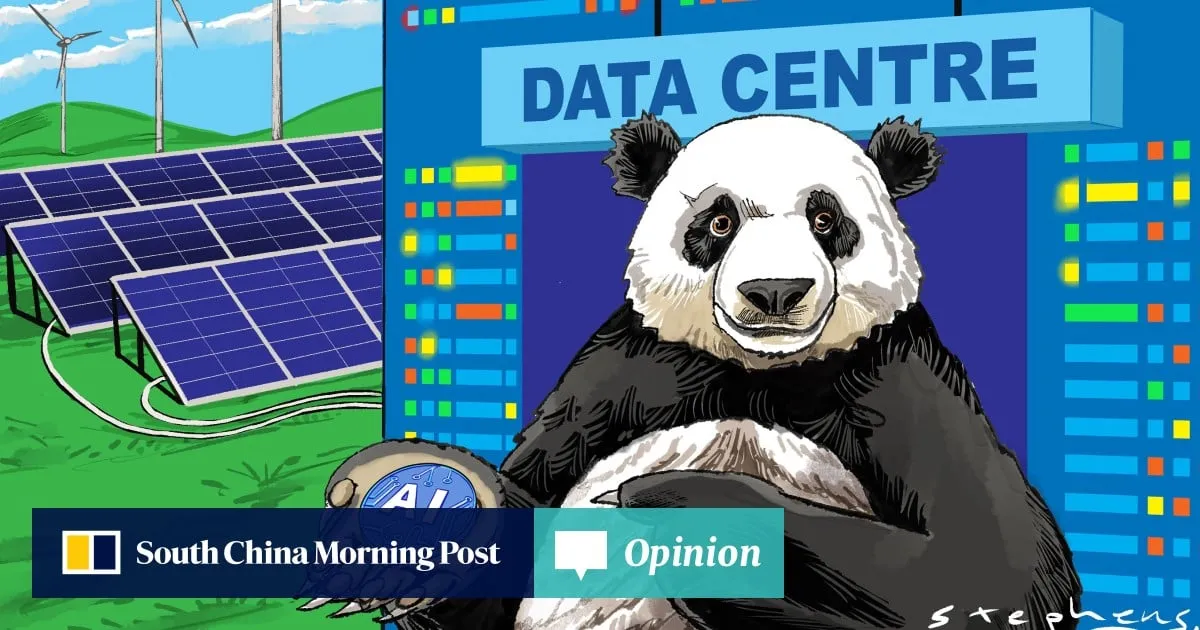
Edition:Get unlimited access to the SCMPHIGHLIGHTSNewsBusiness & TechOpinionLifestyleMore +TopicsFocus to tailor your experience and present relevant ads. By clicking “Accept”, you agree that cookies can be placed per our -AllWhy Beijing is going all in on tokens – and what it really wantsSIGN INOpinionChina’s AI token drive is really about upgrading inland economiesExport of tokens not only embeds China’s energy advantage into global AI systems, it pulls the value chain deeper into the country’s interior4-MIN READ4-MIN1ListenLizzi C. Lee is a fellow on Chinese economy at the Asia Society Policy Institute’s Centre for China Analysis.Published: 9:30am, 25 Apr 2026Updated: 10:23am, 25 Apr 2026The idea of a token economy is gaining traction. The concept is still nascent, loosely defined and easy to dismiss as just another piece of artificial intelligence jargon. It is no surprise Chinese policymakers are quick to jump on the bandwagon. But in the Chinese context, there is a more concrete policy logic that deserves attention.It reflects an emerging attempt to reframe how energy, infrastructure and digital services interact, and in doing so, how China positions itself in the next phase of the global AI competition.According to official estimates, China’s daily token consumption has reached 140 trillion, up from roughly 100 billion just two years earlier – a striking scale of growth. More importantly, the way China embeds the concept in policy suggests it is becoming part of the economic system it seeks to describe. This fits into a broader policy narrative.Under the AI Plus framework, Beijing is working to embed AI across industries. At the China-development-forum" class="entity-link entity-event" data-entity-id="51833" data-entity-type="event">China Development Forum last month, the National Data Administration head described tokens – the smallest computational unit in a large language model – as the “value anchor” and a “settlement unit” connecting supply and demand in the AI era.But the push is closely tied to the long-standing ambition of regional economic rebalancing. For decades, China’s western regions have functioned primarily as energy suppliers to the more industrialised east. Coal, hydropower, wind and solar power, all sent over long distances at very low margins. The token economy is an effort to upgrade these inland regions.The economics are straightforward. Electricity accounts for more than half the costs in data centre operations. Western China benefits from structurally lower power costs due to its abundant resources. So when that electricity is converted into computing power and then into AI services, the resulting output can command significantly higher prices than the energy input.01:46AI rush turns everyday data storage into ‘digital gold’ for Hong Kong consumersAI rush turns everyday data storage into ‘digital gold’ for Hong Kong consumersThis effort builds on initiatives such as “Eastern Data, Western Computing”, which aim to relocate energy-intensive computing to the interior while keeping latency-sensitive services closer to users. What is new with the token economy is the monetisation layer.These regions are generating units of computation integrated into global digital services, indirectly exporting China’s electricity as Chinese AI models are adopted. A user interacting with a Chinese AI model, for example may be indirectly drawing on computing power generated in a remote inland data centre.This is where China sees an opportunity. As AI systems scale up, global energy constraints are becoming increasingly visible. Training and running models require enormous, stable power supplies. Here, China’s access to low-cost energy and its ability to efficiently convert energy into computation is a key advantage. China’s integrated grid and rapid renewable buildout also give it a different starting point from the United States or Europe, where energy and data infrastructure remain more fragmented.Chinese companies are taking action. China’s leading AI giants have reorganised parts of their cloud and AI businesses around token usage. Specific strategies differ, but they converge on a shared premise: tokens, rather than compute capacity per se, should be the key unit and organising principle of the AI business.Further ReadingThis shift is partly driven by the rise of agentic AI, which consumes tokens at far higher rates than chatbots. As AI applications become more complex, token usage will only grow exponentially. China’s latest tech craze is chasing ‘lobsters’ with AI agent OpenClawChina’s latest tech craze is chasing ‘lobsters’ with AI agent OpenClawSome have begun describing tokens as the oil of the AI economy. Like oil, tokens are an intermediate input underpinning a wide range of economic activities. They are measurable, tradeable and tied to underlying resources. Most importantly, they offer a way to monetise physical inputs through layers of technological transformation.SCMP Plus is a new premium news platform that gives you an all-inclusive edge to stay ahead on China news. To access our exclusive content you’ll need to subscribe.Already a subscriber?LOG INBut the oil analogy is incomplete. Tokens are measurable and scalable but unlike oil, they are not inherently scarce or uniform. This points to some of the risks behind the token economy hype.Token consumption is a proxy for activity, but it does not directly capture the real value of such activities. A surge in token usage may reflect genuine productivity gains – or inefficiencies and redundancy. This distinction matters for China’s western regions. Their comparative advantage lies in low-cost energy and large-scale deployment, which aligns more naturally with the production of lower-value tokens.There are also technical constraints. Improvements in fibre networks and distributed computing have reduced transmission delays, but physical limits remain. Some workloads cannot tolerate even modest latency and must be located close to users, placing a ceiling on how much computational demand can be exported.China trials underwater data centres to solve energy woesChina trials underwater data centres to solve energy woesWhile data centres proliferate in the western regions, much of the innovation capacity is concentrated in coastal cities. Chip design, model architecture and commercial developments are still driven by companies and research institutions in coastal hubs, which capture the higher end of the AI value chain. Western regions function primarily as providers of computational capacity, not the main centres of growth and prosperity. The token economy model may boost value thanks to surging AI demand, but bridging the economic gap will require sustained investment.There are also questions about sustainability. Data centres require not just electricity but also land, water and cooling infrastructure. Large-scale deployment still faces environmental trade-offs.Even so, the direction is clear. China is seeking to move up the value chain by reworking its strengths in infrastructure and energy for the AI era. At its core, China’s ambition is to turn places long seen as peripheral – its inland energy hubs – into central nodes in the global AI economy. The token economy is one attempt to link those strengths to emerging global demand in new technologies.
SRCSouth China Morning Post
LANGEN
LEANCenter-Right
WORDS1 096
ENT7
SAT · 2026-04-25 · 01:30 GMTBRIEF NSR-2026-0425-71628
NSR-2026-0425-71628Analysis·EN·Economic Impact
China’s AI token drive is really about upgrading inland economies
China's embrace of AI tokens, the smallest computational units in large language models, is a strategic move to upgrade its inland economies. This initiative, part of the broader "AI Plus" framework, aims to embed AI across industries and reframe the interaction of energy, infrastructure, and digital services.
Lizzi C. LeeSouth China Morning PostFiled 2026-04-25 · 01:30 GMTLean · Center-RightRead · 5 min
South China Morning PostFIG 01
Reading time
5min
Word count
1 096words
Sources cited
1cited
Entities identified
7entities
Quality score
100%
§ 01
Briefing Summary
AI-generatedNEWSAR · AI
China's embrace of AI tokens, the smallest computational units in large language models, is a strategic move to upgrade its inland economies. This initiative, part of the broader "AI Plus" framework, aims to embed AI across industries and reframe the interaction of energy, infrastructure, and digital services. By leveraging the abundant and lower-cost energy resources in western China, the token economy seeks to shift value chains deeper into the country's interior. This policy reflects a long-standing ambition for regional economic rebalancing, moving inland regions beyond their traditional role as energy suppliers to the more industrialized east. The rapid growth in token consumption, reaching 140 trillion daily, highlights the scale of this developing economic system.
Confidence 0.90Sources 1Claims 5Entities 7
§ 02
Article analysis
Model · rule-basedFraming
Economic Impact
Political Strategy
Tone
Measured
AI-assessed
CalmNeutralAlarmist
Factuality
0.60 / 1.00
Mixed
LowHigh
Sources cited
1
Limited
FewMany
§ 03
Key claims
5 extracted01
Tokens are the “value anchor” and a “settlement unit” connecting supply and demand in the AI era.
quoteNational Data Administration head
Confidence
1.00
02
Electricity accounts for more than half the costs in data centre operations.
factualnull
Confidence
0.90
03
Beijing is working to embed AI across industries under the AI Plus framework.
factualnull
Confidence
0.90
04
China's daily token consumption has reached 140 trillion, up from roughly 100 billion just two years earlier.
statisticofficial estimates
Confidence
0.90
05
The token economy is an effort to upgrade inland regions.
factualnull
Confidence
0.80
§ 04
Full report
5 min read · 1 096 words§ 05
Entities
7 identifiedKey playerOppositionContextPositiveNeutralNegative
People1
Organizations2
§ 06
Keywords & salience
9 termsai token
1.00
inland economies
0.90
token economy
0.80
economic rebalancing
0.70
ai competition
0.60
computational unit
0.50
ai plus framework
0.50
energy advantage
0.40
data centre operations
0.40
§ 07
Topic connections
Interactive graph Network visualization showing 51 related topics
View Full Graph Person Organization Location Event|Click node to navigate|Edge numbers = shared articles