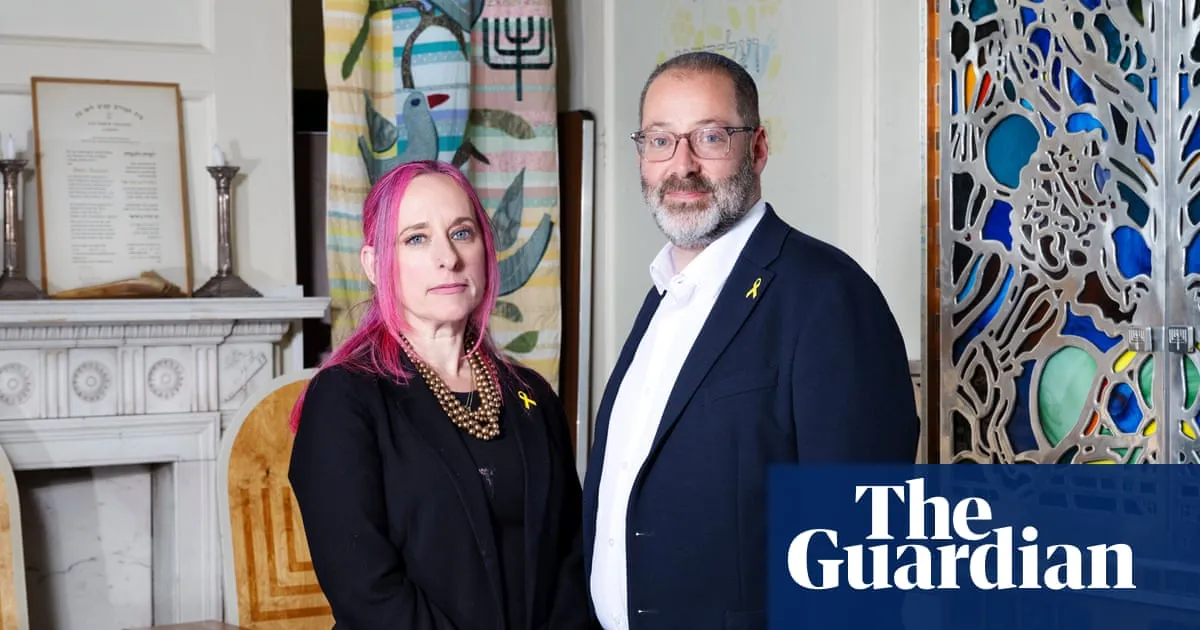
Rabbi Charley Baginsky and Rabbi Josh Levy co-edited 40 essays from Jewish clergy and community leaders on debates surrounding Jewish identity, Zionism and Israel. Photograph: Linda Nylind/The Guardian View image in fullscreen Rabbi Charley Baginsky and Rabbi Josh Levy co-edited 40 essays from Jewish clergy and community leaders on debates surrounding Jewish identity, Zionism and Israel. Photograph: Linda Nylind/The Guardian Israel’s direction poses ‘existential threat’ to Judaism, UK’s leading progressive rabbis warn Rabbis Charley Baginsky and Josh Levy say criticising Israeli government is not disloyalty but a Jewish obligation The UK’s most senior progressive rabbis have warned that Israel’s current political direction risks becoming “incompatible with Jewish values”, while insisting that criticism of the country’s government is “a Jewish obligation” rather than an act of disloyalty. Rabbi Charley Baginsky and Rabbi Josh Levy, co-leads of Progressive Judaism – the newly formed movement representing around a third of synagogues in the UK – said Israel’s trajectory could pose an “existential threat” not just to the country itself but to Judaism. Speaking ahead of the launch of the movement’s first book, Progressive Judaism, Zionism and the State of Israel, they also expressed hope that change remains possible. “We’ve often talked about the direction of Israel being an existential threat not to Jews per se, but to Judaism,” Baginsky said. “What happens when the direction of the government within Israel takes Israel down a line that makes it incompatible with our Jewish values? That’s a huge worry.” That question lies at the heart of the book Baginsky co-edited with Levy and Dr Ed Kessler, which brings together 40 essays from Jewish clergy and community leaders, reflecting a wide range of perspectives on the fraught debates surrounding Jewish identity, Zionism and Israel. Levy argued that exploring these tough questions is not a sign of disloyalty to Israel or to the Jewish community. “It is to be part of a millennial conversation about Jewish values and what God wants of us in the world and our relationship with the land.” He added: “What the government of Israel does reflects on us as Jews and reflects on our Judaism. Therefore, it is our Jewish obligation to be in dialogue with that in some way.” While Progressive Judaism is a Zionist movement committed to a Jewish, pluralist and democratic state in Israel, the collection of essays also includes contributions from voices who would not describe themselves as Zionists. The book forms part of a wider review being carried out by Progressive Judaism into its relationship with Israel and Zionism. “One of the things that we have seen in the world by the Jewish community is the view that diversity of voice is somehow weakening,” Levy said. “But what sits underneath the book is the idea that holding differences makes us stronger.” Baginsky said the mission of Progressive Judaism was to insist on living within that complexity. “To say you’re a Zionist, to say you’re critical of the Israeli government, and to also talk about antisemitism means there are very few spaces that you can’t be criticised in,” she said. Both were keen to stress that any guidelines resulting from the review would not impose a top-down view on what congregants should think or feel. The essays include political perspectives, personal views and religious mediation. The latter was of particular importance to the co-chairs, who said they were keen to assert their perspective as religious Zionists and challenge the narrative being set by far-right Israeli leaders such as Bezalel Smotrich and Itamar Ben-Gvir. “We have a responsibility to show that our religious Zionism is not the religious Zionism that we see sometimes coming out of the West Bank,” Baginsky said. “My Zionism is also a recognition of Palestinian self-determination.” Levy added: “It’s not that kind of proprietorial Zionism. It’s a different kind of Zionism that’s articulated out of our religious life. It’s textual, it’s deep, and it’s rich.” That position has at times brought them into tension with parts of the British Jewish community. Last year, while addressing a rally for Israeli hostages held by Hamas in Gaza, Baginsky and Levy were booed off stage after calling for an end to the war and the establishment of a Palestinian state. “That moment was painful. It was nearly a year ago, and I still feel it viscerally,” Baginsky said. But it has not stopped her from calling for justice and peace for all in the Middle East. Levy agreed, but wanted to also focus on what followed the heckling. “Which was an outpouring of responses from across the Jewish community, and the wider faith community, who wanted to show their support.” Explore more on these topics Judaism Religion Israel Palestine Middle East and north Africa news Share Reuse this content
SRCThe Guardian - World News
LANGEN
LEANCenter-Left
WORDS791
ENT6
TUE · 2026-04-28 · 04:00 GMTBRIEF NSR-2026-0428-72124
NSR-2026-0428-72124News Report·EN·Human Interest
Israel’s direction poses ‘existential threat’ to Judaism, UK’s leading progressive rabbis warn
UK's leading progressive rabbis, Charley Baginsky and Josh Levy, have warned that Israel's current political direction poses an "existential threat" to Judaism. They argue that this trajectory risks becoming "incompatible with Jewish values." The rabbis, co-leads of the newly formed Progressive Judaism movement, state that criticizing the Israeli government is a Jewish obligation, not disloyalty.
Aamna Mohdin Community affairs correspondentThe Guardian - World NewsFiled 2026-04-28 · 04:00 GMTLean · Center-LeftRead · 4 min
The Guardian - World NewsFIG 01
Reading time
4min
Word count
791words
Sources cited
3cited
Entities identified
6entities
Quality score
100%
§ 01
Briefing Summary
AI-generatedNEWSAR · AI
UK's leading progressive rabbis, Charley Baginsky and Josh Levy, have warned that Israel's current political direction poses an "existential threat" to Judaism. They argue that this trajectory risks becoming "incompatible with Jewish values." The rabbis, co-leads of the newly formed Progressive Judaism movement, state that criticizing the Israeli government is a Jewish obligation, not disloyalty. This warning comes ahead of the launch of their book, "Progressive Judaism, Zionism and the State of Israel," which features 40 essays from Jewish clergy and leaders on debates surrounding Jewish identity, Zionism, and Israel. They emphasize that engaging in these critical discussions is part of a long-standing Jewish conversation about values and the relationship with the land.
Confidence 0.90Sources 3Claims 1Entities 6
§ 02
Article analysis
Model · rule-basedFraming
Human Interest
Tone
Measured
AI-assessed
CalmNeutralAlarmist
Factuality
0.85 / 1.00
Factual
LowHigh
Sources cited
3
Well sourced
FewMany
§ 03
Key claims
1 extracted01
Israel's current political direction risks becoming 'incompatible with Jewish values',
factual
Confidence
0.50
§ 04
Full report
4 min read · 791 words§ 05
Entities
6 identifiedKey playerOppositionContextPositiveNeutralNegative
Organizations1
Events1
§ 06
Keywords & salience
9 termsisrael
1.00
judaism
1.00
progressive rabbis
0.90
jewish values
0.80
existential threat
0.70
zionism
0.60
jewish identity
0.50
jewish obligation
0.50
progressive judaism
0.40
§ 07
Topic connections
Interactive graph Network visualization showing 51 related topics
View Full Graph Person Organization Location Event|Click node to navigate|Edge numbers = shared articles