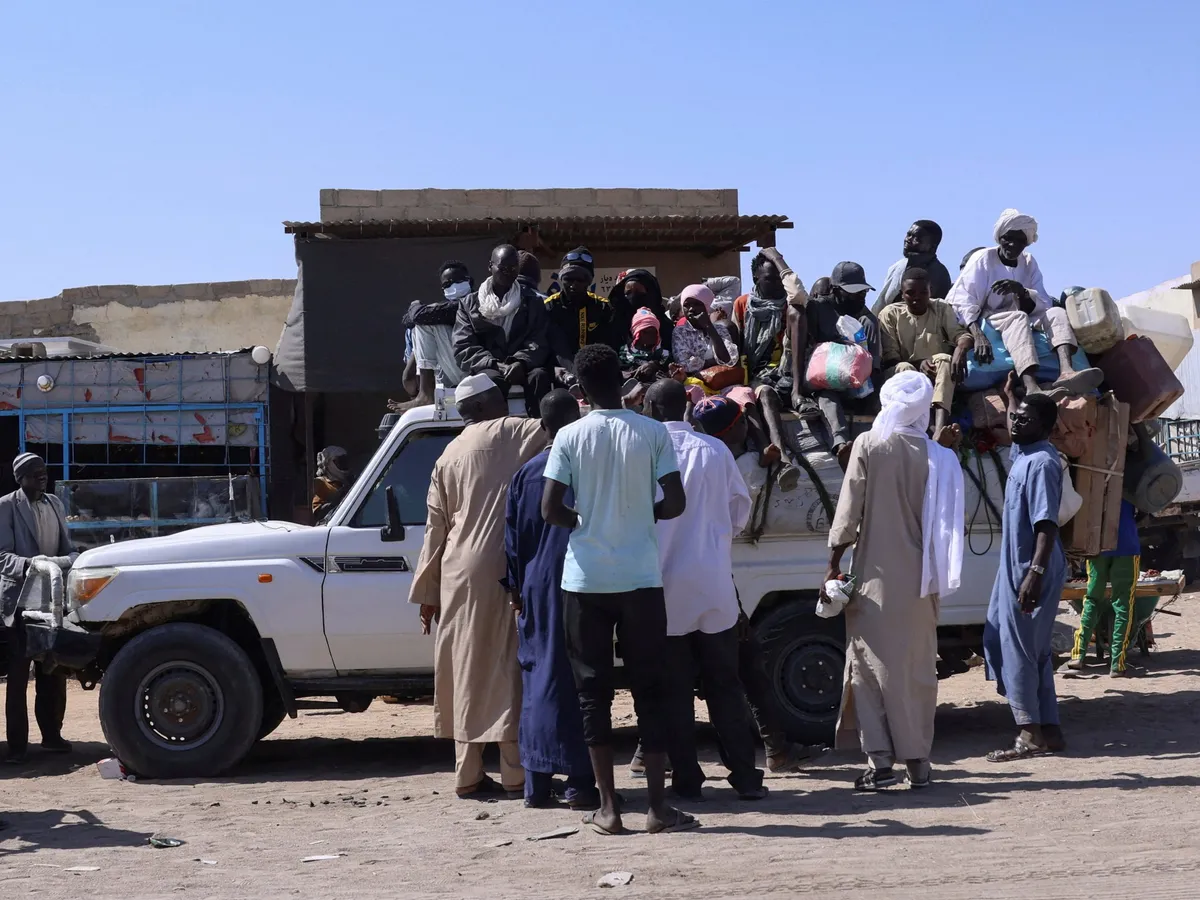
Families in Sudan face hunger and displacement during war with millions dependent on limited and inconsistent aid.Displaced people from Darfur prepare to travel about 250km (155 miles) south to Adre on the Chad-Sudan border at a transport station in Tine in eastern Chad [File: Amr Abdallah Dalsh/Reuters]Published On 28 Apr 2026Omdurman, Sudan – When Marasi Alfadil arrived in Omdurman with her children, there was almost nothing waiting for them.The family eventually found a half-finished building inside a compound to live in. There are no proper walls, no services and little food. But for Marasi, it is still safer than the city she fled.Recommended Stories list of 3 itemslist 1 of 3What are OPEC and OPEC +, and why has the UAE quit?list 2 of 3What is the Azawad Liberation Front, part of the Mali attacks?list 3 of 3Thousands held by paramilitary RSF in Sudan’s el-Fasher: NGOend of listSix months ago, she escaped el-Fasher in North Darfur, just days before fighters from the Rapid Support Forces (RSF) paramilitary group took full control after an 18-month siege of the western city, which at the time was controlled by the group’s opponents in Sudan’s three-year civil war, the Sudanese armed forces (SAF). Thousands of people were killed during the RSF takeover, which a United Nations investigation found bore the “hallmarks of genocide”.“The siege made life hard,” she told Al Jazeera. “Goods could not come in. Anyone who tried to bring food was detained or killed.”Hundreds of thousands of people still remain in el-Fasher, where food shortages and violence continue under the RSF’s control. This has created a hunger crisis so severe that the Integrated Food Security Phase Classification hunger-monitoring system declared a famine in November.Similar conditions have also been reported in Kadugli, the capital of South Kordofan State, while at least 20 other areas across the contested western Sudanese region of Darfur and the central region of Kordofan are at risk of famine.Siege and famineIn el-Fasher and other besieged towns, prolonged blockades have cut off food, fuel and medicine. Markets have either collapsed or become unaffordable.The 2026 Global Report on Food Crises, released by the European Union-funded Global Network Against Food Crises, said conflict in Darfur and Kordofan has severely constrained humanitarian access with “devastating effects on food security”.The report found that by September, about 375,000 people were in the most extreme level of hunger, concentrated in the states of North Darfur, South Kordofan and West Kordofan.For civilians, this has meant hunger has become unavoidable.Marasi’s experience reflects a wider pattern across western and central Sudan, where sieges and fighting have created famine-level conditions.Seeking refugeMarasi is not alone in seeking refuge in Omdurman, which is part of Sudan’s capital region of Khartoum and is controlled by the SAF.In the same compound lives Taqwa, who fled Heglig in West Kordofan after fighting between the SAF and the RSF.She arrived with twins who were just three weeks old.But displacement has not ended her struggle to survive.“Feeding two infants is hard. I don’t have money to buy meat. I don’t have money to buy flour and make porridge,” Taqwa said. “And I can’t work because the babies are still very young.”Her situation reflects a broader crisis highlighted in the Global Report on Food Crises: Displacement has stripped millions of people of their livelihoods and incomes, leaving them dependent on limited and inconsistent aid.By the end of 2025, almost 12 million people were displaced, making Sudan home to the world’s largest internal displacement crisis.The UN estimated nearly 25 million people – more than half of Sudan’s population – were facing crisis levels of food shortages or worse by 2025, including about 4.2 million children under five.And even in areas where people have fled, like Khartoum, food remains scarce and expensive.Aid agencies have reported ongoing funding shortages while violence continues to block access to many regions.For families like Taqwa’s who are reliant on aid, the result is a daily struggle to survive.“There’s very little aid here,” she said, “so we suffer.”
SRCAl Jazeera
LANGEN
LEANCenter
WORDS662
TUE · 2026-04-28 · 19:14 GMTBRIEF NSR-2026-0428-72336
NSR-2026-0428-72336News Report·EN·Conflict
Families forced into displacement by famine in Sudan
Families in Sudan are facing severe hunger and displacement due to ongoing conflict, particularly in Darfur and Kordofan regions. Marasi Alfadil's family fled el-Fasher in North Darfur after its takeover by the Rapid Support Forces (RSF), a paramilitary group, where a UN investigation found the takeover bore "hallmarks of genocide." Prolonged sieges have led to critical shortages of food, fuel, and medicine, causing markets to collapse and creating a famine crisis.
Hiba Morgan,Mariem BahAl JazeeraFiled 2026-04-28 · 19:14 GMTLean · CenterRead · 3 min
Al JazeeraFIG 01
Reading time
3min
Word count
662words
Sources cited
5cited
Entities identified
0entities
Quality score
75%
§ 01
Briefing Summary
AI-generatedNEWSAR · AI
Families in Sudan are facing severe hunger and displacement due to ongoing conflict, particularly in Darfur and Kordofan regions. Marasi Alfadil's family fled el-Fasher in North Darfur after its takeover by the Rapid Support Forces (RSF), a paramilitary group, where a UN investigation found the takeover bore "hallmarks of genocide." Prolonged sieges have led to critical shortages of food, fuel, and medicine, causing markets to collapse and creating a famine crisis. The Integrated Food Security Phase Classification declared famine in November, with hundreds of thousands remaining in el-Fasher and other areas at risk. The conflict has severely limited humanitarian access, exacerbating the devastating effects on food security.
Confidence 0.90Sources 5Claims 5
§ 02
Article analysis
Model · rule-basedFraming
Conflict
Human Interest
Tone
Measured
AI-assessed
CalmNeutralAlarmist
Factuality
0.85 / 1.00
Factual
LowHigh
Sources cited
5
Well sourced
FewMany
§ 03
Key claims
5 extracted01
The Integrated Food Security Phase Classification hunger-monitoring system declared a famine in el-Fasher in November.
statisticIntegrated Food Security Phase Classification
Confidence
1.00
02
The Rapid Support Forces (RSF) took full control of el-Fasher after an 18-month siege.
factual
Confidence
1.00
03
A United Nations investigation found the RSF takeover of el-Fasher bore the 'hallmarks of genocide'.
quoteUnited Nations
Confidence
0.95
04
About 375,000 people were in the most extreme level of hunger by September, concentrated in North Darfur, South Kordofan and West Kordofan.
statisticGlobal Network Against Food Crises
Confidence
0.90
05
At least 20 other areas across Darfur and the central region of Kordofan are at risk of famine.
prediction
Confidence
0.85
§ 04
Full report
3 min read · 662 words§ 06
Keywords & salience
10 termsdisplacement
1.00
sudan
1.00
famine
1.00
hunger crisis
0.90
rapid support forces (rsf)
0.80
darfur
0.70
humanitarian access
0.60
civil war
0.50
food security
0.50
siege
0.40
§ 07
Topic connections
Interactive graph Network visualization showing 7 related topics
View Full Graph Person Organization Location Event|Click node to navigate|Edge numbers = shared articles