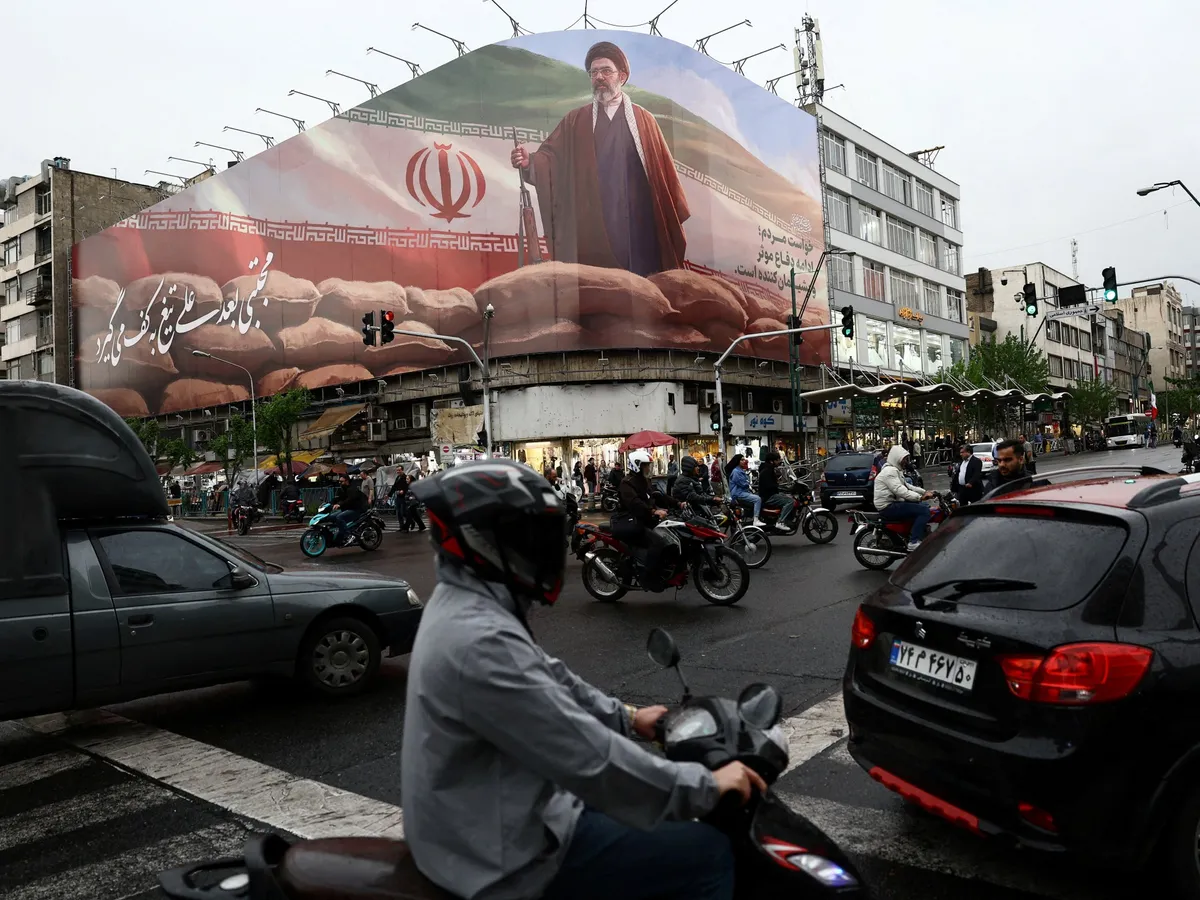
The war has affected trade with some of Iran’s largest partners, including China and the UAE.People ride motorcycles near a billboard featuring an image of Iran's new Supreme Leader Mojtaba Khamenei, amid a ceasefire between US and Iran, in Tehran, Iran, April 20, 2026 [File: Majid Asgaripour/WANA (West Asia News Agency) via Reuters]Published On 29 Apr 2026Tehran, Iran – Iran’s national currency has plunged to new lows as authorities mobilise to dampen the impact of the naval blockade enforced by the United States.The Iranian rial shot above 1.81 million to the US dollar on the open market by early afternoon on Wednesday before partially recovering. The embattled currency changed hands for about 1.54 million earlier this week, and its rate was about 811,000 per US dollar a year ago.Recommended Stories list of 3 itemslist 1 of 3Suspect arrested after two Jewish people stabbed in Londonlist 2 of 3Is Iran’s oil storage nearly full – and will it have to cut production?list 3 of 3‘No more Mr Nice Guy’: Trump warns Iran to ‘get smart’ over stalled talksend of listThe rial had remained relatively stable over the past two months after experiencing an earlier drop as US forces amassed in the lead-up to the US-Israeli war on Iran, which began at the end of February.The latest freefall follows on from unchecked inflation, which has been increasingly plaguing the Iranian economy as a result of mismanagement and sanctions, and continues to ravage households. Washington now has three aircraft carriers in the region and is bringing in more troops and equipment as Israel expresses readiness to restart fighting, three weeks after a ceasefire began.Iran’s authorities this week projected a hardened stance on negotiations with Washington, and pledged to fight the naval blockade of Iran’s southern waters, which the US Central Command insisted on Tuesday had “cut off economic trade going into and coming out of” the country.Amid threats by US President Donald Trump, the Iranian government has also tried to empower its own border provinces to import essential goods by reducing red tape. It has also allocated $1bn from the sovereign wealth fund to buy food, and made a partial policy U-turn to restart offering a preferential subsidised exchange rate with the goal of reducing prices, despite concerns about corruption.Non-oil trade takes hitAccording to customs data released by state media, Iran’s non-oil trade has been negatively affected after commercial ties were disrupted or cut off as a result of the war, and critical infrastructure was bombed.Iran’s customs authority put the total value of non-oil trade in the Iranian calendar year that ended on March 20 at close to $110bn, with $58bn going to imports. The figure was about 16 percent lower than the year before.The volume of non-oil trade was valued at approximately $9bn for the 11th month of the calendar year ending on February 19, and $6.46bn in the final month, indicating a drop of about 29 percent in connection with the war, which started on February 28. The final month was also about 50 percent lower than the more than $13bn estimated value for last year’s corresponding month.Part of the drop is linked with the fact that shipping has been significantly disrupted through the Strait of Hormuz as Iran and the US spar over control of the strategic waterway. The US and Israel also directed some of their thousands of strikes against ports, naval facilities, airports, and railway networks across the country.Iran’s top steel and petrochemical producers were also extensively bombed, as were oil and gas facilities, power stations, and major industrial zones. The US and Israel have threatened to take Iran “back to the Stone Age” through systematic bombing of civilian infrastructure like power plants.To manage the impact and preserve domestic supply, Iranian authorities have imposed temporary restrictions on exports of steel, petrochemicals, polymers and other chemicals.Oil exports in the crosshairsThe US is using its military capabilities and economic chokeholds to drive down Iran’s oil exports, a goal that it has also pursued over recent years through sanctions.Since mid-April, the US military has been deploying its soldiers to take over or inspect ships transiting through waterways near Iran, in addition to targeting what is known as a shadow fleet of tankers used by Iran to circumvent sanctions and ship its oil.Warships and thousands of troops could still launch a ground invasion or destructive aerial attacks against Iran’s Kharg and other critical islands, and the Trump administration expects increased pressure on Iran’s oil sector due to hampered access to export routes and supertankers keeping the oil stored on the water.The US Treasury has been blacklisting refineries in China, the biggest buyers of Iranian crude oil, and going after the banking and cryptocurrency channels alleged to be facilitating Tehran’s oil trade, and having links to the IRGC – which Washington considers a “terrorist” organisation.“We will follow the money that Tehran is desperately attempting to move outside of the country and target all financial lifelines tied to the regime,” said US Treasury Secretary Scott Bessent on social media.Chinese refineries buy roughly 90 percent of Iran’s oil shipments, and imported a record 1.8 million barrels per day in March, according to Vortexa Analytics data cited by the Reuters news agency, which also said purchases were expected to slow due to worsening domestic refining and processing margins.According to figures released by the General Administration of Customs of China, the volume of the country’s bilateral trade with Iran during the first quarter of 2026 stood at $1.55bn, down 50 percent year-on-year.In March, the first month of the war, trade stood at $184m, which was nearly 80 percent lower than the year before and 64 percent lower than the month before. China’s imports from Iran and exports to the country were both considerably reduced as a result of the war.The removal of the United Arab Emirates as a major trade partner and import market for Iran has also significantly affected the country’s economy, increasing its reliance on land neighbours like Turkiye and Iraq to the west and Pakistan to the east.The UAE, a big part of the Trump-led Abraham Accords that saw multiple countries normalise relations with Israel, was heavily targeted by ballistic missiles and drones launched by Iran.The UAE has closed down numerous Iranian institutions on its soil over the past two months, including financial facilitators, instructed Iranian citizens to leave, and has said it will take years to restore bilateral relations to previous levels.
SRCAl Jazeera
LANGEN
LEANCenter
WORDS1 069
WED · 2026-04-29 · 15:30 GMTBRIEF NSR-2026-0429-72408
NSR-2026-0429-72408News Report·EN·Economic Impact
Iran’s currency falls to new low as US blockade, sanctions impact trade
Iran's national currency, the rial, has hit new lows against the US dollar, trading at over 1.81 million to the dollar on Wednesday. This sharp decline is attributed to a US naval blockade and existing sanctions, which are impacting Iran's trade, particularly with China and the UAE.
Maziar MotamediAl JazeeraFiled 2026-04-29 · 15:30 GMTLean · CenterRead · 5 min
Al JazeeraFIG 01
Reading time
5min
Word count
1 069words
Sources cited
3cited
Entities identified
0entities
Quality score
75%
§ 01
Briefing Summary
AI-generatedNEWSAR · AI
Iran's national currency, the rial, has hit new lows against the US dollar, trading at over 1.81 million to the dollar on Wednesday. This sharp decline is attributed to a US naval blockade and existing sanctions, which are impacting Iran's trade, particularly with China and the UAE. The currency's value has plummeted significantly over the past year, exacerbated by unchecked inflation and economic mismanagement. In response, Iranian authorities are attempting to mitigate the impact by empowering border provinces for essential goods imports and allocating funds for food purchases. The US Central Command stated the blockade has effectively cut off Iran's economic trade.
Confidence 0.90Sources 3Claims 5
§ 02
Article analysis
Model · rule-basedFraming
Economic Impact
Conflict
Tone
Mixed Tone
AI-assessed
CalmNeutralAlarmist
Factuality
0.85 / 1.00
Factual
LowHigh
Sources cited
3
Well sourced
FewMany
§ 03
Key claims
5 extracted01
The Iranian rial reached a low of 1.81 million to the US dollar on the open market.
statistic
Confidence
1.00
02
The US Central Command stated that the naval blockade has cut off economic trade going into and coming out of Iran.
quoteUS Central Command
Confidence
0.95
03
The Iranian government allocated $1bn from the sovereign wealth fund to purchase food supplies.
factual
Confidence
0.90
04
Iran’s total non-oil trade value for the Iranian calendar year ending March 20 was approximately $110bn.
statisticIran’s customs authority
Confidence
0.90
05
Non-oil trade volume dropped by approximately 29 percent in the final month of the calendar year ending March 20.
statisticIran’s customs authority
Confidence
0.85
§ 04
Full report
5 min read · 1 069 words§ 06
Keywords & salience
9 termsus sanctions
1.00
iranian currency
1.00
naval blockade
0.90
trade impact
0.80
iranian economy
0.70
inflation
0.60
us-israeli war
0.50
negotiations
0.40
non-oil trade
0.40
§ 07
Topic connections
Interactive graph Network visualization showing 20 related topics
View Full Graph Person Organization Location Event|Click node to navigate|Edge numbers = shared articles