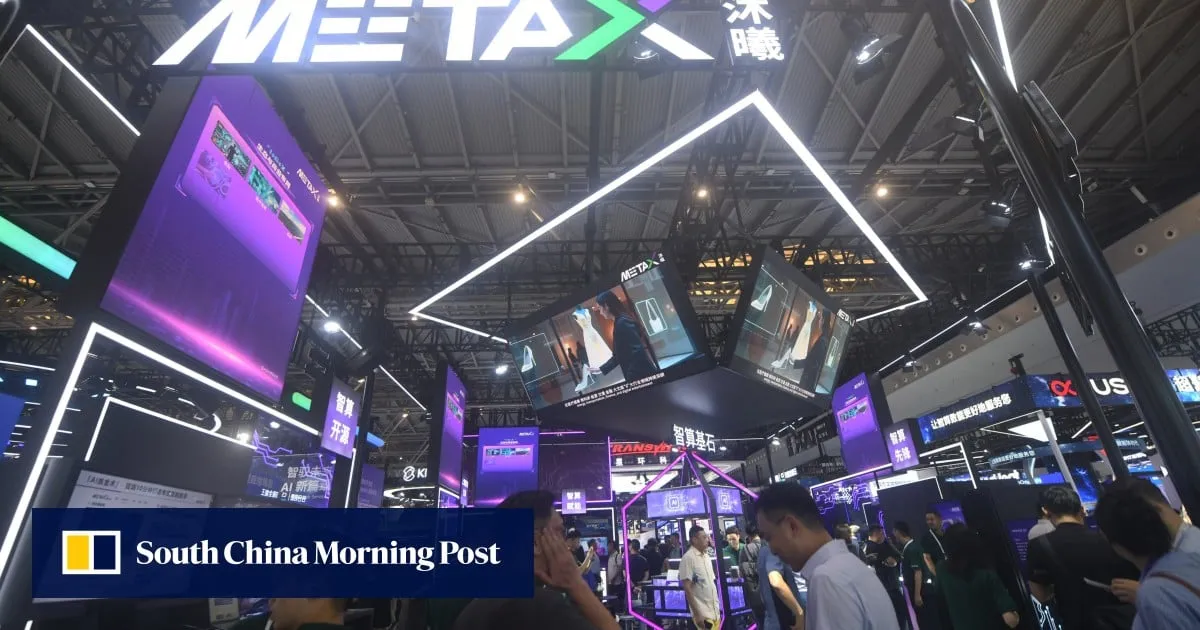
Chinese chip designers Cambricon Technologies and MetaX Integrated Circuits reported substantial growth in the first quarter, as the artificial intelligence boom, lingering US export-control risks and China’s self-sufficiency push drove the country’s demand for home-grown computing power.Cambricon’s first-quarter revenue jumped 160 per cent from a year earlier to 2.89 billion yuan (US$423 million), while profit soared 185 per cent to 1 billion yuan, the company said in a filing on Wednesday.Sometimes dubbed “little Nvidia” in China, the Beijing-based, Shanghai-listed company attributed its strong growth to a “sustained surge in the AI industry’s computing power demand”.The company said last month that it planned to distribute a cash dividend of 15 yuan (US$2.20) for every 10 shares held, totalling more than 632 million yuan, after announcing in February that it had swung to a net profit of 2 billion yuan last year, following years of losses.Shanghai-based MetaX said on Wednesday that its revenue for the first three months of the year grew 75 per cent from a year earlier to 561.9 million yuan. The company, which went public in December, reported a 98.8 million yuan net loss for the quarter.MetaX, founded in 2020 by former engineers of US chipmaker Advanced Micro Devices, attributed its increased revenue to significant growth in shipments of its graphics processing units (GPUs).Cambricon gained 3.07 per cent to 1,416.63 yuan on Wednesday, making it the second most valuable stock on mainland exchanges, after optical chipmaker Yuanjie Semiconductor Technology. MetaX lost 1.47 per cent to 713.36 yuan. Both companies announced their quarterly results after the market closed.The growth of the two leading GPU designers underscores the country’s strong demand for domestic chips as US export control risks persist.Months after US President Donald Trump gave US chip giant Nvidia the green light to resume sales of its advanced H200 AI chips to China, US Commerce Secretary Howard Lutnick said last week that no H200 had been sold to China due to the lack of permission from the Chinese government.Nvidia GPU availability in China had tightened, “creating more room for local substitution”, Morgan Stanley said in a research note last week based on a recent field trip.Cambricon attributed its strong growth to a “sustained surge in the AI industry’s computing power demand”. Photo: VCG via Getty ImagesA rapid rise in AI inference demand, driven by commercialisation across consumer and enterprise applications, also contributed to China’s GPU market boom, Morgan Stanley said.Further ReadingChina’s chip foundries have also benefited from the country’s efforts to achieve semiconductor self-reliance.Shanghai-based contract chip manufacturer Hua Hong Semiconductor, which in February reported record revenue of US$660 million in the fourth quarter, has emerged as the latest target by the US government amid intense AI competition between the world’s two largest economies.The US Department of Commerce last week ordered chip equipment makers including Lam Research, Applied Materials and KLA to stop the shipments of certain tools to Hua Hong, China’s second-largest chip foundry, according to a Reuters report on Wednesday.The reported move, aimed at preventing the Chinese foundry from being able to produce advanced nodes, could be designed to give Trump more bargaining chips against China ahead of his scheduled visit to Beijing next month, Jefferies analysts wrote in a research note on Wednesday, adding that chipmaking equipment would likely be an important topic of discussion.In response to the reported export restrictions for Hua Hong, Chinese Foreign Ministry Spokesperson Lin Jian said on Wednesday that China expected the US to “take concrete actions to safeguard the stability and smooth flow of global industrial and supply chains”.As Chinese companies also remain barred from buying ASML’s extreme ultraviolet lithography machines – crucial for building cutting-edge chips – domestic suppliers of less advanced chipmaking equipment have benefited.Circuit Fabology Microelectronics Equipment, a proponent of so-called direct-write lithography technology, reported on Wednesday that first-quarter revenue surged 112 per cent to 514.7 million yuan, while profit jumped 190 per cent to 108.4 million yuan.China’s top chip equipment maker Naura Technology Group on Wednesday reported a 25.8 per cent year-on-year jump in revenue, while net profit increased 3.42 per cent.Shanghai-based chip designer VeriSilicon said on Wednesday that first-quarter revenue increased 114.47 per cent to 836 million yuan, but losses widened to 341 million yuan from 220 million yuan a year earlier.
SRCSouth China Morning Post
LANGEN
LEANCenter-Right
WORDS705
WED · 2026-04-29 · 13:15 GMTBRIEF NSR-2026-0429-72438
NSR-2026-0429-72438News Report·EN·Technology
Thirst for local AI chips raises revenue for China GPU leaders Cambricon, MetaX
Chinese AI chip designers Cambricon Technologies and MetaX Integrated Circuits reported significant revenue growth in the first quarter of 2024. Cambricon's revenue surged 160% to 2.89 billion yuan, with profit increasing 185% to 1 billion yuan, driven by high demand for AI computing power.
Xinmei ShenSouth China Morning PostFiled 2026-04-29 · 13:15 GMTLean · Center-RightRead · 3 min
South China Morning PostFIG 01
Reading time
3min
Word count
705words
Sources cited
4cited
Entities identified
0entities
Quality score
75%
§ 01
Briefing Summary
AI-generatedNEWSAR · AI
Chinese AI chip designers Cambricon Technologies and MetaX Integrated Circuits reported significant revenue growth in the first quarter of 2024. Cambricon's revenue surged 160% to 2.89 billion yuan, with profit increasing 185% to 1 billion yuan, driven by high demand for AI computing power. MetaX saw its revenue grow 75% to 561.9 million yuan, attributed to increased GPU shipments. This surge in domestic chip demand is fueled by China's push for self-sufficiency and lingering US export control risks, which have tightened the availability of foreign GPUs. Both companies are key players in China's efforts to develop its own advanced semiconductor capabilities.
Confidence 0.90Sources 4Claims 5
§ 02
Article analysis
Model · rule-basedFraming
Technology
Economic Impact
Tone
Measured
AI-assessed
CalmNeutralAlarmist
Factuality
0.85 / 1.00
Factual
LowHigh
Sources cited
4
Well sourced
FewMany
§ 03
Key claims
5 extracted01
Cambricon swung to a net profit of 2 billion yuan last year, following years of losses.
statisticCambricon filing
Confidence
1.00
02
MetaX revenue for the first three months of the year grew 75 per cent from a year earlier to 561.9 million yuan.
statisticMetaX filing
Confidence
1.00
03
Cambricon’s first-quarter revenue jumped 160 per cent from a year earlier to 2.89 billion yuan (US$423 million).
statisticCambricon filing
Confidence
1.00
04
No Nvidia H200 chips have been sold to China due to the lack of permission from the Chinese government.
quoteHoward Lutnick
Confidence
0.90
05
Nvidia GPU availability in China has tightened, creating more room for local substitution.
predictionMorgan Stanley
Confidence
0.80
§ 04
Full report
3 min read · 705 words§ 06
Keywords & salience
10 termsai chips
1.00
cambricon
0.90
metax
0.80
gpu
0.80
china
0.70
us export controls
0.70
computing power
0.60
self-sufficiency
0.60
local substitution
0.50
ai industry
0.40
§ 07
Topic connections
Interactive graph No topic relationship data available yet. This graph will appear once topic relationships have been computed.