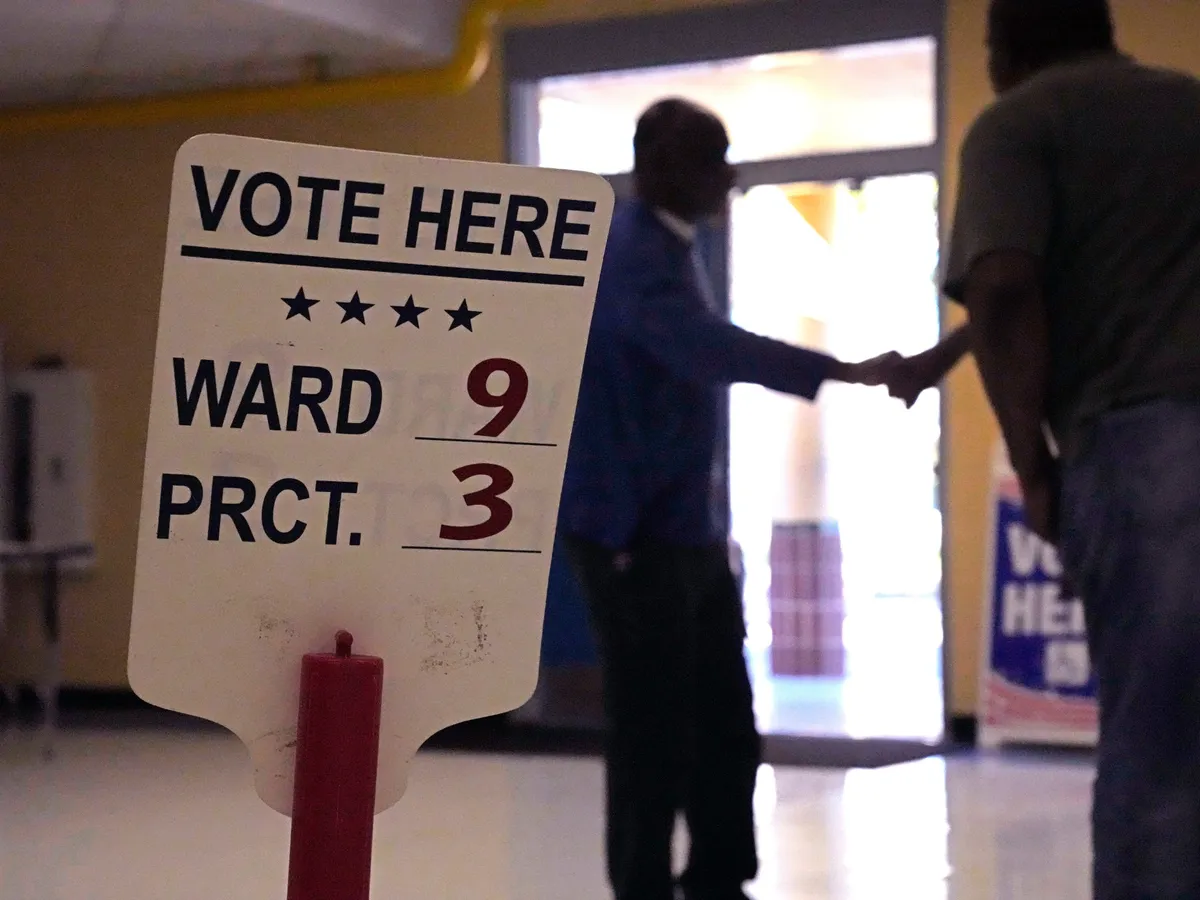
Ruling seen as major blow to US Voting Rights Act, with critics saying it could dilute minority voting power.Voters are seen in the Lower Ninth Ward of New Orleans, Louisiana. [File: Gerald Herbert/The Associated Press]Published On 29 Apr 2026The United States Supreme Court ruled that Louisiana’s electoral map was unconstitutionally drawn to create two Black-majority districts.The decision announced on Thursday represented a major reinterpretation of the landmark US Voting Rights Act, in particular, its provision meant to protect minority voters from having their political power diluted. It is set to benefit Republicans amid a wider battle over congressional redistricting before the midterm elections in November.Recommended Stories list of 3 itemslist 1 of 3Trump says he could be impeached if Republicans lose Congress in midtermslist 2 of 3US Supreme Court allows Texas to use redrawn district map for 2026 midtermslist 3 of 3Could Trump curb voters’ rights before 2026 US midterms?end of listIn the 6-3 ruling, the Supreme Court’s conservative majority held that a map that created two Black-majority congressional districts in Louisiana was unconstitutional.The map had initially been drawn by Louisiana’s Republican-controlled state legislature following the 2020 census. It contained only one Black-majority district out of six total districts, despite Black residents making up a third of the state’s population. A group of voters challenged the map, arguing that its composition weakened Black voters’ electoral strength.A federal judge initially sided with the challengers, ruling the map likely violated Section 2 of the Voting Rights Act. The legislation was passed in 1965 amid the US civil rights movement and sought to respond to the historic disenfranchisement of Black voters in several states. Section 2 has long been interpreted to prohibit electoral maps that would result in diluting the electoral power of minority voters, even without direct proof of racist intent.However, Wednesday’s Supreme Court ruling, written by conservative Justice Samuel Alito, suggested that racist intent must be proven for an electoral map to be deemed in violation of the law.“Only when understood this way does [Section 2] of the Voting Rights Act properly fit within Congress’s Fifteenth Amendment enforcement power,” Alito wrote, referring to the section of the US Constitution that prohibits intentional racial discrimination.Justice Elena Kagan joined the two other liberal justices in dissenting. She warned the ruling will have sweeping repercussions, requiring “smoking-gun evidence of a race-based motive” that state officials could easily work around.“Under the court’s new view of Section 2, a state can, without legal consequence, systematically dilute minority citizens’ voting power,” Kagan wrote.Sophia Lin Lakin, director of the American Civil Liberties Union’s (ACLU) voting rights project, called the ruling a “profound betrayal of the legacy of the civil rights movement.”“By gutting Section 2 of the Voting Rights Act, the Court has weakened the primary legal tool that voters of colour rely on to challenge discriminatory maps and election systems.”A redrawn Louisiana map is expected to benefit Republicans, with Black majority districts typically favouring Democratic candidates.The ruling could also open the door for other states to revisit maps drawn in line with the earlier interpretation of Section 2 of the Voting Rights Act. That could potentially reduce the number of minority-majority congressional districts, which tend to favour Democrats.It was not immediately clear if any other states would seek to do so ahead of the midterm elections in November.Redistricting battle and Florida’s pending mapThe update comes amid a nationwide redistricting battle that has overturned longstanding norms for the practice.Typically, congressional maps are redrawn every 10 years following the census to account for population change, with state legislatures, or in some cases, independent state commissions, overseeing the process.However, Trump heaped pressure on Republicans in Texas last year to conduct a mid-decade slate of redistricting, resulting in a net of solidly Republican districts in Congress. That sparked a tit-for-tat redistricting battle, with Missouri, North Carolina, Ohio, California and Utah redrawing their maps.Heading into April, Republicans were largely assessed to have reaped the most benefits from the redistricting spree, but last week’s vote to approve a new map in Virginia largely neutralised those gains, with Democrats gaining an expected four seats representing the state.Attention has now turned to Florida, where the Republican-controlled state legislature is expected to vote this week on a new map that could give Republicans four more House seats from the state.However, both the legality of the new map and whether it will indeed benefit Republicans have been questioned.All told, Democrats are seen as favourites to re-take the House of Representatives in the midterms, as the approval rating of US President Donald Trump has dipped amid discontent over the economy and issues of affordability.A prediction model at the Center for Politics at the University of Virginia currently rates 217 House seats as “safe, likely, or leans” towards Democrats. That’s compared with 205 seats rated as safe or favourable for Republicans.
SRCAl Jazeera
LANGEN
LEANCenter
WORDS801
WED · 2026-04-29 · 17:45 GMTBRIEF NSR-2026-0429-72523
NSR-2026-0429-72523News Report·EN·Legal & Judicial
US top court voids Louisiana voting map amid national redistricting fight
The US Supreme Court has ruled that Louisiana's congressional map, which created two Black-majority districts, is unconstitutional. In a 6-3 decision, the court's conservative majority stated that proving racist intent is now required to prove a violation of the Voting Rights Act's Section 2.
Joseph StepanskyAl JazeeraFiled 2026-04-29 · 17:45 GMTLean · CenterRead · 4 min
Al JazeeraFIG 01
Reading time
4min
Word count
801words
Sources cited
3cited
Entities identified
0entities
Quality score
75%
§ 01
Briefing Summary
AI-generatedNEWSAR · AI
The US Supreme Court has ruled that Louisiana's congressional map, which created two Black-majority districts, is unconstitutional. In a 6-3 decision, the court's conservative majority stated that proving racist intent is now required to prove a violation of the Voting Rights Act's Section 2. This ruling, authored by Justice Samuel Alito, overturns a lower court's decision that found the map likely violated the act by diluting minority voting power. The map was initially drawn by Louisiana's Republican legislature after the 2020 census, which resulted in only one Black-majority district despite Black residents comprising a third of the state's population. Critics argue this decision could weaken minority voting power nationally.
Confidence 0.90Sources 3Claims 5
§ 02
Article analysis
Model · rule-basedFraming
Legal & Judicial
Social Justice
Tone
Measured
AI-assessed
CalmNeutralAlarmist
Factuality
0.75 / 1.00
Factual
LowHigh
Sources cited
3
Well sourced
FewMany
§ 03
Key claims
5 extracted01
Black residents make up a third of Louisiana's population, while the challenged map contained only one Black-majority district out of six.
statistic
Confidence
1.00
02
The 6-3 ruling held that racist intent must be proven for an electoral map to be deemed in violation of Section 2 of the Voting Rights Act.
factualJustice Samuel Alito
Confidence
1.00
03
The US Supreme Court ruled that Louisiana’s electoral map was unconstitutionally drawn to create two Black-majority districts.
factual
Confidence
1.00
04
The ruling will require 'smoking-gun evidence of a race-based motive' that state officials could easily work around.
quoteJustice Elena Kagan
Confidence
0.90
05
The decision is set to benefit Republicans amid a wider battle over congressional redistricting before the midterm elections.
prediction
Confidence
0.80
§ 04
Full report
4 min read · 801 words§ 06
Keywords & salience
9 termsvoting rights act
1.00
redistricting
0.90
minority voting power
0.80
supreme court
0.70
electoral map
0.70
racial discrimination
0.60
louisiana
0.50
fifteenth amendment
0.40
conservative majority
0.40
§ 07
Topic connections
Interactive graph Network visualization showing 2 related topics
View Full Graph Person Organization Location Event|Click node to navigate|Edge numbers = shared articles