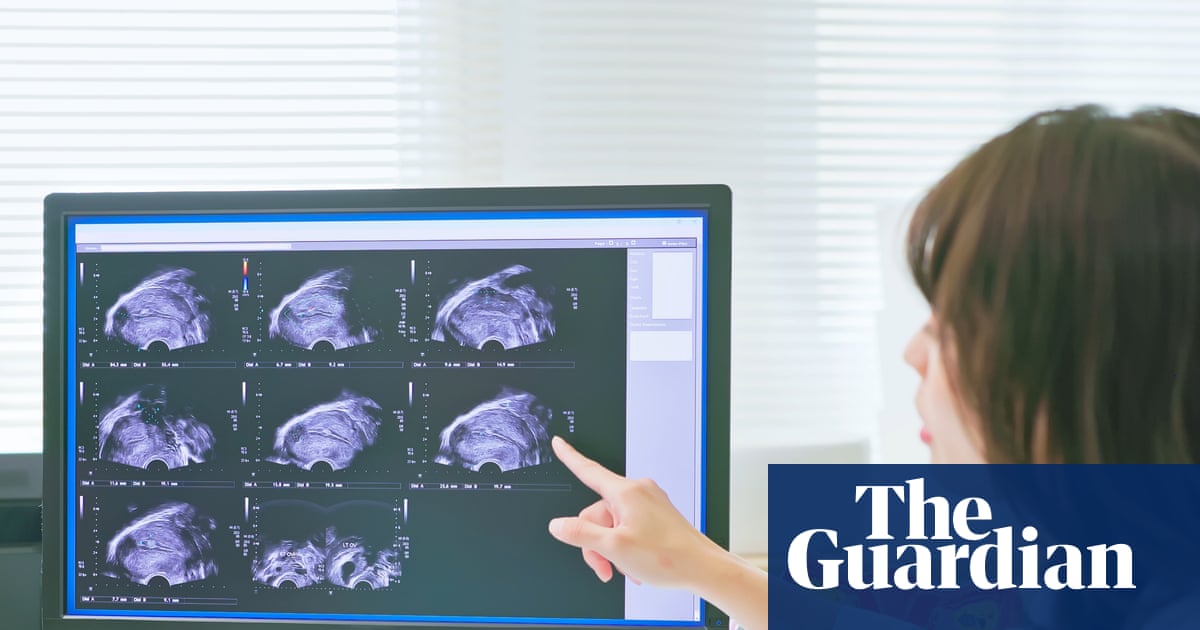
A non-invasive scan for endometriosis has shown promising results in a trial, boosting hopes for far quicker diagnosis.The trial, which included 19 women with the condition, suggests that an experimental radiotracer, called maraciclatide, can “light up” endometriosis on a scan. The current need for a surgical investigation is seen as a major obstacle to timely diagnosis, with women in England typically waiting nearly a decade.Prof Krina Zondervan, head of department at the Nuffield Department of Women’s and Reproductive Health (NDWRH) at the University of Oxford, and co-lead on the study, said: “The most prevalent subtype of endometriosis currently evades reliable detection, leaving women no choice for diagnosis other than invasive surgery. If these results are confirmed in larger phase 3 studies, imaging with maraciclatide could transform clinical research and practice and potentially empower the development of treatments for women across the globe.”Endometriosis is a condition where tissue found in the womb lining grows elsewhere, such as the ovaries and fallopian tubes. Symptoms include painful periods, painful bowel movements, pain when urinating and pain during or after sex. It is thought to affect about one in 10 women and can affect fertility. There are treatments, including hormone medication and surgery, but the lengthy delays to diagnosis have been a continuing problem.Research by the charity Endometriosis UK suggests women in England currently wait an average of 9 years 4 months – rising to 11 years for women from ethnic minority communities. Wes Streeting, the health secretary, highlighted the problem in the government’s renewed Women’s Health Strategy, earlier this month. Endometriosis can progress, leading to more severe physical symptoms and restricting the ability to make informed choices around fertility.Peritoneal endometriosis, the earliest and most common form of the condition, cannot be reliably detected with existing imaging techniques. Standard MRI scans are typically only able to pick up structural changes that appear with more advanced disease.The latest trial investigated the use of a radiotracer, called maraciclatide, developed by the UK-based company Serac. The tracer is designed to bind to tissue that is in the process of creating new blood vessels – a cardinal feature of endometriosis.Nineteen patients, all due to undergo laproscopies for endometriosis, were given an infusion of the tracer and then underwent a scan called a Spect-CT. The scan results aligned with the surgical diagnosis in 16 out of 19 cases and there were no false positives.Serac said it plans to validate the findings in larger phase 3 trials. If confirmed as effective, a minimally invasive scan could make it easier to run trials for new treatments.Dr Tatjana Gibbons, lead author on the paper and also of the NDWRH, said: “These exciting findings indicate that maraciclatide offers a highly promising diagnostic and monitoring tool, particularly for superficial peritoneal endometriosis, which is the most common and yet the hardest type of endometriosis to identify.”The findings are published in The Lancet Obstetrics, Gynaecology, & Women’s Health.
SRCThe Guardian - World News
LANGEN
LEANCenter-Left
WORDS482
ENT7
WED · 2026-04-29 · 22:30 GMTBRIEF NSR-2026-0430-72607
NSR-2026-0430-72607News Report·EN·Public Health
Trial of non-invasive endometriosis scan boosts hopes for quicker diagnosis
A recent trial involving 19 women has shown promising results for a new non-invasive scan to diagnose endometriosis. The experimental radiotracer, maraciclatide, developed by Serac, successfully "lit up" endometriosis on scans by binding to tissue forming new blood vessels, a key characteristic of the condition.
Hannah Devlin Science correspondentThe Guardian - World NewsFiled 2026-04-29 · 22:30 GMTLean · Center-LeftRead · 2 min
The Guardian - World NewsFIG 01
Reading time
2min
Word count
482words
Sources cited
4cited
Entities identified
7entities
Quality score
100%
§ 01
Briefing Summary
AI-generatedNEWSAR · AI
A recent trial involving 19 women has shown promising results for a new non-invasive scan to diagnose endometriosis. The experimental radiotracer, maraciclatide, developed by Serac, successfully "lit up" endometriosis on scans by binding to tissue forming new blood vessels, a key characteristic of the condition. This development offers hope for quicker diagnosis, as currently, women in England typically wait nearly a decade for diagnosis, often requiring invasive surgery. Professor Krina Zondervan of the University of Oxford stated that if confirmed in larger studies, this imaging technique could significantly improve clinical practice and research for endometriosis, a condition affecting about one in 10 women and characterized by tissue growth outside the womb.
Confidence 0.90Sources 4Claims 4Entities 7
§ 02
Article analysis
Model · rule-basedFraming
Public Health
Tone
Measured
AI-assessed
CalmNeutralAlarmist
Factuality
0.80 / 1.00
Factual
LowHigh
Sources cited
4
Well sourced
FewMany
§ 03
Key claims
4 extracted01
The trial results aligned with the surgical diagnosis in 16 out of 19 cases and there were no false positives.
statisticSerac
Confidence
1.00
02
The current need for a surgical investigation is seen as a major obstacle to timely diagnosis, with women in England typically waiting nearly a decade.
statisticProf Krina Zondervan
Confidence
0.90
03
Maraciclatide could transform clinical research and practice and potentially empower the development of treatments for women across the globe.
predictionProf Krina Zondervan
Confidence
0.80
04
Endometriosis can progress, leading to more severe physical symptoms and restricting the ability to make informed choices around fertility.
factualnull
Confidence
0.70
§ 04
Full report
2 min read · 482 words§ 05
Entities
7 identifiedKey playerOppositionContext
§ 06
Keywords & salience
9 termsendometriosis diagnosis
1.00
non-invasive scan
0.90
maraciclatide
0.80
radiotracer
0.70
surgical investigation
0.60
diagnostic delays
0.50
women's health
0.50
clinical practice
0.40
fertility
0.40
§ 07
Topic connections
Interactive graph Network visualization showing 51 related topics
View Full Graph Person Organization Location Event|Click node to navigate|Edge numbers = shared articles