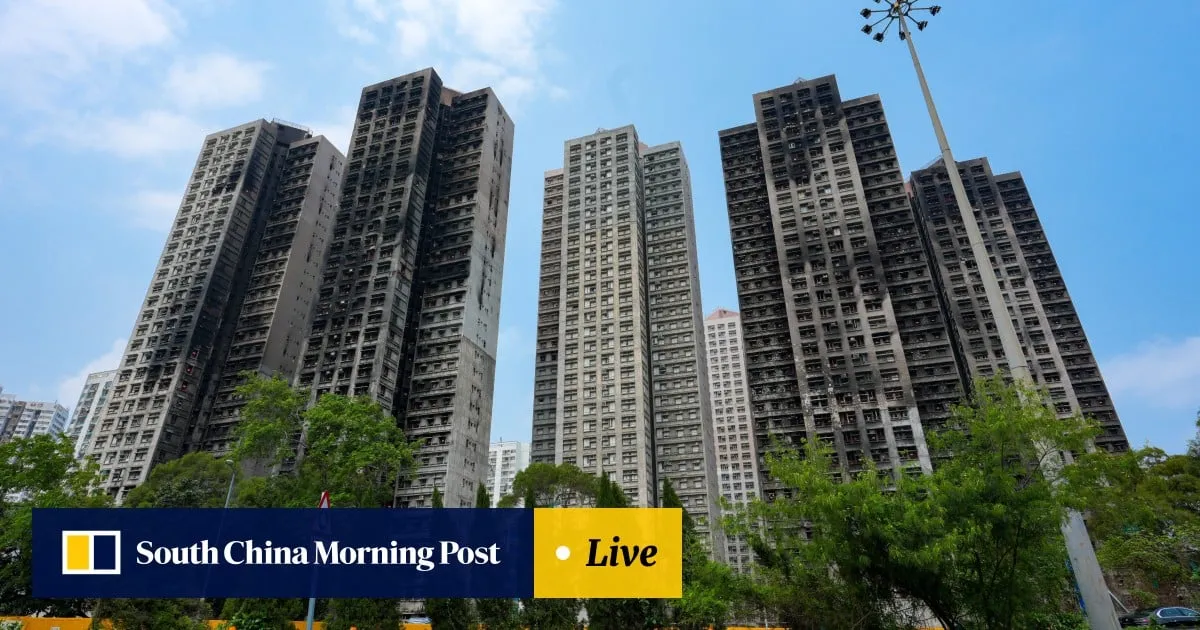
Published: 11:21am, 30 Apr 2026Updated: 11:57am, 30 Apr 20260 New UpdateIntroductionThis story has been made freely available as a public service to our readers. Please consider supporting SCMP’s journalism by subscribing.An independent committee investigating the deadly blaze at Hong Kong’s Wang Fuk Court residential estate is holding its 21st day of evidential hearings on Thursday, with three witnesses from the Urban Renewal Authority set to give evidence.The first witness, URA case manager Matthew Chan Yat-ho, has said the authority was aware of the practice of bid-rigging in the building maintenance sector, but did not consider that such rigging took place in the case of Wang Fuk Court.The URA was also aware of significant differences in prices submitted for renovation contract tenders, but did not not intervene by assessing the reasonableness of bids for individual projects.The tragedy at the Wang Fuk Court housing estate on November 26 last year claimed 168 lives and displaced nearly 5,000 residents.The blaze broke out while the estate’s eight blocks were undergoing renovations. Flammable polyfoam boards used to seal household windows, along with allegedly non-fire-retardant scaffolding mesh, were identified as factors that contributed to the rapid spread of the fire.On day 20 of the hearings, the Buildings Department told the judge-led panel that flammable polyfoam boards should not be used to block household windows due to the fire risks they posed, adding that their use was regulated by law.However, the department said the Wang Fuk Court case did not fall within its remit, as it did not oversee government-built structures such as subsidised housing estates, which are regulated by the Independent Checking Unit (ICU) under the Housing Bureau.A retired senior surveyor from the department also rejected the ICU’s claim that there were no regulations governing foam materials and said the unit had not consulted him before reaching that conclusion.The committee also heard that, before the fire, the department had relied on certificates submitted by contractors to assess the fire retardancy of scaffolding mesh but had no mechanism to verify those documents.The Home Affairs Department’s Tai Po district office liaison officer Or Wai-yin and then district officer Eunice Chan Hau-man were also questioned about the roles of the department and district councillor Peggy Wong Pik-kiu in decisions related to estate management and the HK$336 million (US$42.9 million) renovation project.Follow our live reporting as more details unfold. coverage:11:21AMURA aware of rigging risks but did not consider them for Wang Fuk CourtChan agrees that the URA did not take bid-rigging risks into consideration when handling Wang Fuk Court project tenders.Dawes tells the committee that bid-rigging had been common in Hong Kong’s building maintenance industry, citing a Competition Commission report in 2016.According to the report, 65 per cent of the consultant bidding price fell below “the minimum estimate of costs associated with even the most basic consultancy project, as provided by an industry expert”.“One possible interpretation would be that consultants bid aggressively low in order to win a project and subsequently benefit from awarding renovation work to particular contractors,” the report said.Chan agrees with Dawes that the URA was aware of such manipulation, but asserts that it introduced its Smart Tender system to mitigate rigging risks.He admits that the risk of bid-rigging remained nonetheless, as members of the public were naturally attracted to lower-priced options, and the URA’s lack of price assessments could be exploited by unscrupulous consultants.Wang Fuk Court. Photo: Eugene Lee11:18AMURA didn’t assess price reasonablenessChan says that while the bidding prices for the registered inspector and project consultant at Wang Fuk Court differed significantly, ranging from over HK$2 million to HK$45,000, he did not analyse whether they were reasonable.When asked by committee counsel Victor Dawes whether he suspected any illegal elements upon seeing the “suspiciously low” prices, Chan says he did not.“Project consultancy is a professional service, and prices can vary significantly. They are not strictly correlated with material costs, as is the case for contractors,” he says, adding that such discrepancies in bids for registered inspectors and consultants are “common”, as some newcomers may offer lower prices to gain experience.Chan adds that the typical consultancy fee for an estate with more than 1,000 households is around HK$680,000.However, the committee hears that Will Power secured the consultancy role for the Wang Fuk Court project, which involves nearly 2,000 households, for HK$330,000.Wang Fuk Court. Photo: Eugene Lee11:12AMRenovation contract 3 times that of URA consultant’s estimateA preliminary cost estimate of just over HK$102 million was submitted in January 2019 by RS Surveyors, the independent consultant appointed by the URA to look at the Wang Fuk Court renovation contract tendering, the committee hears.But the estate’s owners’ corporation eventually voted for a costlier HK$336 million contract by Prestige Construction and Engineering – the most expensive option presented.Wang Fuk Court. Photo: Elson Li11:00AMURA ‘had no role’ in hiring consultantThe first to testify on Thursday is Matthew Chan Yat-ho, a case manager from the Urban Renewal Authority, who had been handling the tendering for Wang Fuk Court’s renovation project since 2019.Will Power Architects had been selected as the registered inspector for the project in 2019, and also picked by homeowners as the project consultant in 2021.Although the service contract between the authority and the owners’ corporation stipulated that the URA should assist the latter with hiring a registered inspector and consultant, Chan says the body “had no roles” in both processes.He adds that the URA only provided limited assistance, including uploading tendering s to their tendering system and summarising bids as tables.Wang Fuk Court. Photo: Eugene Lee10:15AMRebuttal on ‘no regulations’ claimsICU surveyor Andy Ku Siu-ping said in his witness statement that there were no regulations governing polyfoam boards used to cover household windows, as their use was temporary and therefore not considered building works.Ku said he had consulted Buildings Department surveyor Franko Tse Kam-ming, who had been seconded to the ICU before retiring in July 2025, before reaching this conclusion.However, speaking before the committee on Monday, Tse said he did not recall such a conversation taking place and that he was unlikely to have made such “absolute” remarks.He added that he had not received any documents related to the Wang Fuk Court case and would regard Ku’s statement as “an unfair allegation” against him.Franko Tse Kam-ming. Photo: Karma Lo10:14AMNo site inspections of scaffolding meshCheung also told the committee that, before the fire, the department had long relied on fire-retardancy certificates submitted by contractors to assess scaffolding mesh, without carrying out on-site inspections.She also said the department lacked a mechanism to verify the authenticity of such documents.Wang Fuk Court. Photo: Jelly Tse10:13AMUse of polyfoam boards ‘inappropriate’Karen Cheung Yuk-ching, an assistant director at the Buildings Department overseeing the Mandatory Building Inspection Scheme, said the use of polyfoam boards to cover windows during renovations was “inappropriate”.She said the practice increased fire risks and could also prevent occupants from seeing outside in the event of a blaze, potentially delaying their response.Cheung added that the department would generally take enforcement action over the use of polyfoam boards, but Wang Fuk Court, a government-built subsidised estate, fell outside its jurisdiction.It should instead be handled by the Housing Bureau’s ICU, she said.Karen Cheung Yuk-ching (centre) . Photo: Jonathan Wong10:12AMMovable panels ‘contravened law’Cheung also said movable wooden panels installed in emergency staircases, replacing fireproof windows, would contravene the law.An ICU witness said in a written statement that the department had been conducting site safety inspections for minor works, such as building repairs, since April 2023, but only informed the unit in January 2026.He argued that, had the department notified the ICU earlier, it could have identified and acted on the wooden panels sooner.Cheung declined to comment on the alleged delay on Monday, saying she was not primarily responsible for the matter.Wang Fuk Court. Photo: Eugene Lee10:11AMDepartment’s role examinedMonday’s hearing also examined the roles of the Home Affairs Department and district councillor Peggy Wong in the building management of Wang Fuk Court.Some residents alleged bid-rigging in the selection of Prestige Construction and Engineering as the main renovation contractor, after the most expensive option was chosen and a large number of proxy votes were used.Or Wai-yin, a liaison officer at the Tai Po District Office, said the department lacked sufficient information to follow up on proxy-related complaints, as the validity of such votes was determined by the chairman of the owners’ corporation management committee or the meeting’s convenor.Regarding complaints about Wong, who admitted collecting some proxy votes, then Tai Po district officer Eunice Chan Hau-man said councillors were entitled to express personal views on building management matters, and the department could not intervene unless the votes were obtained unlawfully.Or Wai-yin (centre). Photo: Karma Lo10:10AMSix ‘human factors’In his opening statement, committee counsel Victor Dawes identified six “human factors” contributing to the heavy toll of the fire.Three of these – the use of polyfoam boards, substandard scaffolding mesh and movable foam boards in emergency staircases – were discussed on Monday.The others were the deactivation of the fire alarm system, depleted fire service water tanks, and workers’ smoking habits.Victor Dawes SC (centre). Photo: Jonathan Wong11:21AMURA aware of rigging risks but did not consider them for Wang Fuk Court11:18AMURA didn’t assess price reasonableness11:12AMRenovation contract 3 times that of URA consultant’s estimate11:00AMURA ‘had no role’ in hiring consultant10:15AMRebuttal on ‘no regulations’ claims10:14AMNo site inspections of scaffolding mesh10:13AMUse of polyfoam boards ‘inappropriate’10:12AMMovable panels ‘contravened law’10:11AMDepartment’s role examined10:10AMSix ‘human factors’
SRCSouth China Morning Post
LANGEN
LEANCenter-Right
WORDS1 549
ENT7
THU · 2026-04-30 · 03:21 GMTBRIEF NSR-2026-0430-72646
NSR-2026-0430-72646News Report·EN·Human Interest
Tai Po fire probe: URA’s lack of price checks opened door to ‘unscrupulous consultants’
An independent committee investigating the deadly Wang Fuk Court fire in Tai Po, which killed 168 people, heard that the Urban Renewal Authority (URA) failed to check renovation contract prices. This lack of oversight, despite awareness of bid-rigging and significant price discrepancies, allegedly allowed "unscrupulous consultants" to operate.
Leopold Chen,Brian WongSouth China Morning PostFiled 2026-04-30 · 03:21 GMTLean · Center-RightRead · 7 min
South China Morning PostFIG 01
Reading time
7min
Word count
1 549words
Sources cited
7cited
Entities identified
7entities
Quality score
100%
§ 01
Briefing Summary
AI-generatedNEWSAR · AI
An independent committee investigating the deadly Wang Fuk Court fire in Tai Po, which killed 168 people, heard that the Urban Renewal Authority (URA) failed to check renovation contract prices. This lack of oversight, despite awareness of bid-rigging and significant price discrepancies, allegedly allowed "unscrupulous consultants" to operate. The fire, which occurred during renovations, was exacerbated by flammable polyfoam boards and non-fire-retardant scaffolding mesh. The Buildings Department stated polyfoam use for windows is regulated and illegal, but the case didn't fall under its purview. The committee also learned the department relied on unverified contractor certificates for scaffolding mesh fire retardancy.
Confidence 0.90Sources 7Claims 3Entities 7
§ 02
Article analysis
Model · rule-basedFraming
Human Interest
Tone
Measured
AI-assessed
CalmNeutralAlarmist
Factuality
0.85 / 1.00
Factual
LowHigh
Sources cited
7
Well sourced
FewMany
§ 03
Key claims
3 extracted01
Flammable polyfoam boards used to seal household windows posed a significant fire risk, according to the Buildings Department.
factualBuildings Department
Confidence
1.00
02
The tragedy at the Wang Fuk Court housing estate claimed 168 lives and displaced nearly 5,000 residents.
statistic
Confidence
1.00
03
The URA was aware of the practice of bid-rigging in the building maintenance sector, but did not consider that such rigging took place in the case of Wang Fuk Court.
quoteMatthew Chan Yat-ho
Confidence
1.00
§ 04
Full report
7 min read · 1 549 words§ 05
Entities
7 identifiedKey playerOppositionContextPositiveNeutralNegative
People3
Organizations1
Events1
§ 06
Keywords & salience
10 termstai po fire
1.00
urban renewal authority
0.90
bid-rigging
0.80
building maintenance
0.70
flammable polyfoam boards
0.70
scaffolding mesh
0.60
price checks
0.50
fire retardancy
0.50
housing bureau
0.40
estate management
0.40
§ 07
Topic connections
Interactive graph No topic relationship data available yet. This graph will appear once topic relationships have been computed.