The Bank of England has left interest rates unchanged at 3.75% but warned that the UK may need to brace for hikes later this year, as “higher inflation is unavoidable” as a result of the war in the Middle East.The Bank’s rate-setting monetary policy committee (MPC) voted to leave borrowing costs on hold on Thursday, with its nine-member committee split 8-1 in their decision.Andrew Bailey, the governor of the Bank of England, said: “The war in the Middle East is causing inflation to rise again this year.”He added that the policymakers were monitoring the global situation and its impact on the UK economy “very closely”, but that the decision to hold rates at 3.75% for now is a “reasonable place given the situation of the economy and the unpredictability of events in the Middle East”.The committee’s role is to try to help keep UK inflation at a target of 2%. It has cut interest rates six times since mid-2024 and had been expected to make further reductions this year before the US-Israeli war on Iran began.However, the Bank said the conflict in the Middle East meant that the outlook for inflation was “a very different picture from three months ago” when it was expected to fall to 2% by the middle of the year. Instead the latest figures from the Office for National Statistics (ONS) figures showed the rate of inflation in the UK rose to 3.3% in March, up from 3% in February.The Bank said the sharp rise in energy prices is already being felt in the UK in the form of higher fuel costs and is likely to push inflation higher as the effect of these higher energy prices pass through the economy.However, while policymakers believe that higher global energy prices will have a direct effect on pushing up fuel costs and energy bills, they said the impact of second-round effects is likely to be restrained. The Bank said demand for labour in the UK is subdued and unemployment has been rising since 2024, making it harder for workers to bargain for higher wages. Similarly, companies’ ability to increase prices is likely to be constrained by weak demand from consumers amid shaky consumer confidence.“Relative to the previous energy shock of 2022 [after the start of the Russian-Ukrainian war], currents events were occurring from a starting point of lower inflation, weaker demand, a looser labour market, and a restrictive monetary policy,” the Bank said.The only dissenting voice in this decision was Huw Pill, the chief economist of the Bank of England, who voted to raise rates to 4%. Pill said he saw the risk of second-round effects of higher prices and wages being “skewed to the upside” and warned that they had the potential to raise UK inflation beyond the near term in a “persistent manner”.The Bank laid out three scenarios for what might happen to the UK economy depending on different impacts of the Iran war. In all three cases, inflation is expected to rise, and unemployment will go up to at least 5.5%.In the worst-case scenario, in which oil prices peak at $130 a barrel and remain at this level for a prolonged period, inflation is expected to peak at 6.2% in the first three months of 2027 and the Bank would push interest rates up to 5.25%, before dropping down to 2.9% by 2028.However, policymakers expect to not be as extreme as this. In the more benevolent scenario A, oil peaks at $108 a barrel this year before falling to below $80 at the start of 2027 and to $72 by the end of 2028. In scenario B, oil prices also peak at $108 but remain higher over a longer period.Earlier today, Brent crude hit a four-year high of $126 a barrel, but has now dropped back to $115.50 a barrel.In scenario A, inflation will be 3.3% in 2026, 2.6% in 2027 and 1.5% in 2028. In scenario B, it is also 3.3% in 2026, then 3% in 2027 and 2% in 2028. Both cases see unemployment rise to 5.5% in 2027 and drop to 5.4% in 2028.In scenario C, its worst-case scenario, unemployment rises to 5.6%.The decision to keep rates on hold for now, however, will come as a relief to the Labour government before the important local elections next week.Rachel Reeves, the chancellor, had also announced a package of anti-inflation measures in her late November budget that she hoped would pave the way for more rate cuts. These included cuts to utility bills and a rail-fare freeze, both of which came into effect in April, and should temper a rise in inflation for this month.Economic activity had showed some momentum in the UK before the energy price shock. In the three months to February, GDP grew by 0.5% and the unemployment rate fell from 5.2% to 4.9%.
SRCThe Guardian - World News
LANGEN
LEANCenter-Left
WORDS803
THU · 2026-04-30 · 11:01 GMTBRIEF NSR-2026-0430-72739
NSR-2026-0430-72739News Report·EN·Economic Impact
Bank of England warns ‘higher inflation is unavoidable’ after leaving interest rates on hold
The Bank of England has maintained its interest rate at 3.75%, despite a split decision by its Monetary Policy Committee. Governor Andrew Bailey stated that higher inflation is now unavoidable due to the war in the Middle East, which is driving up energy prices and consequently fuel costs in the UK.
Tom KnowlesThe Guardian - World NewsFiled 2026-04-30 · 11:01 GMTLean · Center-LeftRead · 4 min
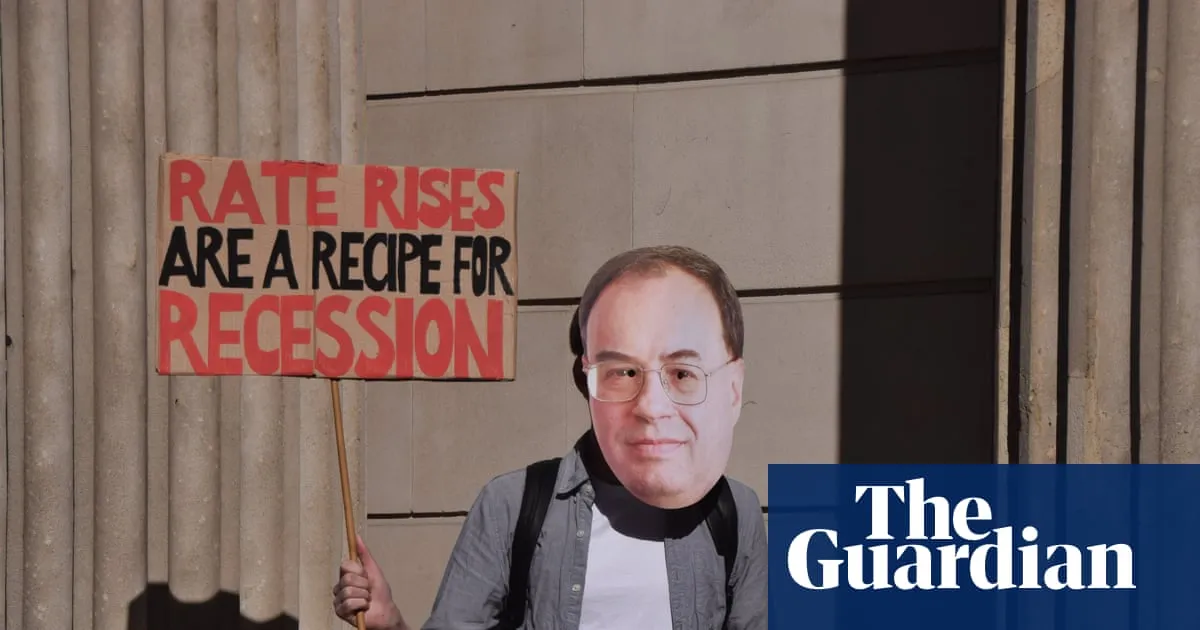
The Guardian - World NewsFIG 01
Reading time
4min
Word count
803words
Sources cited
4cited
Entities identified
0entities
Quality score
75%
§ 01
Briefing Summary
AI-generatedNEWSAR · AI
The Bank of England has maintained its interest rate at 3.75%, despite a split decision by its Monetary Policy Committee. Governor Andrew Bailey stated that higher inflation is now unavoidable due to the war in the Middle East, which is driving up energy prices and consequently fuel costs in the UK. This conflict has altered the inflation outlook significantly from earlier projections. While inflation rose to 3.3% in March, the Bank anticipates that the impact of higher energy prices on broader inflation will be limited by subdued labor demand and weak consumer confidence. The Bank is closely monitoring the global situation and its economic repercussions, with potential for future rate hikes remaining a possibility.
Confidence 0.90Sources 4Claims 5
§ 02
Article analysis
Model · rule-basedFraming
Economic Impact
Conflict
Tone
Measured
AI-assessed
CalmNeutralAlarmist
Factuality
0.85 / 1.00
Factual
LowHigh
Sources cited
4
Well sourced
FewMany
§ 03
Key claims
5 extracted01
Chief economist Huw Pill voted to raise interest rates to 4% due to risks of persistent second-round effects.
factualHuw Pill
Confidence
1.00
02
UK inflation rose to 3.3% in March, up from 3% in February.
statisticOffice for National Statistics
Confidence
1.00
03
The Bank of England's Monetary Policy Committee voted 8-1 to leave interest rates unchanged at 3.75%.
factualBank of England
Confidence
1.00
04
Higher inflation is unavoidable as a result of the war in the Middle East.
quoteAndrew Bailey
Confidence
0.90
05
UK unemployment is expected to rise to at least 5.5% in all three projected economic scenarios.
predictionBank of England
Confidence
0.80
§ 04
Full report
4 min read · 803 words§ 06
Keywords & salience
8 termshigher inflation
1.00
interest rates
0.90
bank of england
0.80
middle east war
0.70
energy prices
0.60
uk economy
0.50
monetary policy
0.50
labour market
0.40
§ 07
Topic connections
Interactive graph No topic relationship data available yet. This graph will appear once topic relationships have been computed.