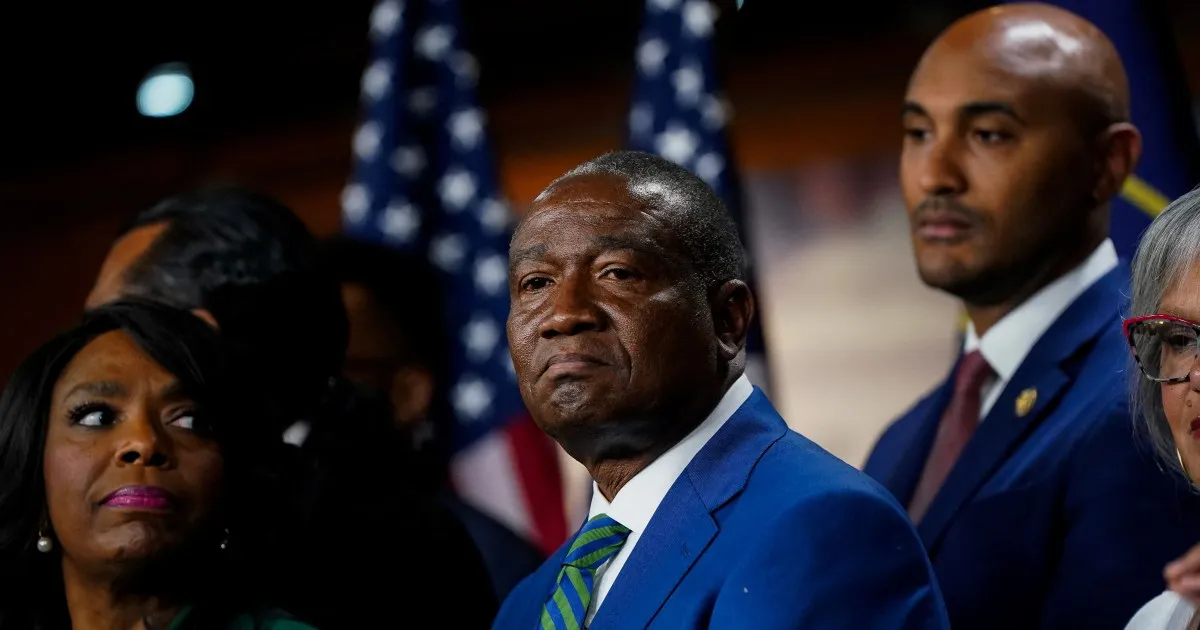
EXPLAINERThe ruling, deemed a ‘big win’ by Trump, will result in redistricting in Louisiana, but it will have farther-reaching effects.Democratic US Representative Cleo Fields, centre, whose congressional district in Louisiana was described as an 'unconstitutional gerrymander' in the Supreme Court majority's opinion, takes part in a Congressional Black Caucus news conference on the court's decision [Elizabeth Frantz/Reuters]Published On 30 Apr 2026The United States Supreme Court has voided a key provision of a landmark civil rights law by ruling that the electoral map of Louisiana had been drawn up unconstitutionally to create two Black-majority districts.The decision represents a major reinterpretation of the landmark Voting Rights Act of 1965 – in particular, its provision designed to protect minority voters from having their political power diluted.It is unclear how much of that provision – Section 2 of the act – remains in force.Wednesday’s Supreme Court ruling is seen as a major win for Louisiana Republicans and President Donald Trump’s administration and is expected to make it harder for minorities to challenge electoral maps as racially discriminatory under the 1965 law.Louisiana Governor Jeff Landry told Republican candidates for the House of Representatives on Wednesday that he planned to suspend next month’s primary elections to allow state lawmakers time to approve a new congressional map, The Washington Post reported, quoting two people with knowledge of the calls.The latest ruling comes during a wider battle over congressional redistricting before midterm elections in November.What has the Supreme Court ruled?The court held that a map that created two Black-majority congressional districts in Louisiana was unconstitutional. The 6-3 ruling by justices blocks an electoral map that had given Louisiana a second Black-majority US congressional district.The court’s conservative majority found that the Louisiana district represented by Democrat Cleo Fields relied too heavily on race.Chief Justice John Roberts described the 6th Congressional District as a “snake” that stretches more than 320km (200 miles) to link parts of Shreveport, Alexandria, Lafayette and Baton Rouge.The ruling was authored by Justice Samuel Alito and joined by his five fellow conservative justices. The dissenting justices are liberals.“That map is an unconstitutional gerrymander,” Alito wrote on behalf of the six conservatives.What is the Voting Rights Act?The Voting Rights Act was a piece of follow-up legislation to the Civil Rights Act, signed into law by President Lyndon B Johnson in 1964. It bans discrimination on the basis of race, colour, religion, sex or national origin.The 1965 law primarily ended common discriminatory practices against Black voters that were prevalent in many states, including literacy tests, that were designed to prevent them from voting.Section 2 of the act prohibits voting practices or procedures that discriminate on the basis of race, colour or membership of a language-minority group.The section has long been understood to bar electoral maps that dilute the voting strength of minority communities, even when there is no direct evidence of racist intent.The law also established a process known as preclearance, which required that all or parts of 15 states with a history of discriminatory practices in voting obtain federal approval before making changes to the way they hold elections.What is gerrymandering?Gerrymandering refers to the practice by politicians of redrawing the boundaries of electoral districts to give themselves a political advantage.Redrawing electoral boundaries is not always done with the deliberate aim of securing an advantage in elections. When there is no such intent, the process is known simply as redistricting, rather than gerrymandering.How has the US Supreme Court weakened the Voting Rights Act?Section 2 of the act was amended by Congress in 1982 to prohibit electoral maps that would result in undermining the clout of minority voters, even without direct proof of racist intent.For more than four decades, plaintiffs could win a Section 2 claim by showing that a voting map had a racially discriminatory impact under this legal standard, known as the “results test”.The Supreme Court’s ruling on Wednesday, however, has in effect applied an “intent test” to Section 2, experts said. In the ruling, Alito wrote that the focus of Section 2 must now be to enforce the US Constitution’s prohibition on intentional racial discrimination under its 15th Amendment.The 15th Amendment, ratified in 1870 after the US Civil War, which ended slavery, authorises Congress to pass laws ensuring that the right to vote is not denied “on account of race, colour or previous condition of servitude”.Interpreting Section 2 to “outlaw a map solely because it fails to provide a sufficient number of majority-minority districts would create a right that the amendment does not protect”, Alito concluded.What have the reactions been to this ruling?“I love it,” Trump told reporters after hearing of the decision, adding that he believes Republican-led states will now want to reconfigure their voting maps.In a social media post, Trump praised Alito as “brilliant” and called the ruling “a BIG WIN for Equal Protection under the Law, as it returns the Voting Rights Act to its Original Intent, which was to protect against intentional Racial Discrimination”.The Trump administration had backed the challenge made in the Louisiana case to the Voting Rights Act, advocating for raising the bar for proving a Section 2 violation.US House Speaker Mike Johnson, a Republican from Louisiana, said the Supreme Court had reached the “obvious result” in the case.“We’ll see what effect it has,” Johnson told reporters. “We have, as you know, a primary coming up in about two weeks. So we’ll see if the state legislature deems it appropriate to go in and draw new maps.”Former President Barack Obama, a Democrat, warned that the ruling will free state legislatures to reconfigure electoral districts to “systematically dilute and weaken the voting power of racial minorities – so long as they do it under the guise of ‘partisanship’ rather than explicit ‘racial bias'”.“This is a devastating and profound step backwards for American Democracy,” Democratic Senator Raphael Warnock wrote on social media.Justice Elena Kagan, in a dissent joined by the two other liberal justices on the Supreme Court, said the ruling rendered the Voting Rights Act “all but a dead letter” and predicted “grave” consequences.“Under the court’s new view of Section 2, a state can, without legal consequence, systematically dilute minority citizens’ voting power,” Kagan wrote. “Of course, the majority does not announce today’s holding that way. Its opinion is understated, even antiseptic. The majority claims only to be ‘updating’ our Section 2 law, as though through a few technical tweaks.”“But in fact, those ‘updates’ eviscerate the law, so that it will not remedy even the classic example of vote dilution given above,” Kagan added.The Congressional Black Caucus, a group of African American US lawmakers, condemned the ruling.“Without the protections of the VRA [Voting Rights Act], Republicans now have the ability to move forward with a nationwide scheme to rig congressional maps in their favor – to manufacture more districts for themselves by eliminating majority-Black districts, while stripping away the ability to challenge those racist, anti-Black maps in court,” it said in a statement.Warnock, a member of the caucus, said the ruling gutted the protections that civil rights champion Martin Luther King Jr “marched for [and] the protections made possible by civil rights protesters who spilled blood in pursuit of a more perfect union”.The effect of the ruling may be felt more strongly in 2028 because most filing deadlines for this year’s congressional races have already passed. Louisiana, though, may have to redraw its congressional districts now to comply with the decision.With November’s congressional elections looming, the court’s decision could prompt Republican-led states to seek to redraw electoral maps to weaken US House seats considered safely Democratic.The ruling was made during a battle unfolding in Republican-governed and Democratic-led states around the country involving the redrawing of electoral maps to change the composition of US House districts for partisan advantage before November.Trump and his fellow Republicans hope to retain the party’s razor-thin majorities in the House and Senate.Republicans currently hold 217 seats in the House while Democrats hold 212. There is one independent and five vacancies in the House.In the Senate, Republicans hold 53 seats and Democrats hold 45. Two independents caucus with the Democrats.In February, for example, the Supreme Court ruled in favour of a California redistricting measure that is likely to net the Democratic Party more congressional seats. The court rejected a challenge from the state Republican Party.The full impact of the court’s latest ruling on the midterms is not immediately clear although legal experts said states may try to enact new maps. Louisiana, where Black people make up roughly one-third of the population, has six US House districts. After Wednesday’s court ruling, it will now have one majority-Black district.The state has primary elections set for May 16. The governor’s announcement to suspend the voting could come as early as Friday, one day before early voting is due to begin, according to The Washington Post.
SRCAl Jazeera
LANGEN
LEANCenter
WORDS1 464
THU · 2026-04-30 · 13:42 GMTBRIEF NSR-2026-0430-72756
NSR-2026-0430-72756News Report·EN·Legal & Judicial
Has the US Supreme Court weakened the Voting Rights Act – and how?
The US Supreme Court has voided a key provision of the Voting Rights Act of 1965 by ruling Louisiana's congressional map unconstitutional. The 6-3 decision, authored by Justice Samuel Alito, found that the creation of a second Black-majority district relied too heavily on race, deeming it an unconstitutional gerrymander.
Sarah ShamimAl JazeeraFiled 2026-04-30 · 13:42 GMTLean · CenterRead · 6 min
Al JazeeraFIG 01
Reading time
6min
Word count
1 464words
Sources cited
5cited
Entities identified
0entities
Quality score
75%
§ 01
Briefing Summary
AI-generatedNEWSAR · AI
The US Supreme Court has voided a key provision of the Voting Rights Act of 1965 by ruling Louisiana's congressional map unconstitutional. The 6-3 decision, authored by Justice Samuel Alito, found that the creation of a second Black-majority district relied too heavily on race, deeming it an unconstitutional gerrymander. This ruling is expected to make it more difficult for minorities to challenge electoral maps as racially discriminatory. Louisiana's governor plans to suspend primary elections to allow for the creation of a new congressional map. The decision represents a significant reinterpretation of the Voting Rights Act's protections against the dilution of minority voting power.
Confidence 0.90Sources 5Claims 5
§ 02
Article analysis
Model · rule-basedFraming
Legal & Judicial
Social Justice
Tone
Measured
AI-assessed
CalmNeutralAlarmist
Factuality
0.85 / 1.00
Factual
LowHigh
Sources cited
5
Well sourced
FewMany
§ 03
Key claims
5 extracted01
Chief Justice John Roberts described the 6th Congressional District as a 'snake' stretching more than 320km to link specific cities.
quoteJohn Roberts
Confidence
1.00
02
Justice Samuel Alito authored the majority opinion describing the Louisiana map as an 'unconstitutional gerrymander'.
quoteSamuel Alito
Confidence
1.00
03
The Supreme Court ruled 6-3 that a Louisiana map creating two Black-majority congressional districts was unconstitutional.
factual
Confidence
1.00
04
Governor Jeff Landry plans to suspend next month’s primary elections to allow state lawmakers time to approve a new congressional map.
factualThe Washington Post
Confidence
0.90
05
The ruling is expected to make it harder for minorities to challenge electoral maps as racially discriminatory under the 1965 law.
prediction
Confidence
0.70
§ 04
Full report
6 min read · 1 464 words§ 06
Keywords & salience
10 termssupreme court
1.00
voting rights act
1.00
redistricting
0.90
gerrymander
0.80
minority voters
0.70
black-majority districts
0.60
electoral map
0.60
louisiana
0.50
section 2
0.50
donald trump
0.40
§ 07
Topic connections
Interactive graph Network visualization showing 51 related topics
View Full Graph Person Organization Location Event|Click node to navigate|Edge numbers = shared articles