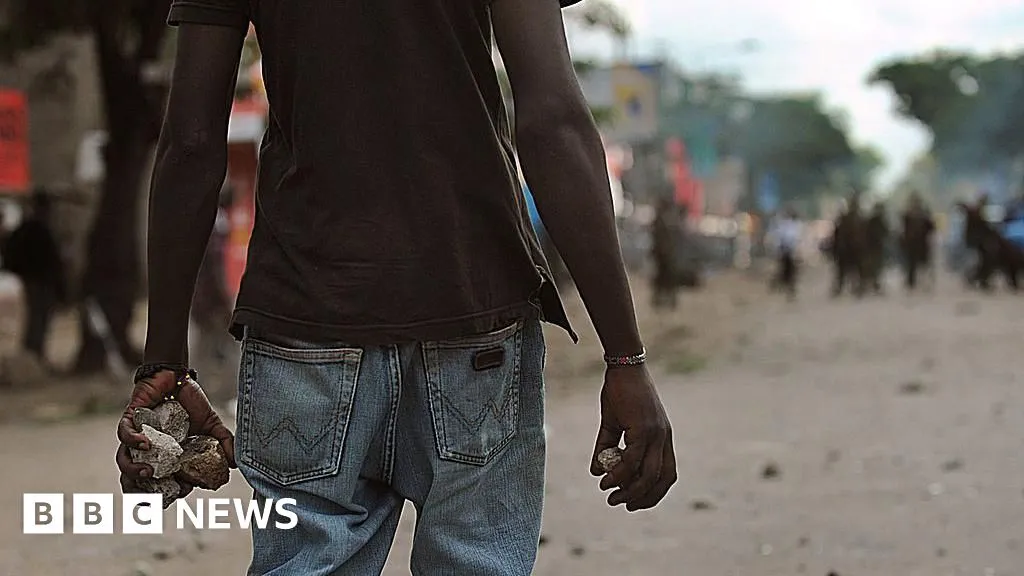
They were a major driver of the unrest surrounding the shocking nationwide violence that followed the 2007 election, which left about 1,500 people dead.And the stage is now being set for a particularly tense electoral cycle even though the next nationwide vote is up to 15 months away.AFP via Getty ImagesEmbittered by his impeachment, Rigathi Gachagua is aiming to unseat the president in next year's pollBearing a huge grudge over his 2024 impeachment and removal from government, former Deputy President Rigathi Gachagua is planning to run for the presidency. In addition, there is an open split within one of the main parties.This is all helping to raise the political temperature with attacks on politicians by hired youths – known locally as goons – becoming more brazen.Interior Minister Kipchumba Murkomen acknowledged to a parliamentary committee that the government was struggling to contain the groups that he said had evolved from street-level outfits into "sophisticated and decentralised networks".Murkomen, who appeared alongside Kenya's security chiefs, disclosed that more than 104 local criminal gangs were active in the country, many under the patronage of politicians"The gangs are owned by political leaders who play a significant role in mobilising people. It is chaotic. An irresponsible leader is a threat to national security," he said, without naming any names.At least 300 suspects have been arrested, as the authorities intensified a crackdown against the criminal groups, with police recovering weapons and communication devices during the raids. However, no politicians were among those held.Successive governments have attempted to ban such groups, yet the problem has persisted with gangs mutating, rebranding and reappearing under new names each electoral cycle.They have developed into sophisticated organisations with a clear structure, a security source told the BBC.The former deputy president appears to have been a target.Since his impeachment, Gachagua has been subjected to a sustained pattern of violence, including being attacked by armed groups at churches over two dozen times. He and his allies have attributed the violence to state-sponsored criminal networks trying to derail his presidential bid.AFP via Getty ImagesTraumatic memories of the deadly violence that followed the 2007 election remainFor months, opposition leaders and civil society groups have accused police of either colluding with, or turning a blind eye to, organised gangs that descend on rallies armed with crude weapons.In many cases, they say, the violence unfolds in the presence of police.The death of veteran politician Raila Odinga last October has also triggered a sharp political realignment in Kenya, with his ODM opposition party splitting into two hostile camps divided over whether or not to support President William Ruto.A 28-year-old man was shot dead when police clashed with supporters of the anti-Ruto faction at a rally in February, prompting the group to condemn what it described as "state-sponsored acts of violence by police and hired goons".Government spokesperson Isaac Mwaura firmly denied reports that some of the criminal groups were state-sponsored."The use of criminal gangs to intimidate or silence individuals undermine our democracy and will not be tolerated. Anyone found financing, supporting, or engaging in such acts will be held fully accountable under the law," he told the BBC.It is not just opposition figures and events that are targeted.In February, a senatorial aspirant aligned to the governing Kenya Kwanza alliance was attacked after a group of people stormed a church service in the western town of Kakamega and forcibly ejected her from the building.Last November, by-elections in western and central Kenya were marred by widespread violence, with polling agents attacked, armed groups clashing during vote counting and police firing tear gas at voters."These incidents paint a troubling picture of a country where political rivalry increasingly spills into organised street violence executed by hired gangs operating with precision and impunity," said Robert Chege, a security analyst.Each attack, taken alone, might be explained away. But together, they sketch a country edging towards an abyss it has fallen into before and barely survived, observers warn."The worrying problem in Kenya is that this is now a near norm carried out by all major political parties. It is, to wit, a Kenyan culture, an epidemic," wrote Prof Makau Mutua, a legal expert and adviser to Ruto.A report last year from the state-funded National Crime Research Centre found hundreds of criminal gangs in operation, with more than 120 linked to politicians. These were no longer temporary formations but had become entrenched institutions within their communities, the report said.Kenya Police Service This issue of goons and guns is going to stop soon. We have clearly investigated it."Inspector General of Police Douglas Kanja told parliamentarians that the police were taking the matter seriously, adding that security agencies had already identified those behind the chaos."This issue of goons and guns is going to stop soon. We have clearly investigated. We have seen where they come from, who funds, who does what, who is the grassroots organiser and so forth," Kanja added.The interior minister addressed concerns regarding accusations of police inaction against gangs. He acknowledged problems in some instances, blaming "operational challenges", including corruption and information leaks, noting that the ministry was taking all allegations of police complicity or inaction seriously.Critics, however, argue that the government's response has been inconsistent - strong in rhetoric but weak in execution.
SRCBBC News - World
LANGEN
LEANCenter
WORDS867
SUN · 2026-05-03 · 06:57 GMTBRIEF NSR-2026-0503-73360
NSR-2026-0503-73360News Report·EN·Conflict
Kenya battles to stop the 'goons and guns' as fears of political violence grow
Kenya is facing growing fears of political violence ahead of next year's general election, with hired youth gangs, known as "goons," becoming increasingly active. These groups, often linked to politicians, have evolved into sophisticated networks, posing a significant threat to national security.
BBC News - WorldFiled 2026-05-03 · 06:57 GMTLean · CenterRead · 4 min
BBC News - WorldFIG 01
Reading time
4min
Word count
867words
Sources cited
1cited
Entities identified
0entities
Quality score
75%
§ 01
Briefing Summary
AI-generatedNEWSAR · AI
Kenya is facing growing fears of political violence ahead of next year's general election, with hired youth gangs, known as "goons," becoming increasingly active. These groups, often linked to politicians, have evolved into sophisticated networks, posing a significant threat to national security. The Interior Minister acknowledged the government's struggle to contain over 104 active criminal gangs, some of which are allegedly patronized by political leaders. This situation is exacerbated by the presidential ambitions of former Deputy President Rigathi Gachagua, who claims to have been a target of violence since his impeachment. Authorities have arrested hundreds and recovered weapons, but no politicians have been detained, highlighting the persistent challenge of addressing these politically-motivated criminal organizations.
Confidence 0.90Sources 1Claims 5
§ 02
Article analysis
Model · rule-basedFraming
Conflict
National Security
Tone
Mixed Tone
AI-assessed
CalmNeutralAlarmist
Factuality
0.75 / 1.00
Factual
LowHigh
Sources cited
1
Limited
FewMany
§ 03
Key claims
5 extracted01
The 2007 post-election violence in Kenya left approximately 1,500 people dead.
statistic
Confidence
1.00
02
A 28-year-old man was shot dead when police clashed with supporters of an anti-Ruto faction at a rally in February.
factual
Confidence
1.00
03
At least 300 suspects have been arrested in an intensified crackdown against criminal groups.
factual
Confidence
1.00
04
More than 104 local criminal gangs are active in Kenya, many under the patronage of politicians.
statisticKipchumba Murkomen
Confidence
0.90
05
Rigathi Gachagua has been attacked by armed groups at churches over two dozen times since his impeachment.
factualRigathi Gachagua and allies
Confidence
0.70
§ 04
Full report
4 min read · 867 words§ 06
Keywords & salience
8 termspolitical violence
1.00
election violence
0.90
criminal gangs
0.90
politicians
0.80
national security
0.70
presidential bid
0.60
impeachment
0.50
security chiefs
0.40
§ 07
Topic connections
Interactive graph No topic relationship data available yet. This graph will appear once topic relationships have been computed.