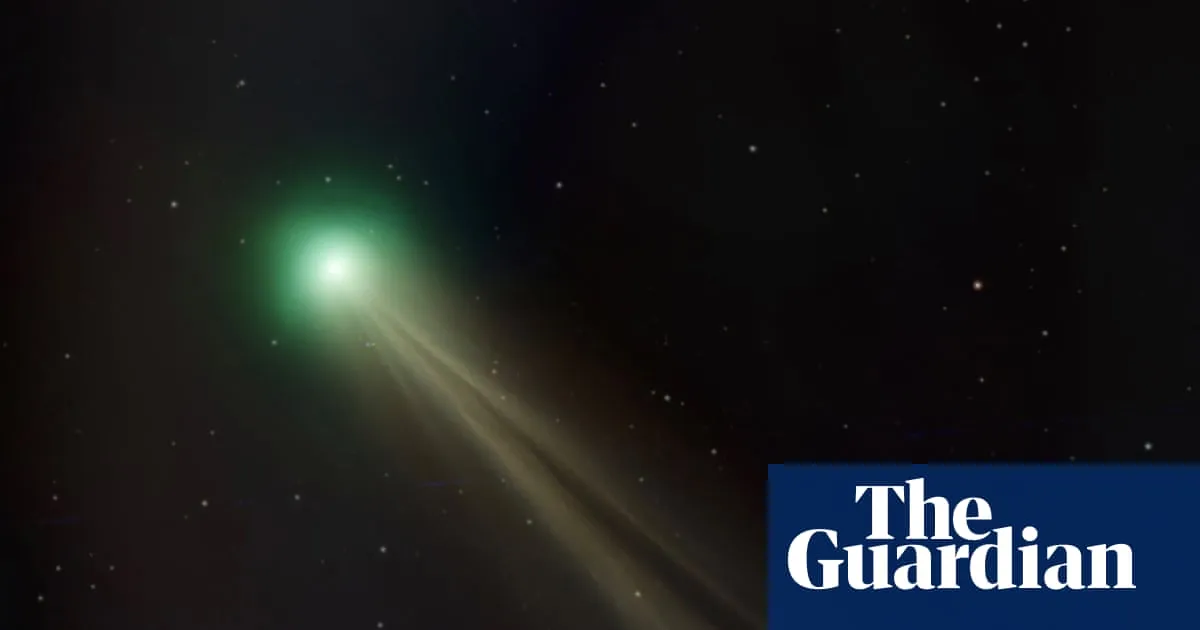
A comet formed on the edges of the solar system will grace southern skies over the next fortnight, giving viewers a rare chance to glimpse it before it disappears from view for another 170,000 years.The comet – known as C/2025 R3 PanSTARRS – had been travelling through the northern hemisphere but has “swung around the sun” and is now visible in the south, said Josh Aoraki, an astronomer at Te Whatu Stardome in Auckland, New Zealand.The comet is fairly bright, but people would need binoculars, a telescope or a camera to see it, Aoraki said.“It’s not naked-eye brightness … [but] this one is a decently easy one to photograph, which is always nice,” he said.The comet will gradually decrease in brightness over the next two weeks, and interested viewers in New Zealand, Australia, South Africa and the Pacific should aim to capture it as soon as possible, Aoraki said.Those wishing to see the comet should find a clear, unobstructed view of the western horizon just after sunset, when the comet is still low in the sky. It will be most visible in the hour after the sun goes down.For those who do manage to spy it, they can expect to see a blue-green orb – a temporary gas around the nucleus, called a coma – and a smudgy tail.“You get the coma and the tail looking like a little fuzzy meteor in the sky.”C/2025 R3 PanSTARRS originates in the Oort Cloud – a vast shell of icy comet-like objects surrounding the distant-most edges of our solar system. It was discovered in 2025 and is a long-period comet that takes roughly 170,000 years to orbit the sun – that’s if it doesn’t break apart first.“It’s really hard to predict the trajectory of them, because as they do go around the sun, they’re losing mass, and that can change the path,” Aoraki said.“So it could be back in that amount of time, but it also could be ejected from the solar system entirely.”
SRCThe Guardian - World News
LANGEN
LEANCenter-Left
WORDS331
ENT10
MON · 2026-05-04 · 03:25 GMTBRIEF NSR-2026-0504-73517
NSR-2026-0504-73517News Report·EN·Human Interest
Rare comet to flash through New Zealand skies – before it disappears for 170,000 years
Comet C/2025 R3 PanSTARRS, originating from the Oort Cloud, is currently visible in southern skies over the next two weeks. Astronomers advise that while not visible to the naked eye, the comet can be observed with binoculars or telescopes.
Eva Corlett in WellingtonThe Guardian - World NewsFiled 2026-05-04 · 03:25 GMTLean · Center-LeftRead · 2 min
The Guardian - World NewsFIG 01
Reading time
2min
Word count
331words
Sources cited
1cited
Entities identified
10entities
Quality score
100%
§ 01
Briefing Summary
AI-generatedNEWSAR · AI
Comet C/2025 R3 PanSTARRS, originating from the Oort Cloud, is currently visible in southern skies over the next two weeks. Astronomers advise that while not visible to the naked eye, the comet can be observed with binoculars or telescopes. It is best viewed in the hour after sunset, low on the western horizon, in locations like New Zealand, Australia, South Africa, and the Pacific. The comet, which takes approximately 170,000 years to orbit the sun, will gradually decrease in brightness. Observers can expect to see a blue-green coma and a smudgy tail. Its trajectory is difficult to predict due to mass loss, meaning it might return in 170,000 years or be ejected from the solar system.
Confidence 0.90Sources 1Claims 5Entities 10
§ 02
Article analysis
Model · rule-basedFraming
Human Interest
Tone
Measured
AI-assessed
CalmNeutralAlarmist
Factuality
0.80 / 1.00
Factual
LowHigh
Sources cited
1
Limited
FewMany
§ 03
Key claims
5 extracted01
The comet requires binoculars, a telescope, or a camera to be seen, not naked eye.
factualJosh Aoraki
Confidence
0.95
02
Viewers should look for a clear, unobstructed view of the western horizon just after sunset.
factualarticle
Confidence
0.90
03
C/2025 R3 PanSTARRS originates in the Oort Cloud and takes roughly 170,000 years to orbit the sun.
factualJosh Aoraki
Confidence
0.90
04
Comet C/2025 R3 PanSTARRS is visible in southern skies over the next fortnight.
factualJosh Aoraki
Confidence
0.90
05
The comet's trajectory is hard to predict and it could be ejected from the solar system.
predictionJosh Aoraki
Confidence
0.70
§ 04
Full report
2 min read · 331 words§ 05
Entities
10 identifiedKey playerOppositionContextPositiveNeutralNegative
People1
Organizations1
Locations7
§ 06
Keywords & salience
9 termscomet
1.00
c/2025 r3 panstarrs
0.90
solar system
0.80
oort cloud
0.70
long-period comet
0.70
astronomy
0.60
skies
0.50
photography
0.40
telescope
0.40
§ 07
Topic connections
Interactive graph No topic relationship data available yet. This graph will appear once topic relationships have been computed.