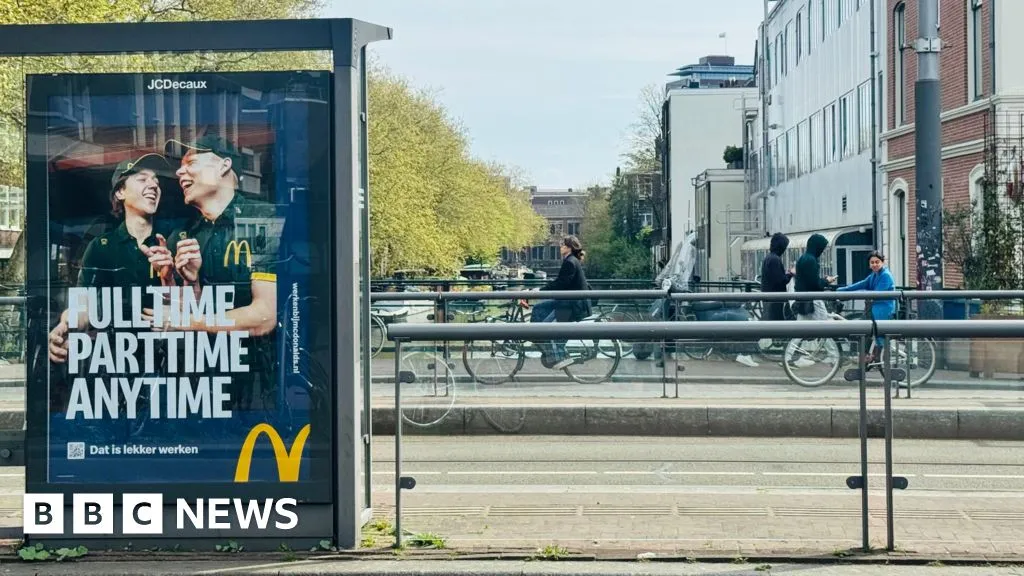
This view is echoed by Anke Bakker, who is Amsterdam group leader for a Dutch political party that focuses on animal rights – Party for the Animals.She instigated the new restrictions, and rejects accusations of them being nanny state."Everybody can just make their own decisions, but actually we are trying to get the big companies not to tell us all the time what we need to eat and buy," says Bakker."In a way, we're giving people more freedom because they can make their own choice, right?"Removing that constant visual nudge, she says, both reduces impulse buying, and signals that cheap meat and fossil heavy travel are no longer aspirational lifestyle choices.Meat was a relatively small slice of Amsterdam's outdoor advertising market – accounting for an estimated 0.1% of ad spend, compared with roughly 4% for fossil related products.The advertising was instead dominated by the likes of clothing brands, movie posters, and mobile phones.But politically the ban sends a message. Grouping meat with flights, cruises and petrol and diesel cars reframes it from a purely private dietary choice to a climate issue.Local politicians Anneke Veenhoff (left) and Anke Bakker say the ban was neededUnsurprisingly, the Dutch Meat Association, which represents the industry, is unhappy at the move, which it calls "an undesirable way to influence consumer behaviour". It adds that meat "delivers essential nutrients and should remain visible and accessible to consumers".Meanwhile, the Dutch Association of Travel Agents and Tour Operators says that the ban on advertising holidays that include air travel is a disproportionate curb on companies' commercial freedom.For activists like lawyer Hannah Prins and her environmental organisation Advocates for the Future, which worked closely with campaign group Fossil-Free Advertising, the ban on meat advertising is a deliberate attempt to create a "tobacco moment" for high carbon food."Because if I look now back at like old pictures, you have Johan Cruyff," says Prins. "The famous Dutch footballer."He would be in s for tobacco. That used to be normal. He died of lung cancer."That you were allowed to smoke on the train, on restaurants. For me, that's like, whoa, why did people do that? You know, that feels so weird."So it really is like what we see in our public space is what we find normal in our society. And I don't think it's normal to see murdered animals on billboards. So I think it's very good that that's going to change."Lawyer Hannah Prins wants people to view meat in the same way as they do smokingThe Dutch capital is not starting from scratch.Haarlem, 18km (11 miles) to its west, was in 2022 the first city in the world to announce a broad ban on most meat advertising in public spaces. It came into force in 2024, together with a prohibition on fossil fuel adverts.Utrecht and Nijmegen have since followed with their own measures that explicitly restrict meat (and in Nijmegen's case also dairy) advertising on municipal billboards, on top of existing bans on adverts for fossil fuels, petrol cars and flying.Globally, dozens of cities have, or are moving to, ban fossil-fuel advertising. Such as Edinburgh, Sheffield, Stockholm and Florence. France even has a nationwide ban.Campaigners hope that the Dutch approach - linking meat and fossil fuels - will act as a legal and political blueprint others can copy.Stand at a tram stop in Amsterdam and you might no longer see a juicy burger or a 19 euro ($18.70; £14.90) flight to Berlin on the shelter.Yet the same eye-catching offers can still pop up in your social media algorithm. And, let's face it, many of us would be looking down at our screens until the tram trundles along.
SRCBBC News - World
LANGEN
LEANCenter
WORDS607
ENT10
SUN · 2026-05-03 · 23:07 GMTBRIEF NSR-2026-0504-73597
NSR-2026-0504-73597News Report·EN·Environmental
Amsterdam bans public adverts for meat and fossil fuels
Amsterdam has banned public advertisements for meat and fossil fuel products. The initiative, led by the Party for the Animals, aims to reduce the influence of large companies on consumer choices and reframe high-carbon products as climate issues rather than purely personal decisions.
BBC News - WorldFiled 2026-05-03 · 23:07 GMTLean · CenterRead · 3 min
BBC News - WorldFIG 01
Reading time
3min
Word count
607words
Sources cited
5cited
Entities identified
10entities
Quality score
100%
§ 01
Briefing Summary
AI-generatedNEWSAR · AI
Amsterdam has banned public advertisements for meat and fossil fuel products. The initiative, led by the Party for the Animals, aims to reduce the influence of large companies on consumer choices and reframe high-carbon products as climate issues rather than purely personal decisions. While meat advertising represented a small portion of the market, fossil fuel products accounted for approximately 4%. The Dutch Meat Association and the Dutch Association of Travel Agents and Tour Operators have expressed opposition, calling the ban an undesirable influence on consumer behavior and a disproportionate curb on commercial freedom. Activists compare the ban on meat advertising to historical efforts to de-normalize tobacco use, aiming to create a similar societal shift regarding high-carbon food consumption.
Confidence 0.90Sources 5Claims 5Entities 10
§ 02
Article analysis
Model · rule-basedFraming
Environmental
Political Strategy
Tone
Measured
AI-assessed
CalmNeutralAlarmist
Factuality
0.60 / 1.00
Mixed
LowHigh
Sources cited
5
Well sourced
FewMany
§ 03
Key claims
5 extracted01
Haarlem was the first city in the world to announce a broad ban on most meat advertising in public spaces in 2022.
factual
Confidence
1.00
02
The ban on meat advertising is a deliberate attempt to create a 'tobacco moment' for high carbon food.
quoteHannah Prins
Confidence
1.00
03
Amsterdam has banned public adverts for meat and fossil fuels.
factual
Confidence
1.00
04
Fossil related products accounted for roughly 4% of Amsterdam's outdoor advertising market.
statistic
Confidence
0.90
05
Meat accounted for an estimated 0.1% of Amsterdam's outdoor advertising market.
statistic
Confidence
0.90
§ 04
Full report
3 min read · 607 words§ 05
Entities
10 identifiedKey playerOppositionContextPositiveNeutralNegative
People4
Organizations5
Locations1
§ 06
Keywords & salience
10 termsadvertising ban
1.00
meat advertising
0.90
fossil fuels
0.80
climate issue
0.70
consumer behaviour
0.60
party for the animals
0.50
amsterdam
0.50
lifestyle choices
0.40
commercial freedom
0.40
tobacco moment
0.40
§ 07
Topic connections
Interactive graph Network visualization showing 6 related topics
View Full Graph Person Organization Location Event|Click node to navigate|Edge numbers = shared articles