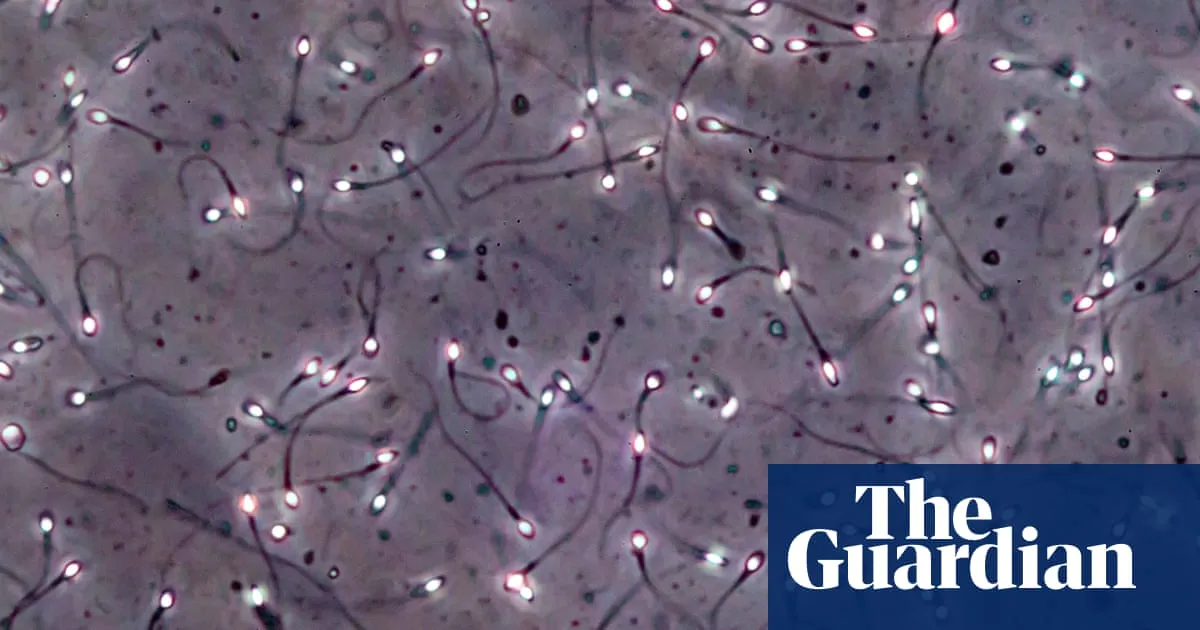
In a groundbreaking fertility trial, a man whose testicular tissue was frozen before he underwent chemotherapy as a child to be re-transplanted 16 years later has been able to produce sperm.It is the first time a transplant of cryopreserved prepubertal testicular tissue has been demonstrated to restore sperm production in an adult patient. The 27-year-old man had the sample frozen when he was 10, before undergoing potent chemotherapy as part of treatment for sickle cell disease.“This is a huge finding,” said Prof Ellen Goossens, of the Vrije Universiteit Brussel, who led the trial. “Many more people will have hope that they can have biological children. It’s great to see for the patients for whom we already have tissue banked.”Treatments such as chemotherapy and radiotherapy can be life-saving for childhood cancer and sickle cell patients – but can also leave them infertile. After puberty, it is possible to preserve male patients’ sperm to use later in IVF, but this is not an option for prepubescent boys.In 2002, the Belgian clinic became the first to start banking testicular tissue of prepubertal patients. The immature testes contain spermatogonial stem cells – the precursors of sperm – and sertoli cells, essential “nurse” cells that support and nourish developing sperm.“At that time this field was in its infancy,” said Goossens. “These methods were just being developed in animals. We told patients’ families we couldn’t guarantee that the fertility restoration would be successful.”The clinic’s first wave of patients are now reaching their mid-20s and some have reached the point of wanting to start a family, including the first patient to have tissue re-transplanted. To treat his sickle cell disease, he had received high-dose chemotherapy in 2008 to wipe out his own blood cells before undergoing a bone marrow transplant. Before the treatment, the clinic surgically removed one testicle, segmented it into small pieces and froze the tissue.Last year, four tissue fragments were grafted back into the remaining testicle and four under the skin of the scrotum. After a year inside the body, the grafts were removed and analysed in the laboratory. The results are published in a preprint paper, which is yet to be peer reviewed.Two of the grafts from inside the testicle had produced mature sperm, which was collected and frozen. Because the tissue fragments are not directly connected to the sperm duct, the researchers do not expect sperm cells to naturally find their way into the semen.About 200 patients each year would be likely to benefit in the UK if they proceed with IVF treatment. Photograph: Science Photo Library/Zephyr/Getty“The sperm that was isolated looked normal,” said Goossens. “We still have to see whether it’s able to fertilise an egg.”Prof Rod Mitchell, a paediatric endocrinologist, is running a similar trial at the Centre for Reproductive Health at University of Edinburgh, which began banking testicular tissue in 2014 and, together with colleagues in Oxford and London, have samples cryopreserved for more than 1,000 UK patients in the UK.He said: “There is now proof of principle in humans that this approach is going to work, which is amazing.” Mitchell expects his clinic to carry out the first transplants imminently.“I always believed it would work,” he said. “If you freeze tissue and keep cells alive, then they should have the potential. You’re putting the tissue back into the perfect environment to stimulate it. Scientifically and biologically it makes sense. In reality, it’s still amazing.”More than 3,000 patients worldwide already have testicular tissue banked. In the UK, it is estimated that about 200 patients each year would be likely to benefit.Mitchell added: “We’re at a point where, internationally, we’ve been working on this for 15 years – in some cases more. It’s all been about collecting tissue from the boys. Now it’s coming to fruition. We’re all super excited about it.“One of the things we want to make sure is that people know about this. We know that we’re not necessarily reaching all of them.”The first patient is considering whether to undergo a second round of grafts with the aim of collecting more sperm, or whether to proceed with IVF in the near future.
SRCThe Guardian - World News
LANGEN
LEANCenter-Left
WORDS685
ENT3
MON · 2026-05-04 · 14:00 GMTBRIEF NSR-2026-0504-73651
NSR-2026-0504-73651News Report·EN·Technology
Man produces sperm from testicular tissue frozen as a child in breakthrough trial
In a significant fertility breakthrough, a 27-year-old man has successfully produced sperm from testicular tissue that was frozen when he was 10 years old, before undergoing chemotherapy for sickle cell disease. This marks the first instance of cryopreserved prepubertal testicular tissue transplantation restoring sperm production in an adult.
Hannah Devlin Science correspondentThe Guardian - World NewsFiled 2026-05-04 · 14:00 GMTLean · Center-LeftRead · 3 min
The Guardian - World NewsFIG 01
Reading time
3min
Word count
685words
Sources cited
2cited
Entities identified
3entities
Quality score
100%
§ 01
Briefing Summary
AI-generatedNEWSAR · AI
In a significant fertility breakthrough, a 27-year-old man has successfully produced sperm from testicular tissue that was frozen when he was 10 years old, before undergoing chemotherapy for sickle cell disease. This marks the first instance of cryopreserved prepubertal testicular tissue transplantation restoring sperm production in an adult. The procedure, conducted by researchers at Vrije Universiteit Brussel, involved re-transplanting tissue fragments into the man's scrotum. After a year, mature sperm were successfully harvested from the grafts, offering hope for biological children to individuals who undergo fertility-compromising treatments before puberty. This advancement builds on early efforts in banking immature testicular tissue, which contains crucial stem cells for sperm development.
Confidence 0.90Sources 2Claims 5Entities 3
§ 02
Article analysis
Model · rule-basedFraming
Technology
Human Interest
Tone
Measured
AI-assessed
CalmNeutralAlarmist
Factuality
0.80 / 1.00
Factual
LowHigh
Sources cited
2
Limited
FewMany
§ 03
Key claims
5 extracted01
The results are published in a preprint paper, which is yet to be peer reviewed.
factual
Confidence
1.00
02
The trial's lead, Prof Ellen Goossens, stated, 'Many more people will have hope that they can have biological children.'
quoteProf Ellen Goossens
Confidence
1.00
03
This is the first time a transplant of cryopreserved prepubertal testicular tissue has restored sperm production in an adult.
factual
Confidence
0.95
04
A man produced sperm from testicular tissue frozen as a child, re-transplanted 16 years later.
factual
Confidence
0.95
05
The sperm isolated from the grafts looked normal, but its ability to fertilize an egg still needs to be determined.
factualProf Ellen Goossens
Confidence
0.90
§ 04
Full report
3 min read · 685 words§ 05
Entities
3 identifiedKey playerOppositionContextPositiveNeutralNegative
Organizations1
Locations1
§ 06
Keywords & salience
10 termssperm production
1.00
fertility restoration
1.00
testicular tissue
0.90
cryopreservation
0.80
childhood cancer treatment
0.70
sickle cell disease
0.70
spermatogonial stem cells
0.60
fertility trial
0.50
bone marrow transplant
0.40
chemotherapy
0.40
§ 07
Topic connections
Interactive graph No topic relationship data available yet. This graph will appear once topic relationships have been computed.