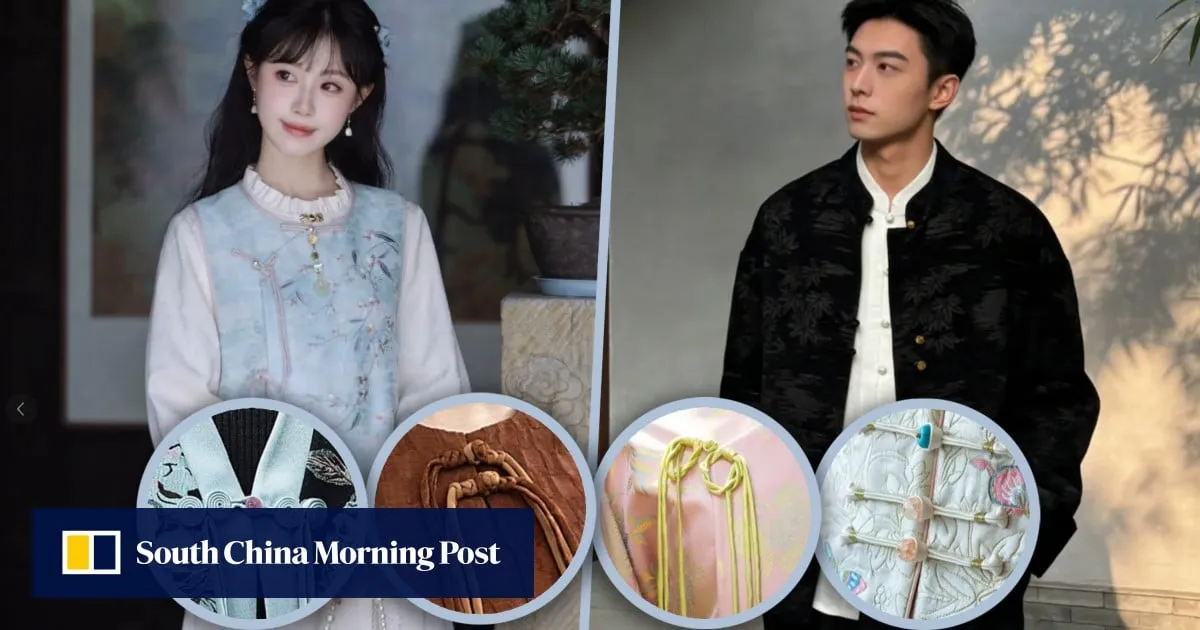
The revival of Chinese hanfu, or traditional dress of the Han people, in recent years has drawn attention to the complicated etiquette surrounding buttons.As the Xinzhongshi, or neo-Chinese style clothing, took over the market in recent years, some people complained online that they had bought clothes that would bring bad luck.The telltale sign was the number of buttons on a garment.A traditional Chinese white silk top with stylish rope-like buttons, above. Photo: RedNoteIn some Chinese regions, a folk belief existed which held that if the number of buttons is four or six, this would hinder the wearers’ career success because of the old saying “four or six, neither one thing nor the other”.As the number of buttons on a garment is usually limited, the belief was also passed down that an even number of buttons would bring bad fortune.There are also theories that odd numbers of buttons are for the living and even number is for the dead.However, it is also thought that a shroud should have no buttons at all, as the Chinese character for button, kou, also means “hold back” and the dead’s offspring fear to be “held back” by their ancestors.A blue and gold coloured garment being worn at the 2024 China-funeral-technology-and-culture-festival" class="entity-link entity-event" data-entity-id="123276" data-entity-type="event">China Funeral Technology and Culture Festival in China. Photo: WeiboIn some regions, it was believed that men should not wear three buttons and women should not wear four.Some would remove one button to save the clothes.Apart from the number of buttons, there is also the belief that coats which button on the left side are for the dead.This is because of the traditional Chinese belief that left is the sky, the sun, the higher and right is the earth, the shade and the lower.Further ReadingButtoning on the left side places the garment’s right piece on top of the left piece, thus believed to be the shade suppressing the sun.Traditional red and black Chinese tops with different numbers of buttons. Photo: RedNoteAccording to researcher at the Shanghai Art & Design Academy, Fang Yun, modern round buttons did not appear on Chinese clothes until at least the Yuan dynasty (1271–1368).Before that, hanfu, or Chinese Han people’s clothing, mainly used ropes or ribbons to tie the garments. This reflected their belief in natural harmony and the creation of ethereal beauty.Fang said that the rules on buttons varied in different time periods and regions.For example, in Shanghai during the China" class="entity-link entity-organization" data-entity-id="39764" data-entity-type="organization">Republic of China period (1912–1949), the number of buttons denoted social rank.A man models a traditional Chinese top at the 2024 China-funeral-technology-and-culture-festival" class="entity-link entity-event" data-entity-id="123276" data-entity-type="event">China Funeral Technology and Culture Festival. Photo: WeiboAccording to Wang Xuegen, an expert in homespun fabric weaving and tailoring in the old Shanghai, five buttons were worn by ordinary people, seven by hooligans, six and 11 for people practising kung fu and 13 for kung fu masters.Wang said if ordinary people wore eleven buttons, they would take a beating for nothing.There is also a superstition that people cannot mend a button when the garment is being worn.If one insists on doing so, then the person wearing the clothes should hold a straw in their mouth, otherwise the two would become enemies.
SRCSouth China Morning Post
LANGEN
LEANCenter-Right
WORDS521
ENT8
THU · 2026-05-07 · 01:00 GMTBRIEF NSR-2026-0507-74290
NSR-2026-0507-74290News Report·EN·Human Interest
In China, number of clothing buttons holds meaning; specific counts assigned for the dead
In China, the number and placement of buttons on clothing carry significant cultural meaning, particularly with the resurgence of traditional hanfu. Folk beliefs associate specific button counts with luck and prosperity, with four or six buttons sometimes seen as hindering career success due to superstitions about "neither one thing nor the other." Odd numbers are generally considered auspicious for the living, while even numbers are sometimes linked to the deceased, though shrouds are ideally buttonless.
Fran LuSouth China Morning PostFiled 2026-05-07 · 01:00 GMTLean · Center-RightRead · 3 min
South China Morning PostFIG 01
Reading time
3min
Word count
521words
Sources cited
2cited
Entities identified
8entities
Quality score
100%
§ 01
Briefing Summary
AI-generatedNEWSAR · AI
In China, the number and placement of buttons on clothing carry significant cultural meaning, particularly with the resurgence of traditional hanfu. Folk beliefs associate specific button counts with luck and prosperity, with four or six buttons sometimes seen as hindering career success due to superstitions about "neither one thing nor the other." Odd numbers are generally considered auspicious for the living, while even numbers are sometimes linked to the deceased, though shrouds are ideally buttonless. Additionally, left-sided buttoning is believed to be for the dead, symbolizing shade suppressing the sun. These customs, which vary by region and historical period, reflect deeper cultural beliefs about fortune, social status, and the afterlife.
Confidence 0.90Sources 2Claims 5Entities 8
§ 02
Article analysis
Model · rule-basedFraming
Human Interest
Social Justice
Tone
Measured
AI-assessed
CalmNeutralAlarmist
Factuality
0.40 / 1.00
Mixed
LowHigh
Sources cited
2
Limited
FewMany
§ 03
Key claims
5 extracted01
According to researcher Fang Yun, modern round buttons appeared on Chinese clothes at least by the Yuan dynasty (1271–1368).
factualFang Yun
Confidence
0.90
02
In Shanghai during the Republic of China period (1912–1949), the number of buttons denoted social rank, with five for ordinary people and thirteen for kung fu masters.
factualWang Xuegen
Confidence
0.80
03
There is a belief that an even number of buttons brings bad fortune, while odd numbers are for the living and even numbers are for the dead.
factual
Confidence
0.70
04
In some Chinese regions, folk belief holds that four or six buttons on a garment hinder career success due to the saying 'four or six, neither one thing nor the other'.
factual
Confidence
0.70
05
Some believe coats buttoning on the left side are for the dead, as left is associated with the sky/sun and right with earth/shade, thus left-buttoning implies shade suppressing the sun.
factual
Confidence
0.60
§ 04
Full report
3 min read · 521 words§ 05
Entities
8 identifiedKey playerOppositionContextPositiveNeutralNegative
Organizations2
§ 06
Keywords & salience
10 termsclothing buttons
1.00
hanfu
1.00
folk belief
0.90
traditional dress
0.80
superstition
0.70
bad luck
0.70
neo-chinese style
0.60
funeral customs
0.50
yuan dynasty
0.40
republic of china
0.40
§ 07
Topic connections
Interactive graph Network visualization showing 51 related topics
View Full Graph Person Organization Location Event|Click node to navigate|Edge numbers = shared articles