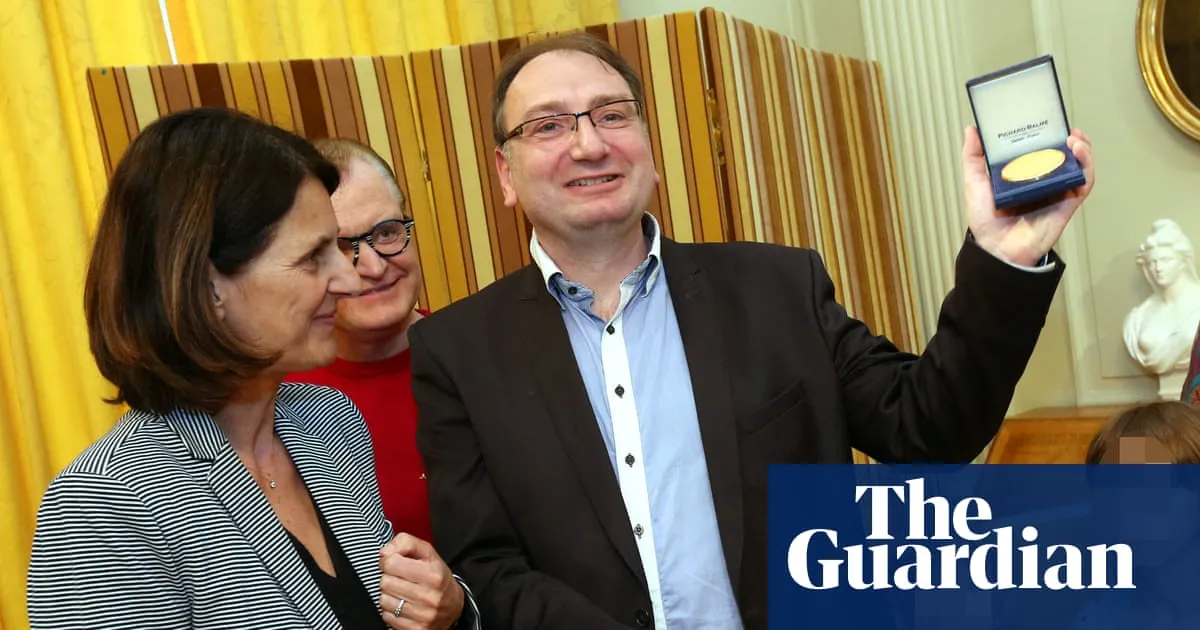
At a ceremony at the French National Assembly attended by Nobel prize winners, former government ministers, MPs, decorated scientists and academics, all attention was on a previously unknown literature professor.Florent Montaclair, then 46, a balding, bespectacled figure in an ill-fitting suit and rosé-coloured shirt, was receiving the 2016 Gold Medal of Philology - the study of linguistics – from an international society of the same name.Montaclair was the first French recipient of the medal, previously awarded to the Italian author and linguist Umberto Eco, those attending were told.It was a glittering event and an impressive achievement – but unfortunately, detectives claim, the award itself was entirely fake and part of a complex international hoax worthy of a film script.Although the ceremony did take place, there was no International Society of Philology. The American university to which it was supposedly affiliated existed only online and its address was traced to a jewellery store in Lewes, Delaware. The award – likened to a Nobel prize – was invented by Montaclair, and the academic had bought the medal from a jeweller in Paris for €250 to present to himself.Now the professor is under investigation for suspected forgery, use of forged documents, impersonation and fraud. He denies any criminality.The public prosecutor Paul-Édouard Lallois, based in Montbéliard in eastern France, said detectives had spent months trying to unpick what he described as a “tissue of lies”. He said he found “all roads lead back to Monsieur Montaclair”.“It was all a gigantic hoax. It could be made into a film or television series,” Lallois told the Guardian.The labyrinthine investigation now centres on whether Montclair, employed at the Marie and Louis Pasteur University, a teacher training college in Besançon, used the fake medal and a “doctorate” from the University of Philology and Education in the US to obtain a promotion and pay rise.Until 2015, when an article appeared in his local newspaper claiming he was about to win the equivalent of a Nobel prize or Fields medal, Montaclair was an unremarkable teaching instructor who liked to write fantasy books, many about vampires, in his spare time.After the national assembly ceremony, Montaclair, who gave a Tedx Talk titled the Galilean Challenge, decided the next recipient should be the American intellectual Noam Chomsky, then 87, who travelled to Paris to collect the award in front of 200 people.But in 2018, Montaclair designated the Romanian academic Eugen Simion, then 85, as winner and the complex alleged hoax began to fall apart.Romanian journalists from the online publication Scena9, intrigued by the honour bestowed on one of their compatriots, dug deeper and discovered that the University of Philology and Education and the International Society of Philology existed solely through websites created and hosted in France.Their article was headlined: “The fake Nobel prize that duped the Romanian Academy.”The alleged hoax might still never have been discovered but for Montaclair’s ambition. In 2018 he had applied to the French ministry of higher education for promotion, allegedly backing up his request by submitting a “state doctorate” awarded by the same American university. Although the qualification was not recognised in France, he was subsequently promoted and made an associate professor.After being alerted to the alleged fraud, Lallois and police arrived at Montaclair’s home in February with a search warrant. “I said: ‘Monsieur Montaclair, do you know why we’re here?’ and he replied straight away: ‘It’s about the medal, I suppose.’”Montaclair admitted ordering the medal and creating or running certain websites, but denies any wrongdoing.Lallois said whether Montaclair obtained that promotion and any material gain from an allegedly fake diploma and medal was at the heart of his investigation.“In his view, the medal is not a forgery. A forgery implies that there is a genuine medal. As the genuine philology medal does not exist, his medal cannot be a forgery,” Lallois said.“Anyone can create a medal. You can order online the ‘best journalist in France’ medal, in gold, silver or bronze, award it to yourself and hold your own little ceremony quietly at home over drinks.“If you stay at home with your little medals on top of your mantelpiece, there are no legal consequences. If, on the other hand, you mention it to your employer, if you mention it to the media, and if all this leads to a certain amount of professional recognition, then it has concrete implications, and that is where the notion of fraud can begin to arise.”He added: “Mr Montaclair is hiding behind the argument that he has not misappropriated anything since he created it.” He said Montaclair had also denied comparing the award to a Nobel or Fields prize.“We are talking about intellectual fraud consisting of duping a whole host of people into believing that one is the sole recipient in France of an international distinction in a discipline that is particularly little known.“This whole scheme allowed him to gain academic standing that he would not have had had it not been for the creation and media coverage of this medal.”Montaclair has also been given legal notice that he is to be suspended in a separate investigation by his university employers but has indicated to them he intends to appeal.Jean-Baptiste Euvrard, Montaclair’s lawyer, said the case was “a real-life drama”, adding that he believed his client had been “a little overwhelmed by what he created”.He said inventing an international award and the society that bestowed it “is not a criminal offence”.“People are saying that 10 years ago, everyone fell for a monstrous hoax but everyone has the right to be imaginative; it’s up to the person you’re talking to whether they believe it or not,” Euvrard told Le Monde.Lallois also believes Montaclair ended up “believing his own lie”. He said he felt sympathy for the professor’s wife, a secondary school teacher, and two daughters, who were unaware of the alleged hoax.The prosecutor said he would be interviewing Montaclair again in a few weeks and would then decide if any charges should be pressed. If convicted, Montaclair faces a maximum five-year sentence.“The question is, why did this man risk his entire career to do this?” Lallois said. “He is very intelligent, cultured and interesting. He had a good career in the public education system, even if it appeared to have stagnated a little.“I can only imagine he did it for a little glory and recognition from the academic community and his peers.”
SRCThe Guardian - World News
LANGEN
LEANCenter-Left
WORDS1 059
ENT12
THU · 2026-05-07 · 04:00 GMTBRIEF NSR-2026-0507-74312
NSR-2026-0507-74312News Report·EN·Human Interest
French professor accused of ‘gigantic hoax’ after inventing Nobel-style prize
French literature professor Florent Montaclair is under investigation for allegedly orchestrating a "gigantic hoax" by inventing a prestigious Nobel-style award, the Gold Medal of Philology. He reportedly presented this fake award to himself at a ceremony in the French national assembly in 2016, claiming it was from a non-existent International Society of Philology affiliated with a fraudulent American university.
Kim Willsher in ParisThe Guardian - World NewsFiled 2026-05-07 · 04:00 GMTLean · Center-LeftRead · 5 min
The Guardian - World NewsFIG 01
Reading time
5min
Word count
1 059words
Sources cited
3cited
Entities identified
12entities
Quality score
100%
§ 01
Briefing Summary
AI-generatedNEWSAR · AI
French literature professor Florent Montaclair is under investigation for allegedly orchestrating a "gigantic hoax" by inventing a prestigious Nobel-style award, the Gold Medal of Philology. He reportedly presented this fake award to himself at a ceremony in the French national assembly in 2016, claiming it was from a non-existent International Society of Philology affiliated with a fraudulent American university. Detectives are investigating if Montaclair used the fabricated award and a fake doctorate to secure a promotion and pay rise. The investigation, described as a "tissue of lies," also involves Montaclair's subsequent presentation of the fake award to Noam Chomsky. Montaclair denies any wrongdoing.
Confidence 0.90Sources 3Claims 5Entities 12
§ 02
Article analysis
Model · rule-basedFraming
Human Interest
Legal & Judicial
Tone
Mixed Tone
AI-assessed
CalmNeutralAlarmist
Factuality
0.80 / 1.00
Factual
LowHigh
Sources cited
3
Well sourced
FewMany
§ 03
Key claims
5 extracted01
Romanian journalists discovered that the 'University of Philology and Education' and the 'International Society of Philology' existed solely through websites created and hosted in France.
factualRomanian journalists (Scena9)
Confidence
1.00
02
The professor allegedly bought the medal for €250 from a Parisian jeweler to present to himself.
factualDetectives
Confidence
1.00
03
The 'International Society of Philology' and its affiliated American university existed only online, with the university's address traced to a jewelry store.
factualDetectives
Confidence
1.00
04
A French professor is accused of orchestrating a 'gigantic hoax' by inventing a Nobel-style prize.
factualDetectives/Public Prosecutor
Confidence
1.00
05
The investigation centers on whether the fake medal and doctorate were used to obtain a promotion and pay rise.
factualArticle
Confidence
0.90
§ 04
Full report
5 min read · 1 059 words§ 05
Entities
12 identifiedKey playerOppositionContextPositiveNeutralNegative
People4
Organizations3
§ 06
Keywords & salience
10 termsfake prize
1.00
gigantic hoax
1.00
nobel prize
0.90
philology
0.80
forgery
0.70
fraud
0.70
academic fraud
0.60
impersonation
0.60
french professor
0.50
umberto eco
0.40
§ 07
Topic connections
Interactive graph No topic relationship data available yet. This graph will appear once topic relationships have been computed.