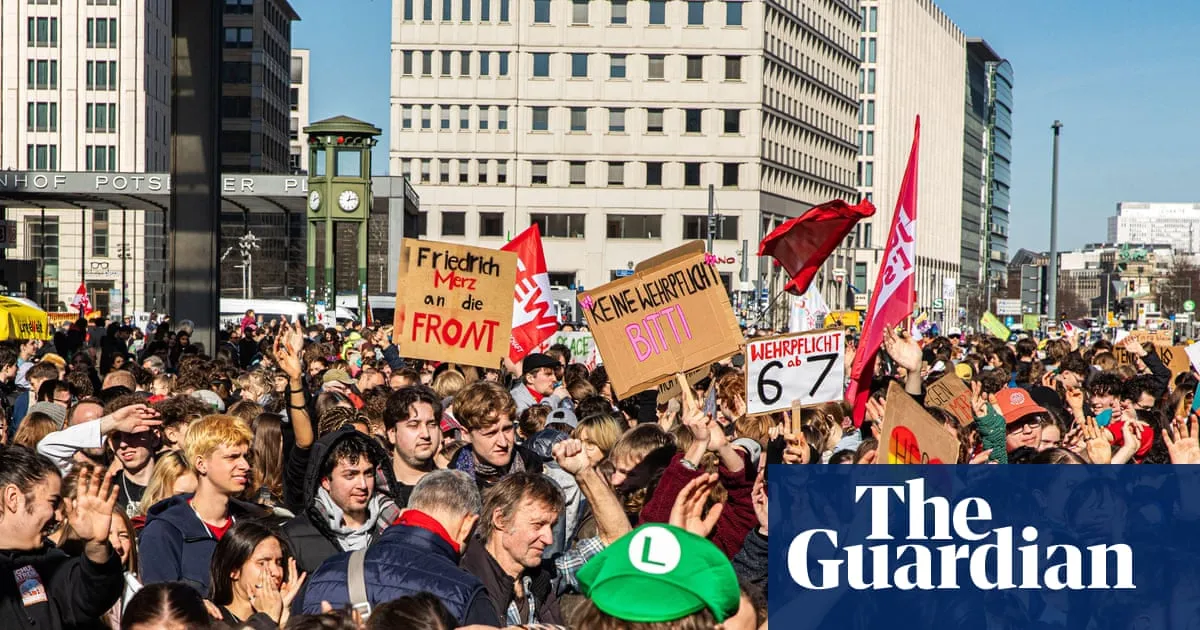
Young people protesting at Potsdamer Platz in Berlin in March over Germany's new military service legislation. Photograph: Sipa US/Alamy Stock Photo/Alamy Live News. View image in fullscreen Young people protesting at Potsdamer Platz in Berlin in March over Germany's new military service legislation. Photograph: Sipa US/Alamy Stock Photo/Alamy Live News. More than 50,000 pupils expected to strike over German rearmament policy Organisers of nationwide protest say its aim is to stop the government turning young Germans into ‘cannon fodder’ Tens of thousands of pupils across Germany are expected to boycott the classroom and take to the streets in a nationwide protest organisers say is to stop the government’s rearmament policy turning young people into “cannon fodder”. Despite threats from teachers’ associations and education ministries, which have said anyone who demonstrates during school hours could risk penalties and even expulsion, organisers say they expect the number of participants at Friday’s school strike to be at least as high as the estimated 50,000 who attended each of the first two. “The government and industry are preparing for war and we, the young, are supposed to become the cannon fodder. Neither have we even been consulted,” Hannes Kramer, the main spokesperson for the movement Schulstreik gegen Wehrpflicht (School Strike Against Conscription), told the Guardian. The protest reflects unrest felt in homes and classrooms across Germany, Kramer said, since Friedrich Merz’s government brought in in hotly contested changes to military service policy, arguing the country needed to boost its defences amid growing threats from Russia after its full-scale invasion of Ukraine. View image in fullscreen Striking pupils in Bochum, Germany, in March. Photograph: Anadolu/Getty Images Under the Military Service Modernisation Act, mandatory questionnaires are being sent to all 18-year-olds to assess their willingness and suitability for military service. From next year, compulsory medical tests will be introduced. The law also includes a clause according to which men aged between 17 and 45 will in theory be allowed to travel abroad for longer than three months only if they receive permission from the armed forces. The legislation passed in December stops short of allowing for conscription, but the defence minister, Boris Pistorius, has said that is still on the table if the new policy fails to pull in enough recruits. According to experts, the professional military needs to expand by about 80,000 members to 260,000 over the next 10 years, and its reservists by 140,000 to 200,000 within a similar timeframe. The third school boycott in five months has been deliberately timetabled to coincide with the anniversary of the end of the second world war and victory over Nazi Germany, amid warnings from the organisers that Germany’s deliberate rebuilding of its military strength is in danger of putting it on the path of no return to conflict. “VE Day on 8 May [1945] was the day that German fascism was defeated in Europe,” said Kramer, 21, a student of educational science at the University of Göttingen. “We use this date to make clear the consequence of war and what the consequences of rampant militarisation can be.” View image in fullscreen A protest sign reading ‘the youth refuse’. Photograph: ZUMA Press, Inc./Alamy Stock Photo/Alamy Live News. “Currently almost half of the federal budget is being spent on tanks, bombs and infrastructure to prepare the country for war,” he said, adding that then as now, “big German companies, arms factories as well as banks, stand to gain … we are very afraid that we have not learned the lessons from our history.” Unnerved not only by Russia but the changed transatlantic relationship with Donald Trump in the White House, the German government has said it plans to put €779bn (£673bn) into defence from now until the end of the decade, roughly doubling spending for the previous five years. That would put the country on track to exceed Nato spending targets of 3.5% of GDP by 2030. Merz has cast the rearmament drive as essential for Germany’s – and Europe’s – long-term security, telling MPs in his first speech to the Bundestag as chancellor that a properly funded German military was “what our friends and partners expect from us; more than that, they demand it”. “If you want peace, prepare for war,” has become his government’s mantra. But Kramer said the act of rearmament itself could end up propelling Germany into conflict. “Even though the situation is different and Germany is not now under a fascist regime, we feel the parallels in the rhetoric of German ambitions towards global influence and power through military might,” he said. “Framing the current militarisation and the preparation for war as defence, as Merz does with his repeated claims that Germany as one of the biggest economies in the world needs to become a global power in this, is frightening, awful and very dangerous”. At the last demonstration in March, pupils protested across about 150 towns and cities, carrying banners with slogans such as: “The rich want war, the youth want a future”. Others carried posters declaring: “Dying is not on the timetable”, “Friedrich Merz to the front!”, “Our only war is the class war” and “Education instead of army physicals”. Across the country, the demonstrators repeatedly highlighted what they said was the jarring contrast between Germany’s multibillion-euro rearmament of the and the underfunded education system. In Koblenz, one person held up a poster asking: “Why should I fight for a country that is not even capable of fighting for us young people?” Kramer, a member of the Socialist German Workers Youth (SDAJ), said the movement had grown out of a collective feeling among pupils “that their self-determination was being diminished”. He said the creeping knowledge that they might be forced into war, was “part of a series of crises that young people have faced in recent years, starting before the pandemic, that have shown them they are being ignored by politicians. “Schools are falling apart; even in this, one of the richest countries in the world, there is a shortage of teachers; the worsening housing situation means many are forced to live with their parents; and young people’s concerns about the climate have long been ignored.” Explore more on these topics Germany Protest Friedrich Merz Europe Young people news Share Reuse this content
SRCThe Guardian - World News
LANGEN
LEANCenter-Left
WORDS1 042
ENT10
THU · 2026-05-07 · 11:39 GMTBRIEF NSR-2026-0507-74383
NSR-2026-0507-74383News Report·EN·Conflict
More than 50,000 pupils expected to strike over German rearmament policy
Over 50,000 German pupils are expected to strike nationwide on Friday to protest the government's rearmament policy. Organizers of the "School Strike Against Conscription" movement aim to prevent young people from becoming "cannon fodder" amidst changes to military service legislation.
Kate Connolly in BerlinThe Guardian - World NewsFiled 2026-05-07 · 11:39 GMTLean · Center-LeftRead · 5 min
The Guardian - World NewsFIG 01
Reading time
5min
Word count
1 042words
Sources cited
3cited
Entities identified
10entities
Quality score
100%
§ 01
Briefing Summary
AI-generatedNEWSAR · AI
Over 50,000 German pupils are expected to strike nationwide on Friday to protest the government's rearmament policy. Organizers of the "School Strike Against Conscription" movement aim to prevent young people from becoming "cannon fodder" amidst changes to military service legislation. The new policy, introduced by the Friedrich Merz government, includes mandatory questionnaires for 18-year-olds and compulsory medical tests from next year, with the possibility of conscription if recruitment targets are not met. Protesters argue they have not been consulted on these changes, which they believe signal a move towards war. Despite potential penalties, organizers anticipate participation levels similar to previous protests.
Confidence 0.90Sources 3Claims 5Entities 10
§ 02
Article analysis
Model · rule-basedFraming
Conflict
Political Strategy
Tone
Mixed Tone
AI-assessed
CalmNeutralAlarmist
Factuality
0.60 / 1.00
Mixed
LowHigh
Sources cited
3
Well sourced
FewMany
§ 03
Key claims
5 extracted01
The Military Service Modernisation Act includes mandatory questionnaires for 18-year-olds and compulsory medical tests from next year.
factual
Confidence
1.00
02
The professional military needs to expand by about 80,000 members to 260,000 over the next 10 years.
statisticExperts
Confidence
0.90
03
Germany needs to boost its defences amid growing threats from Russia after its full-scale invasion of Ukraine.
quoteFriedrich Merz's government
Confidence
0.90
04
The protest aims to stop the government turning young Germans into ‘cannon fodder’.
quoteOrganisers
Confidence
0.90
05
More than 50,000 pupils are expected to strike over German rearmament policy.
statisticOrganisers
Confidence
0.80
§ 04
Full report
5 min read · 1 042 words§ 05
Entities
10 identifiedKey playerOppositionContextPositiveNeutralNegative
People3
Organizations1
Locations5
§ 06
Keywords & salience
10 termsgerman rearmament policy
1.00
school strike
0.90
military service legislation
0.80
conscription
0.70
youth protest
0.70
cannon fodder
0.60
defence policy
0.50
russia ukraine invasion
0.50
boris pistorius
0.40
friedrich merz
0.40
§ 07
Topic connections
Interactive graph Network visualization showing 51 related topics
View Full Graph Person Organization Location Event|Click node to navigate|Edge numbers = shared articles