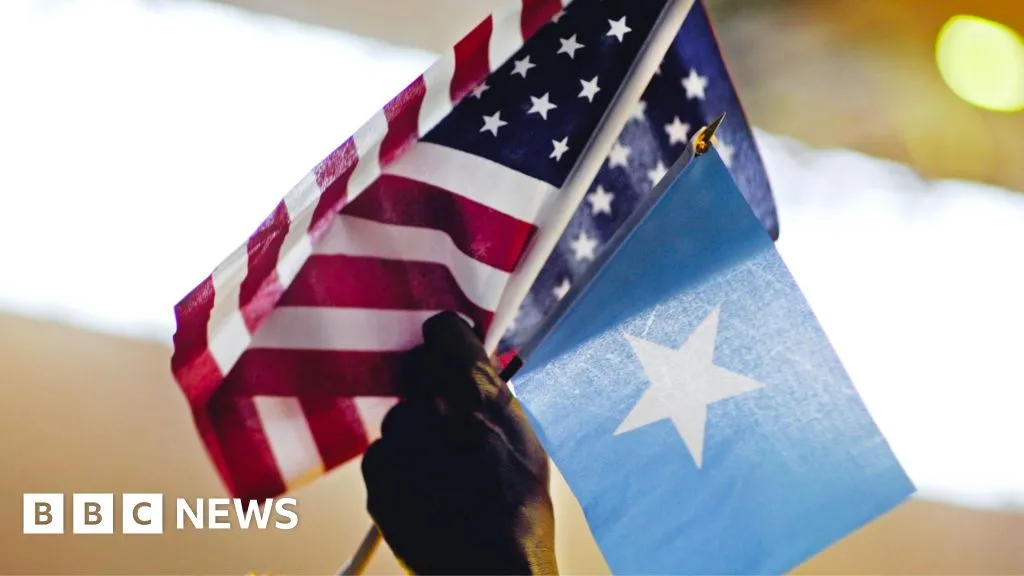
Trump's effort to end TPS for Somalis, the immigration enforcement operation earlier this year, as well as some disparaging comments made by the US president about the Somali community, have made them feel targeted.At peak level, the deployment of agents in Minnesota was in the thousands, before Trump's border tsar Tom Homan announced a draw-down. In mid-February, he said only a "small" contingent would remain.There are about 260,000 people of Somali heritage in the US, more than half of whom are born in the country, while many more have been naturalised, according to the US Census Bureau. These numbers dwarf those who are there illegally, according to Somali community leaders.Many arrived in the years following the collapse of the last government to control the whole of Somalia in 1991. The country has since experienced chronic droughts and known little peace - and for the past two decades has been battling Islamist militants, in particular those from al-Shabab, a group aligned with al-Qaeda.Abdi left Somalia in 2022 - fleeing after he says al-Shabab fighters tried to recruit him."I spent about $15,000 [£11,000] to get here. My family gave everything," he told me when I met him in March, speaking quietly from a dimly lit apartment hallway.He bought a Kenyan passport from smugglers and flew to Brazil and there began his long journey towards the US across the Darién Gap, a stretch of jungle between Colombia and Panama, which is widely regarded as one of the world's most perilous migration routes."At one point I stepped on a dead body," he said.After reaching the US-Mexico border, he crossed into the US and applied for asylum. On legal advice, he also applied for TPS, which allowed him to live and work in the country until 2029.ReutersThe Department for Homeland Security says those who are in the US legally have nothing to fearThose detained in the ICE raids have included some joint US-Somali citizens, though their relatives were too afraid to talk to me. Other families split up by deportations to Somalia were also fearful of going on the record - often too traumatised.If deported, a person faces a 10-year bar on returning to the US, sometimes longer, even if they have any children in the country.The US Department for Homeland Security (DHS) says its Operation Metro Surge in Minnesota has been a victory for public safety."We have arrested over 11,000 criminal illegal aliens who were killing Americans, hurting children and reigning terror in Minneapolis because sanctuary politicians refuse to protect their own people and instead protect criminals," it told the BBC in a statement.A hard line on immigration was a central plank of Trump's re-election campaign and it remains his strongest policy in polling, even though more still disapprove than approve, according to the latest Ipsos figures.In Adbi's mind the situation remains an existential crisis: "I would rather live in hiding here for the rest of my life than go back to Somalia, because my life would be at risk."BBC / Brian KhisaMinneapolis Mayor Jacob Frey questions how TPS can be removed for Somalis on the one hand, while warning people not to travel to Somalia on the otherFor Minneapolis Mayor Jacob Frey, such fears point to a contradiction at the heart of US policy."The federal government is saying there's no need for Temporary Protected Status in the United States, while at the same time warning people not to travel to Somalia because it's dangerous," he told the BBC."Which one is it?"Walking through parts of Minneapolis, home to several migrant communities, the impact of the raids is still visible - even if daily life is slowly beginning to return to some normality and schools have reopened.A few shops and restaurants remain closed, their doors shut during what would normally be a busy time.In a car park outside a Chinese takeaway, I met a tow-truck driver removing cars."I heard the owner and the staff of this restaurant were detained by ICE, and that's why it's been shut down," he said, adding that some vehicles had been sitting there for days because their owners were too afraid to return.BBC / Brian KhisaWhat we saw here looked like a war zone""We are living through some dark times," Minnesota congresswoman Ilhan Omar recently told a Democratic convention in Minneapolis.Afterwards, the first Somali-American to serve in the US Congress told the BBC how difficult the last few months had been - even for children."There is still that fear that you will get stopped, that your parents might get stopped. Even our healthcare centres have been impacted."A fierce critic of Trump, who has repeatedly been targeted in the president's remarks about Somali immigrants, she questioned the scale of the operation and the tactics used by ICE."The difference between what we've previously seen with other administrations, including the [Barack] Obama administration that had one of the highest rates of removal, is that that process… was done without creating chaos [and] fear."The way Operation Metro Surge was carried out was having men in our streets who are masked, who are not identifiable, in great numbers with military grade weapons drawn at people. What we saw here looked like a war zone."The DHS maintains those in the US legally have nothing to fear and that ICE agents wore masks to "protect themselves from being doxed by terrorist sympathisers".I met them at a mosque in Minneapolis, where the imam described how the crisis had strengthened ties across faith groups: "The ICE raid created more closeness and more brotherhood and sisterhood."The pastor agreed: "When the surge happened, people came together, asking where help was needed and how we could respond."Together they set up informal alert systems to warn residents when immigration officers were nearby.BBC / Brian KhisaVolunteers like Renee Good, a US citizen shot by ICE and commemorated here in Minneapolis, warn people when agents are in the areaTwo US citizens, Renee Good and Alex Pretti, who were members of similar volunteer groups, were killed by federal immigration agents during the surge in January.Outside the mosque I met Lisa and her husband, a retired white couple who are both volunteer observers.Asking me not to disclose her full name, Lisa explained how residents remained on alert and used whistles to warn others if immigration agents were seen nearby."It's quieter, but they're sneakier. They're blending in, so it's harder to tell," she said.
SRCBBC News - World
LANGEN
LEANCenter
WORDS1 056
ENT12
THU · 2026-05-07 · 23:54 GMTBRIEF NSR-2026-0508-74581
NSR-2026-0508-74581News Report·EN·Human Interest
'I'd rather live in hiding in the US than return to Somalia'
Somali immigrants in the U.S. feel targeted due to the Trump administration's efforts to end Temporary Protected Status (TPS) and immigration enforcement operations.
BBC News - WorldFiled 2026-05-07 · 23:54 GMTLean · CenterRead · 5 min
BBC News - WorldFIG 01
Reading time
5min
Word count
1 056words
Sources cited
3cited
Entities identified
12entities
Quality score
100%
§ 01
Briefing Summary
AI-generatedNEWSAR · AI
Somali immigrants in the U.S. feel targeted due to the Trump administration's efforts to end Temporary Protected Status (TPS) and immigration enforcement operations. Many Somalis, who arrived following the collapse of their government in 1991 and fled conflict and drought, fear deportation back to a country still battling instability and militant groups like al-Shabab. One individual recounted a perilous journey to the U.S. seeking asylum and TPS, expressing a preference for living in hiding over returning to Somalia. While the Department of Homeland Security states legal immigrants have nothing to fear, recent raids have detained individuals with U.S. citizenship, and families fear speaking out due to trauma and potential repercussions.
Confidence 0.90Sources 3Claims 5Entities 12
§ 02
Article analysis
Model · rule-basedFraming
Human Interest
Social Justice
Tone
Mixed Tone
AI-assessed
CalmNeutralAlarmist
Factuality
0.60 / 1.00
Mixed
LowHigh
Sources cited
3
Well sourced
FewMany
§ 03
Key claims
5 extracted01
There are about 260,000 people of Somali heritage in the US, with over half born in the country.
statisticUS Census Bureau
Confidence
1.00
02
DHS claims Operation Metro Surge in Minnesota arrested over 11,000 criminal illegal aliens.
factualUS Department for Homeland Security
Confidence
1.00
03
The US Department for Homeland Security states that those in the US legally have nothing to fear.
factualUS Department for Homeland Security
Confidence
1.00
04
Abdi spent $15,000 and traveled through perilous routes including the Darién Gap to reach the US.
quoteAbdi
Confidence
1.00
05
Trump's efforts to end TPS for Somalis, immigration enforcement, and presidential comments have made the community feel targeted.
factualSomali community
Confidence
0.80
§ 04
Full report
5 min read · 1 056 words§ 05
Entities
12 identifiedKey playerOppositionContextPositiveNeutralNegative
Organizations3
§ 06
Keywords & salience
9 termssomali community
1.00
temporary protected status (tps)
0.90
immigration enforcement
0.80
deportation
0.70
al-shabab
0.60
asylum
0.60
migration route
0.50
us president
0.40
public safety
0.40
§ 07
Topic connections
Interactive graph Network visualization showing 51 related topics
View Full Graph Person Organization Location Event|Click node to navigate|Edge numbers = shared articles