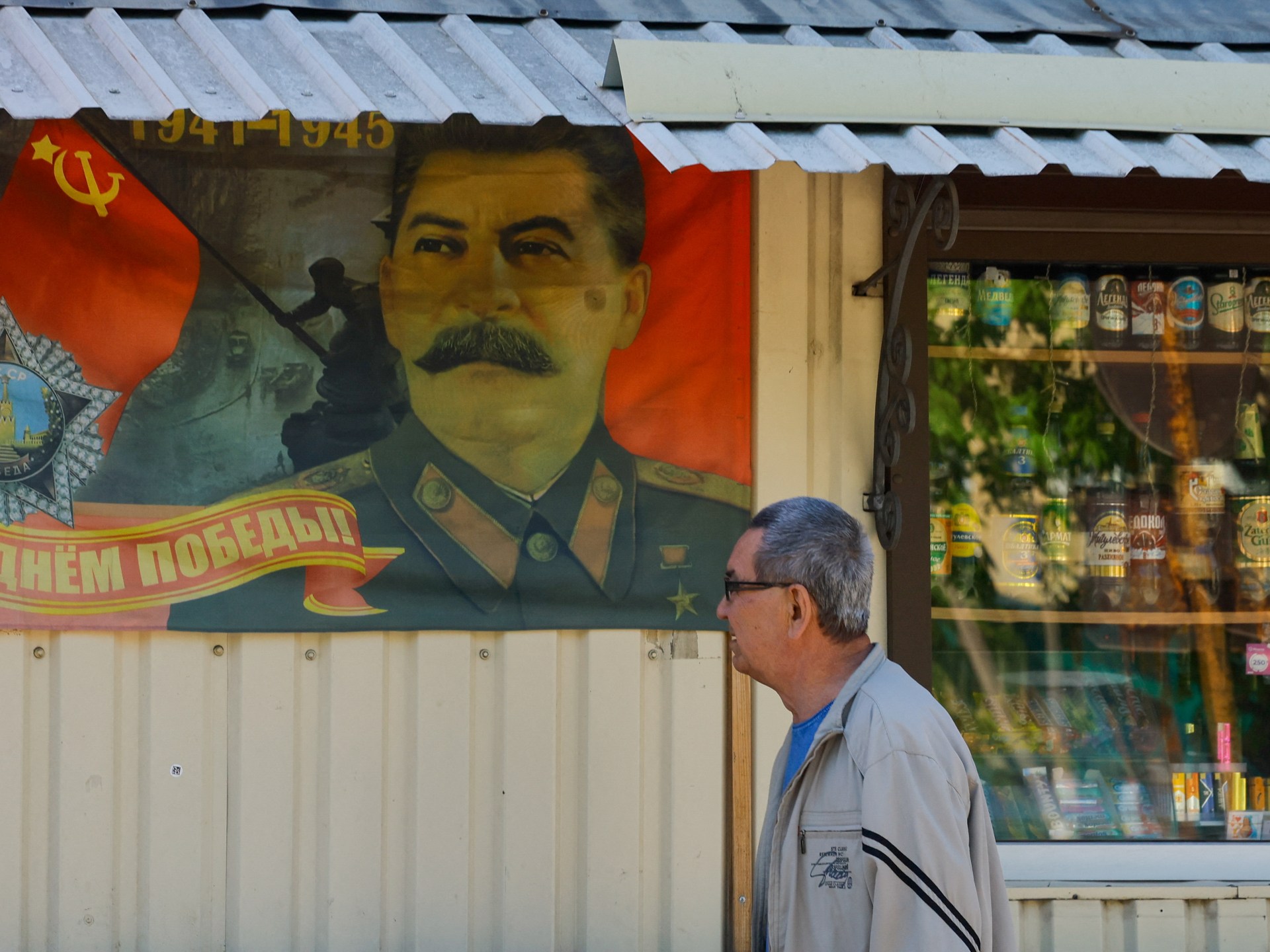
As the Ukraine war drags, Moscow is transforming the economy of the occupied Donbas region, officials, residents and analysts say.A man walks past a poster displaying a portrait of Soviet leader Joseph Stalin and an illustration of a Red Army soldier raising a flag atop the Reichstag, before celebrations of the 80th anniversary of the victory over Nazi Germany in World War II, in a Russian-controlled area of Donetsk, on May 4, 2025. A slogan on the poster reads: 'Congratulations on Victory Day!' [Alexander Ermochenko/Reuters]Published On 14 Jan 2026Kyiv, Ukraine – A Russian officer in the Moscow-occupied part of the Donetsk region in southeastern Ukraine has reportedly become unusually lenient towards one new soldier.As the tale goes, the officer lets him spend several days in the administrative capital, also named Donetsk, and – knowing that the serviceman is single and childless – gives him the phone number of a “nice woman”. Overwhelmed by the war, the serviceman craves intimacy, and within days, the woman persuades him to get married.Recommended Stories list of 4 itemslist 1 of 4Ukraine calls on allies to raise pressure as Russia fires Oreshnik missilelist 2 of 4Russia hits Ukraine with Oreshnik hypersonic missile: Why it matterslist 3 of 4Civilian casualties in Ukraine up sharply in 2025, UN monitor sayslist 4 of 4Russian drone attack kills 4 in Ukraine’s Kharkiv, as peace remains elusiveend of listElated after a short honeymoon, he gets back to his military unit, but instead of congratulating him, the officer sends him on a mission he never returns from.The nascent widow promptly cashes “the coffin money”, between 5 and 10 million rubles ($64,000-127,000) – and splits it with the officer, who has already found her another “fiance”.“It’s a real business,” a Donetsk resident told Al Jazeera, explaining an alleged scheme that has also been reported by Ukrainian and exiled Russian media last year.The resident spoke on condition of anonymity because anyone interviewed by foreign media risks reprisal.Drugs and stolen armsBut this is just one of the ways fast money can be made in the Russia-occupied part of Donetsk – about four-fifths of the rustbelt region the size of Albania, dotted with dozens of mines and factories.The presence of tens of thousands of Russian soldiers creates a bonanza for some locals.Undersupplied Russian servicemen spend part of their monthly pay of several thousand dollars on flak jackets, tactical boots and other gear.Restaurants, shops selling alcohol, underground brothels and casinos are booming, according to Ukrainian officials and media reports – along with a black market for drugs, especially amphetamines and crystal meth that help soldiers stay awake and overcome fear and boredom.There is another black market – of stolen weaponry, from pistols and assault rifles to explosives and even grenade launchers, according to dozens of Russian court records that often name Chechen servicemen as mastermind contrabandists.The market dates back to 2014, when Moscow-backed separatists carved out two “People’s Republics” in Donetsk and neighbouring Luhansk.In 2022, Moscow declared their annexation along with two more Ukrainian regions, even though none of them are 100 percent occupied.But Donetsk and Luhansk – known collectively as Donbas – still keep the vestiges of “independence” such as a “head of state”, a “parliament”, border checkpoints and customs offices.‘Militarising the economy’Moscow’s reasons are simple, according to the head of the Strategic Research and Security Institute, a Kyiv-based think tank.“They need to create a militarised springboard that is not on Russian territory,” Pavel Lisyanskiy told Al Jazeera. “They militarise the economy, there’s fewer and fewer people, it will be a huge military base to frighten Europe.”However, Moscow “is no longer ashamed to just dispatch its appointees” who control the economy despite occasional objections from separatists, Volodymyr Fesenko, head of the Kyiv-based Penta think tank, told Al Jazeera.Moscow is not ceremonious with them, jailing and assassinating the most disobedient ones, Fesenko said.Ukrainian officials and media reports have claimed that Moscow had several separatist strongmen killed, and several more have been forced out and jailed in Russia.‘Everyone’s in jail’Moscow has poured billions of dollars into construction projects in the Donbas, where entire cities such as Avdiivka or Bakhmut have nearly been razed to the ground, and dozens of plants and factories cannot possibly be restored.“Unfeasible” was the word Donetsk’s “head” Denis Pushilin used in September when describing the rebuilding of the colossal Azovstal and Ilych steel plants in the southern city of Mariupol.The plants once churned out two-fifths of Ukraine’s steel that contributed 0.6 percent to the nation’s gross domestic product.Instead, Pushilin said, new resorts will be built in their stead near the Sea of Azov, which is favoured by tourists with little children because of its shallow waters with next to no waves.But the construction boom goes hand in hand with corruption.Under Ukraine, it was “controllable”, analyst Fesenko said. “But after 2014, a big redistribution began, and criminal wars added to the corruption.”In November, Donetsk’s “deputy construction minister”, Yulia Mervaezova, was charged with embezzling 9 billion rubles ($115m), and the amount “will probably go up”, prosecutors reportedly said.Meanwhile, Donetsk residents use rainwater and melted snow for drinking because of catastrophic water shortages caused by the destruction of a sophisticated water supply system.A pipeline drawing water from southwestern Russia cannot provide nearly enough, but no construction company wants to build a second pipeline because of corruption risks, a top official admitted.“Nobody wants to approach [the second pipeline], because everyone who built the first one is in jail,” Russia’s Deputy Prime Minister Marat Khusnullin said in November.The unveiling of construction projects “has become a tool of political theatre and elite enrichment rather than genuine efforts at recovery”, according to analysis by the Jamestown Foundation, a think tank in Washington, DC, published in December. “This approach prioritises political visibility and control over genuine reconstruction.”Russia’s federal budget can no longer foot the bills – and Moscow forced some 40 Russian regions to “sponsor” the construction of apartment buildings, schools, hospitals and roads in occupied Ukrainian cities, towns and districts.“Sponsor regions play the key role in the region’s restoration and development,” Donetsk’s “construction minister” Vladimir Dubovka said in January 2025.The regions also dispatch thousands of teachers, health professionals and construction workers to the Donbas.The city of Moscow “sponsors” the regional centres of Donetsk and Luhansk, St Petersburg – Mariupol, while the town of Shakhtarsk is “supervised” by the resource-rich Pacific island of Sakhalin.The “sponsors” often find the money by ignoring their own needs.As the northwestern Arkhangelsk region paid for the rebuilding of occupied Melitopol, its administration reportedly turned a blind eye to the plight and pleas of residents of several apartment buildings that stood on concrete stilts nailed in permafrost, which thawed because of global warming.‘Irreversible consequences’Donbas has some of the world’s richest coal mines, including ones with coking coal necessary for steel making.It also boasts deposits of iron ore, lithium, graphite, manganese, nickel, titanium, rare earths and noble gas neon used in chip-making.But the renewed and so far limited extraction of minerals is “barbaric”, analyst Lisyanskiy said.Last year, half a dozen small water bodies disappeared because of tectonic fissures caused by irresponsible mining, he said.Meanwhile, the remaining rivulets, lakes and groundwater in Donbas are contaminated by chemical waste as safety standards are routinely snubbed.“The consequences are irreversible, it’s not even a hundred years, believe me,” said Lisyanskiy, who spent years working as a mine engineer in the Donbas region.
SRCAl Jazeera
LANGEN
LEANCenter
WORDS1 220
ENT4
WED · 2026-01-14 · 13:04 GMTBRIEF NSR-2026-0114-7463
NSR-2026-0114-7463News Report·EN·Conflict
Russia turning occupied Donbas into ‘huge military base to frighten Europe’
Reports from January 2026 indicate Russia is transforming the occupied Donbas region of Ukraine into a large military base. The increased military presence has spurred economic changes, including alleged schemes involving Russian officers and local residents profiting from soldiers' deaths.
Mansur MirovalevAl JazeeraFiled 2026-01-14 · 13:04 GMTLean · CenterRead · 5 min
Al JazeeraFIG 01
Reading time
5min
Word count
1 220words
Sources cited
2cited
Entities identified
4entities
Quality score
100%
§ 01
Briefing Summary
AI-generatedNEWSAR · AI
Reports from January 2026 indicate Russia is transforming the occupied Donbas region of Ukraine into a large military base. The increased military presence has spurred economic changes, including alleged schemes involving Russian officers and local residents profiting from soldiers' deaths. Undersupplied Russian soldiers spend wages locally, creating economic opportunities. The region, largely controlled by Russia, is experiencing a rise in illegal activities like drug sales and stolen arms, fueled by the influx of soldiers and money. Sources suggest Moscow's actions aim to intimidate Europe by establishing a strong military foothold in the area.
Confidence 0.90Sources 2Claims 5Entities 4
§ 02
Article analysis
Model · rule-basedFraming
Conflict
Economic Impact
Tone
Mixed Tone
AI-assessed
CalmNeutralAlarmist
Factuality
0.60 / 1.00
Mixed
LowHigh
Sources cited
2
Limited
FewMany
§ 03
Key claims
5 extracted01
There is a black market for drugs and stolen weaponry in the Russia-occupied part of Donetsk.
factualnull
Confidence
0.80
02
Moscow is transforming the economy of the occupied Donbas region.
factualofficials, residents and analysts
Confidence
0.80
03
Undersupplied Russian servicemen spend part of their pay on gear.
factualnull
Confidence
0.70
04
The 'coffin money' is between 5 and 10 million rubles ($64,000-127,000).
statistica Donetsk resident
Confidence
0.70
05
A Donetsk resident described an alleged scheme involving fake marriages for 'coffin money'.
quotea Donetsk resident
Confidence
0.60
§ 04
Full report
5 min read · 1 220 words§ 05
Entities
4 identified§ 06
Keywords & salience
10 termsdonbas
1.00
russia
0.90
occupied territory
0.80
ukraine war
0.70
military base
0.70
donetsk
0.60
economic transformation
0.60
russian soldiers
0.50
war profiteering
0.50
coffin money
0.40
§ 07
Topic connections
Interactive graph Network visualization showing 51 related topics
View Full Graph Person Organization Location Event|Click node to navigate|Edge numbers = shared articles