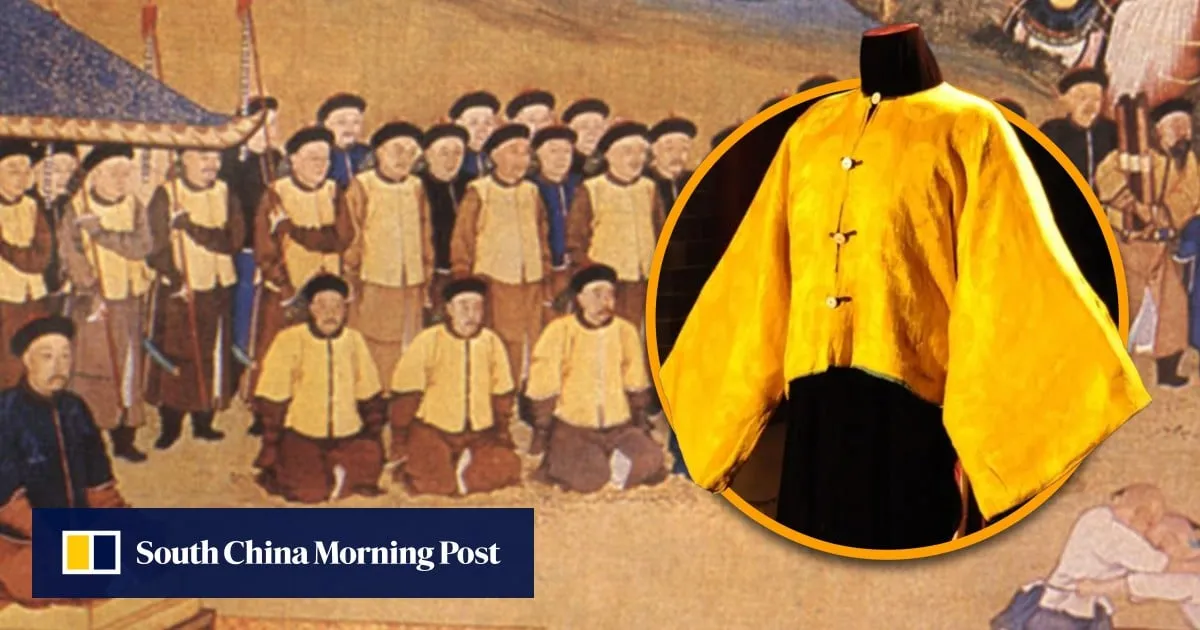
In ancient China, ordinary people were not allowed to wear yellow as it symbolised the imperial power, apart from one exception: the emperor’s yellow jacket.Magua is a style of jacket worn by Manchu males during the Qing dynasty (1644–1912). It was worn over the long robe as protection while riding horses.Huang magua, or the imperial yellow jacket, has a special meaning due to its colour.The above painting depicts two men from ancient times wearing yellow robes. Photo: HandoutIn Qing dynasty, only the emperors, empresses and empress dowagers could wear yellow. Ordinary people were not allowed to dress in the colour. Even crown princes were only allowed to use yellow on small accessories.The tradition of yellow being the imperial colour began in Sui dynasty (581-618), when the Emperor Wen of Sui started the trend of wearing yellow.He ignored the then attire policy that required emperors to wear white on important occasions and chose yellow out of his personal preference. Later, he even adapted his court robe into yellow.Officials and ordinary people followed suit and yellow once became an “in” colour in the Sui dynasty.Three generations of a whole family pictured in their ancient finery. Photo: HandoutIn Tang Dynasty (618-907), emperors followed the Sui tradition of wearing yellow.During Emperor Gaozong of Tang’s reign, he banned officials and ordinary people from dressing in yellow, making the colour unique to himself.It is believed that the colour yellow stands for the earth out of the five elements, symbolising that “all land belongs to the king, and all people are his subjects.”In Qin (221–207 BC) and Han (206 BC – AD 220) dynasties, emperors wore black, as the colour stands for the water element.A painting of an emperor wearing an ornate yellow robe while sitting on his throne. Photo: HandoutIt is said that Qin Shi Huang, or “China’s first emperor”, believed that the Qin conquered the Zhou dynasty (about 1046–221 BC) which was represented by the fire element, so Qin must be water, and the colour black would boost the nation’s fortune.Further ReadingEmperors in different dynasties also wore various shades of yellow.For example, Sui and Tang emperors wore mostly ochre yellow, which had a golden tint. Qing emperors wore bright yellow.Emperors’ court robes were also sewn with dragon patterns, making the colour yellow appear even more divine.Thus, the imperial yellow jacket was seen as one of the highest glories in the Qing dynasty.Only a certain few people were allowed to wear imperial yellow jackets.For example, those who worked closely for the emperors, such as the imperial bodyguards, and those who went hunting with the emperors, to create a sense of grandeur.They were only allowed to wear the jacket at work, and would be punished if they wore it on other occasions.This modern-day re-enactment depicts an emperor with his nobles marching behind him. Photo: HandoutEmperors would also award imperial yellow jackets to those with special merits as a prize.While in the modern costume dramas set in Qing dynasty, the imperial yellow jacket is portrayed to have the power of pardoning the wearer’s future faults, it was in fact not the case.When a person awarded with the imperial yellow jackets made mistakes at work, the emperor would take back the jacket as a punishment.Li Hongzhang, a statesman in the late Qing dynasty, was deprived of his imperial yellow jacket two times after being blamed for defeats in war.While the imperial yellow jacket’s power no longer existed after the fall of the Qing dynasty, in modern times, the phrase is still used to mock minions of the company boss.
SRCSouth China Morning Post
LANGEN
LEANCenter-Right
WORDS590
ENT9
SUN · 2026-05-10 · 08:00 GMTBRIEF NSR-2026-0510-75051
NSR-2026-0510-75051Analysis·EN·Human Interest
What was Qing dynasty’s imperial yellow jacket, what it symbolised, why it mattered
During China's Qing dynasty (1644–1912), the imperial yellow jacket, known as a "magua," held significant symbolic meaning. Yellow was exclusively reserved for the emperor, empress, and empress dowager, signifying imperial power and the belief that the emperor ruled all land.
Fran LuSouth China Morning PostFiled 2026-05-10 · 08:00 GMTLean · Center-RightRead · 3 min
South China Morning PostFIG 01
Reading time
3min
Word count
590words
Sources cited
0cited
Entities identified
9entities
Quality score
100%
§ 01
Briefing Summary
AI-generatedNEWSAR · AI
During China's Qing dynasty (1644–1912), the imperial yellow jacket, known as a "magua," held significant symbolic meaning. Yellow was exclusively reserved for the emperor, empress, and empress dowager, signifying imperial power and the belief that the emperor ruled all land. This tradition of yellow as the imperial color began with Emperor Wen of Sui and was later reinforced by emperors like Tang Gaozong, who banned others from wearing it. The color yellow, representing the earth element, symbolized that all land belonged to the king. While emperors in earlier dynasties like Qin and Han wore black, the Qing emperors donned bright yellow, often adorned with dragon patterns, making the imperial yellow jacket a symbol of supreme honor.
Confidence 0.90Claims 5Entities 9
§ 02
Article analysis
Model · rule-basedFraming
Human Interest
Tone
Measured
AI-assessed
CalmNeutralAlarmist
Factuality
0.70 / 1.00
Factual
LowHigh
Sources cited
0
No named sources
FewMany
§ 03
Key claims
5 extracted01
Magua is a style of jacket worn by Manchu males during the Qing dynasty, worn over a long robe for protection while riding horses.
factual
Confidence
0.90
02
In ancient China, ordinary people were not allowed to wear yellow as it symbolised imperial power, except for the emperor's yellow jacket.
factual
Confidence
0.90
03
In Qin and Han dynasties, emperors wore black as the colour stands for the water element.
factual
Confidence
0.80
04
The tradition of yellow being the imperial colour began in the Sui dynasty when Emperor Wen of Sui chose yellow out of personal preference.
factual
Confidence
0.80
05
It is believed that the colour yellow stands for the earth out of the five elements, symbolising that 'all land belongs to the king, and all people are his subjects.'
factual
Confidence
0.70
§ 04
Full report
3 min read · 590 words§ 05
Entities
9 identifiedKey playerOppositionContextPositiveNeutralNegative
People3
§ 06
Keywords & salience
9 termsimperial yellow jacket
1.00
qing dynasty
1.00
imperial power
0.90
symbolism of yellow
0.80
ancient china
0.70
manchu males
0.60
sui dynasty
0.50
tang dynasty
0.50
five elements
0.40
§ 07
Topic connections
Interactive graph Network visualization showing 5 related topics
View Full Graph Person Organization Location Event|Click node to navigate|Edge numbers = shared articles