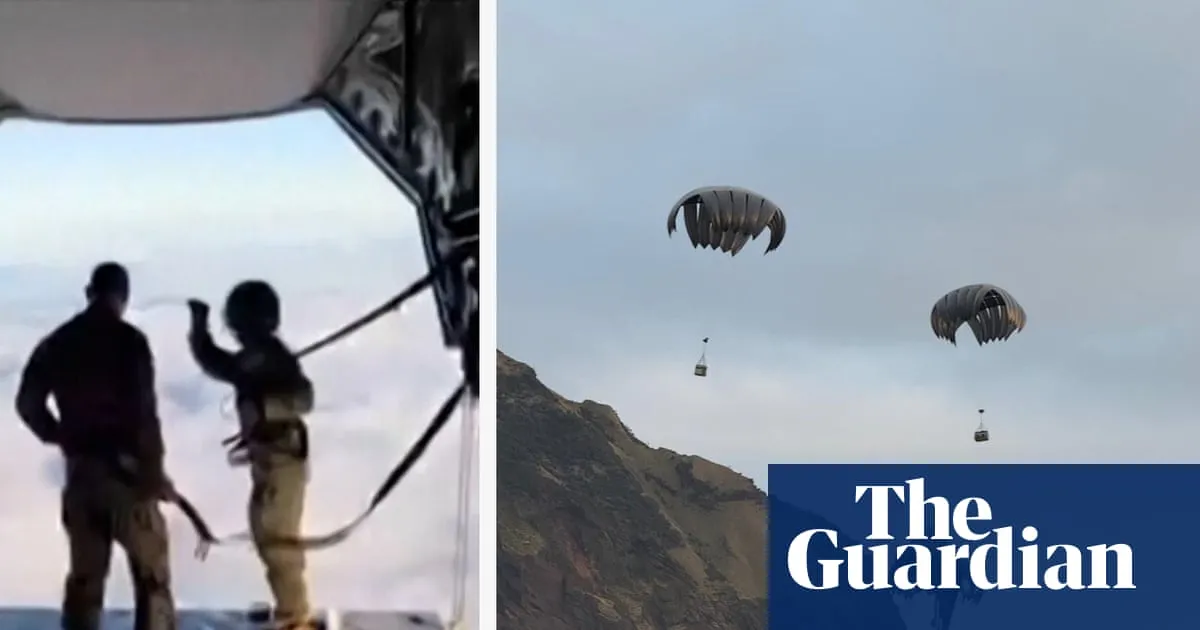
Paratroopers landed on a “golf course covered in rocks” to supply medical personnel and oxygen to Britain’s most remote overseas territory as it deals with a suspected hantavirus case, an army commander has said.The UK Health Security Agency confirmed on Friday that a British national had disembarked from the cruise ship MV Hondius to the South Atlantic island of Tristan da Cunha, where they live, with a suspected case of hantavirus.Six paratroopers, a Royal Air Force (RAF) consultant and an army nurse from 16 Air Assault Brigade were parachuted to the island, which is normally only accessible by boat, while oxygen supplies and medical aid were also dropped.An RAF A400M transport aircraft flew from RAF Brize Norton, in Oxfordshire, to Ascension Island, supported by an RAF Voyager, before heading to Tristan da Cunha.Tristan da Cunha, in a group of volcanic islands in the South Atlantic Ocean, is Britain’s most remote inhabited overseas territory – accessible only by boat, it has no airstrip and a population of 221.Brig Ed Cartwright, the commander of 16 Air Assault Brigade, said there was “7,000 miles and about 56 hours” between help being requested and “having those parachutists and those medical stores on the ground”.Describing the mission, he told Sky News: “No airstrip, high winds, very difficult to reach, and over a week for a boat, and the patient, as I understand, was on oxygen, and that oxygen supply was running out – so we had very few options.“I think the soldiers will have had a great time, but it’s pretty risky. Parachuting has some inherent dangers. The winds were reasonably high.“The parachuters – I’ve spoken to them – they described it to me as a ‘pretty tasty jump’.“They would have got out of the aircraft, had to turn straight into wind to avoid being pushed past the island and into the Atlantic, and then had a very difficult descent down through the cloud and then on to the drop zone, which was a golf course covered in rocks.”The Army commander said there was a plan to get them back.He added: “There are some ships being moved and some further medical support being prepared, so we’ll be able to extract them safely in due course.”The Ministry of Defence said it was the first time medical personnel had been parachuted in to provide humanitarian support.Yvette Cooper, the foreign secretary, said the safety of “all members of the British family” was the top priority.“We will continue to work closely with international authorities and the Tristan da Cunha administration, keeping those affected informed and ensuring the right support is in place in the UK and across the overseas territories,” she said.
SRCThe Guardian - World News
LANGEN
LEANCenter-Left
WORDS443
ENT11
SUN · 2026-05-10 · 17:26 GMTBRIEF NSR-2026-0510-75128
NSR-2026-0510-75128News Report·EN·Public Health
British paratroopers land on Tristan da Cunha for suspected hantavirus case
British paratroopers and medical personnel were parachuted onto Tristan da Cunha, Britain's most remote inhabited territory, to respond to a suspected hantavirus case. The mission, involving six paratroopers, a consultant, and a nurse from 16 Air Assault Brigade, was necessitated by the island's inaccessibility by air and dwindling oxygen supplies for the patient, a British national who had disembarked from a cruise ship.
Press AssociationThe Guardian - World NewsFiled 2026-05-10 · 17:26 GMTLean · Center-LeftRead · 2 min
The Guardian - World NewsFIG 01
Reading time
2min
Word count
443words
Sources cited
3cited
Entities identified
11entities
Quality score
100%
§ 01
Briefing Summary
AI-generatedNEWSAR · AI
British paratroopers and medical personnel were parachuted onto Tristan da Cunha, Britain's most remote inhabited territory, to respond to a suspected hantavirus case. The mission, involving six paratroopers, a consultant, and a nurse from 16 Air Assault Brigade, was necessitated by the island's inaccessibility by air and dwindling oxygen supplies for the patient, a British national who had disembarked from a cruise ship. An RAF A400M aircraft flew the team and medical aid from Ascension Island to the remote South Atlantic territory. The operation, described as risky due to high winds and the island's challenging terrain, highlights the UK's commitment to supporting its overseas territories in emergencies. The Ministry of Defence stated this was the first instance of medical personnel being parachuted for humanitarian support.
Confidence 0.90Sources 3Claims 5Entities 11
§ 02
Article analysis
Model · rule-basedFraming
Public Health
Human Interest
Tone
Measured
AI-assessed
CalmNeutralAlarmist
Factuality
0.80 / 1.00
Factual
LowHigh
Sources cited
3
Well sourced
FewMany
§ 03
Key claims
5 extracted01
This was the first time medical personnel had been parachuted in to provide humanitarian support.
factualMinistry of Defence
Confidence
1.00
02
Tristan da Cunha is Britain's most remote inhabited overseas territory, accessible only by boat with no airstrip.
factualarticle
Confidence
1.00
03
Six paratroopers, an RAF consultant, and an army nurse were parachuted to the island.
factualarticle
Confidence
1.00
04
A British national disembarked from the cruise ship MV Hondius to Tristan da Cunha with a suspected case of hantavirus.
factualUK Health Security Agency
Confidence
1.00
05
Paratroopers landed on Tristan da Cunha to supply medical personnel and oxygen for a suspected hantavirus case.
factualarmy commander
Confidence
1.00
§ 04
Full report
2 min read · 443 words§ 05
Entities
11 identifiedKey playerOppositionContextPositiveNeutralNegative
Organizations4
§ 06
Keywords & salience
10 termstristan da cunha
1.00
hantavirus case
1.00
medical personnel
0.90
paratroopers
0.90
remote territory
0.80
humanitarian support
0.70
medical aid
0.60
airdrop mission
0.50
south atlantic
0.40
uk health security agency
0.40
§ 07
Topic connections
Interactive graph No topic relationship data available yet. This graph will appear once topic relationships have been computed.