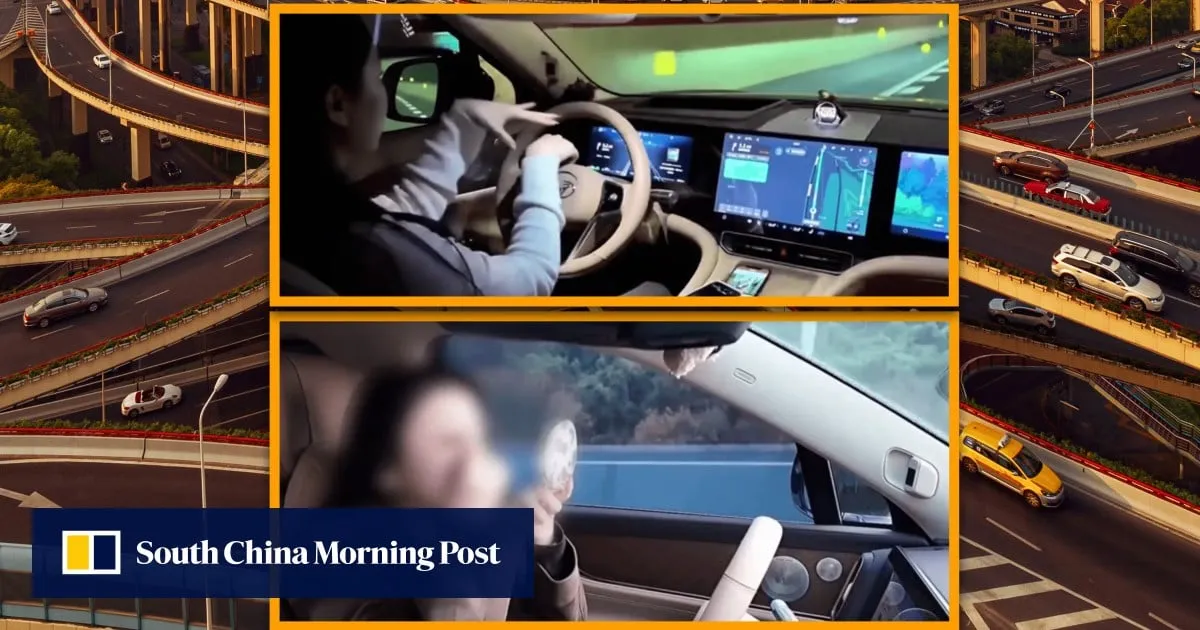
A woman in eastern China has been fined for applying make-up and dancing behind the wheel, then claiming her car’s driver-assistance system drove better than she could.According to CCTV News, the driver, surnamed Lin, is from Wenzhou in Zhejiang province and had repeatedly posted videos online flaunting her vehicle’s assisted driving.In the widely shared clips, Lin is seen travelling through a tunnel with the system activated, both hands off the steering wheel, while applying foundation and lipstick, moving to music and eating snacks.A screen shot from a video Lin posted online shows her applying make-up while driving. Photo: CCTVShe was driving an AITO SUV worth about 500,000 yuan (US$73,000), part of a premium smart vehicle brand backed by Chinese technology giant Huawei.Lin had also decorated the driver’s seat with flowers and ornaments. The distance she travelled has not been disclosed.Local traffic police recently contacted her after internet users reported her for dangerous driving.“Although my hands were doing other things, I was still thinking about driving,” Lin told officers.Police warned her that unexpected situations, such as roadworks requiring a sudden lane change, could occur at any time.A member of safety staff shows how to drive an autonomous vehicle in southern China. Photo: XinhuaThey said driver-assistance systems were designed for relatively simple road conditions and could not reliably cope with complex scenarios or emergencies.Lin replied: “I had not thought about that because I really trust smart driving. As a female driver, I think it drives better than I do.”Officers stressed that driver assistance is not autonomous driving and cannot identify every obstacle on the road.Under China’s vehicle automation standards, driver-assistance systems offer only limited steering or speed-control support, such as adaptive cruise control and lane keeping.Further ReadingDrivers are required to remain alert and in control at all times.Police said motorists remain legally responsible when using such functions, and traffic violations can lead to fines, licence revocation or administrative detention.Lin was eventually fined 200 yuan (US$30) and had points deducted from her licence for obstructing safe driving.Her case has triggered a heated discussion on mainland social media, with drawing more than 10 million views.A man, centre, stands outside a car in a traffic jam in Beijing’s rush hour. Photo: ReutersOne online observer said: “I am terrified of irresponsible drivers like this. If nothing happens, they are lucky; if it does, they endanger both themselves and others.”“I hardly ever use smart-driving features. Humans are still more reliable and flexible than machines,” said another.The misuse of driver-assistance technology is not uncommon in China.On May 4, a man returning to Shanghai said he saw a driver sleeping in a speeding car while its assisted-driving system was activated.In February 2023, a drunk driver from central China activated the function and later argued he was not controlling the vehicle. He was sentenced to five months’ detention and fined 10,000 yuan (US$1,500).
SRCSouth China Morning Post
LANGEN
LEANCenter-Right
WORDS473
ENT10
MON · 2026-05-11 · 01:00 GMTBRIEF NSR-2026-0511-75182
NSR-2026-0511-75182News Report·EN·Human Interest
China woman fined for applying make-up, dancing while driving; claims assisted driving more reliable
A woman in Wenzhou, China, was fined 200 yuan and had points deducted from her license for applying makeup and dancing while driving an AITO SUV. She had posted videos online showcasing her car's driver-assistance system, claiming it drove better than she could and that she was still attentive despite her hands being occupied.
Zoey ZhangSouth China Morning PostFiled 2026-05-11 · 01:00 GMTLean · Center-RightRead · 2 min
South China Morning PostFIG 01
Reading time
2min
Word count
473words
Sources cited
3cited
Entities identified
10entities
Quality score
100%
§ 01
Briefing Summary
AI-generatedNEWSAR · AI
A woman in Wenzhou, China, was fined 200 yuan and had points deducted from her license for applying makeup and dancing while driving an AITO SUV. She had posted videos online showcasing her car's driver-assistance system, claiming it drove better than she could and that she was still attentive despite her hands being occupied. Local traffic police intervened after online reports, emphasizing that driver-assistance systems are not fully autonomous and cannot handle complex or emergency situations. They reminded her that drivers remain legally responsible and must remain alert and in control at all times. The incident sparked widespread online discussion about the capabilities and limitations of vehicle automation.
Confidence 0.90Sources 3Claims 5Entities 10
§ 02
Article analysis
Model · rule-basedFraming
Human Interest
Technology
Tone
Mixed Tone
AI-assessed
CalmNeutralAlarmist
Factuality
0.70 / 1.00
Factual
LowHigh
Sources cited
3
Well sourced
FewMany
§ 03
Key claims
5 extracted01
The woman was fined 200 yuan and had points deducted from her license for obstructing safe driving.
factualarticle
Confidence
1.00
02
Motorists remain legally responsible when using driver-assistance functions, and violations can lead to fines, license revocation, or detention.
factualPolice
Confidence
1.00
03
Driver-assistance systems are designed for simple road conditions and cannot reliably cope with complex scenarios or emergencies.
factualLocal traffic police
Confidence
1.00
04
The driver claimed her car's driver-assistance system drove better than she could.
quoteLin
Confidence
1.00
05
A woman in China was fined for applying make-up and dancing while using a driver-assistance system.
factualarticle
Confidence
1.00
§ 04
Full report
2 min read · 473 words§ 05
Entities
10 identifiedKey playerOppositionContextPositiveNeutralNegative
People1
Organizations5
§ 06
Keywords & salience
8 termsdriver assistance systems
1.00
dangerous driving
0.90
autonomous driving
0.80
traffic violations
0.70
legal responsibility
0.60
smart driving
0.50
huawei
0.40
china
0.40
§ 07
Topic connections
Interactive graph Network visualization showing 51 related topics
View Full Graph Person Organization Location Event|Click node to navigate|Edge numbers = shared articles