In 2018, he had announced tariffs on $250bn (£185bn) of Chinese imports - the moment that many analysts say the trade war started.The same year, Trump imposed levies on other trading partners - including Mexico, Canada and Europe - which he said were also taking advantage of the US.The sweeping measures were a shock, especially for China, said policy researcher Ning Leng from Georgetown University."It was the first time they dealt with Trump seriously, and they probably did not expect him to go ahead with it," Ning said.At the time, China was much more reliant on trade with America.The US was a key importer of Chinese manufactured goods, putting its workers at risk if American buyers turned away due to Trump's tariffs.The tensions added to existing issues that have weighed on China's economy for years, including sluggish domestic consumption, high unemployment and a prolonged property crisis.Exports to the US offered a lifeline for Chinese jobs, but with Trump, that was now put at risk."It's harder for one country to withstand a trade war with another that it has trade surplus with," Ning said.When Joe Biden succeeded Trump in 2021 he kept up the pressure on Beijing.His administration chose to not lift Trump's tariffs on China, sharing a belief that the US needed to keep a lid on its rival's growth in sectors like technology, Ning said.Biden also introduced restrictions on Chinese firms, including tech giant Huawei, which was essentially ousted from the US over national security concerns. He also put TikTok under scrutiny, with its US operation eventually being separated from its Chinese parent company.Bloomberg via Getty ImagesJoe Biden introduced more restrictions on Chinese goods to the US Chinese electric vehicles (EVs) were also effectively blocked from the US market after heavy tariffs were imposed by Biden."We often think that Trump is tough on China, but there is an argument to say that Biden was even more protectionist than Trump was," said economist Tang Heiwai from the University of Hong Kong.Trump 2.0Trump doubled down on his tariff policies after returning to office in 2025.He imposed 20% tariffs on China, accusing it of allowing the influx of the drug fentanyl into the US. On Trump's so-called Liberation Day, he set a 34% levy on Chinese goods, making the total tariffs on China among the highest of any country.The tariffs shook Chinese businesses and led to goods piling up in warehouses, while US firms scrambled to find alternative supplies.Beijing quickly retaliated with its own measures, including duties on US agricultural goods, hitting farmers - a key Trump voter base.But Trump doesn't appear to have accounted for China's near-monopoly of the world's supplies of rare earths - crucial for making everything from smartphones to fighter jets. Trump had used tariffs to force countries to make deals favourable to the US. But he couldn't risk key businesses that rely on China's raw materials. It was time to bargain.A meeting between Trump and Xi in October ended with Beijing suspending those export controls, marking a win for Trump. He also said he got China to start immediately buying US agricultural goods and other farm products - a backbone of the American economy.AFP via Getty ImagesXi and Trump held talks at Gimhae Air Base in South Korea on 30 October 2025In return, Washington dropped part of the tariffs it had imposed on China over the flow of ingredients used to make the synthetic opioid fentanyl.
SRCBBC News - World
LANGEN
LEANCenter
WORDS569
ENT12
MON · 2026-05-11 · 05:39 GMTBRIEF NSR-2026-0511-75236
NSR-2026-0511-75236Analysis·EN·Economic Impact
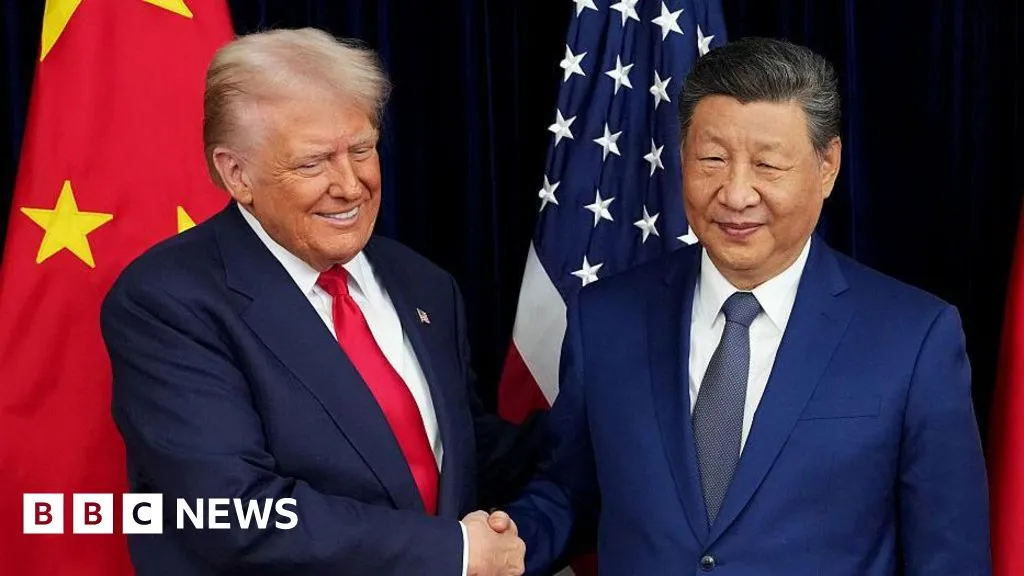
Trump and Xi are set to meet. Where do US-China tariffs stand?
Ahead of a meeting between Presidents Trump and Xi, US-China tariffs remain a significant point of contention. Initiated by Trump in 2018 on $250 billion of Chinese imports, these tariffs marked the start of a trade war, impacting China's economy which was heavily reliant on US exports.
BBC News - WorldFiled 2026-05-11 · 05:39 GMTLean · CenterRead · 3 min
BBC News - WorldFIG 01
Reading time
3min
Word count
569words
Sources cited
2cited
Entities identified
12entities
Quality score
100%
§ 01
Briefing Summary
AI-generatedNEWSAR · AI
Ahead of a meeting between Presidents Trump and Xi, US-China tariffs remain a significant point of contention. Initiated by Trump in 2018 on $250 billion of Chinese imports, these tariffs marked the start of a trade war, impacting China's economy which was heavily reliant on US exports. President Biden maintained and even expanded these tariffs, citing national security and a desire to curb China's technological growth, also imposing restrictions on companies like Huawei and blocking Chinese electric vehicles. If Trump returns to office in 2025, he plans to further increase tariffs on China, citing issues like fentanyl imports. These ongoing trade policies have disrupted businesses in both countries.
Confidence 0.90Sources 2Claims 5Entities 12
§ 02
Article analysis
Model · rule-basedFraming
Economic Impact
Political Strategy
Tone
Measured
AI-assessed
CalmNeutralAlarmist
Factuality
0.70 / 1.00
Factual
LowHigh
Sources cited
2
Limited
FewMany
§ 03
Key claims
5 extracted01
Biden imposed heavy tariffs on Chinese electric vehicles (EVs), effectively blocking them from the US market.
factual
Confidence
0.95
02
Biden kept Trump's tariffs on China, believing the US needed to control its rival's growth in sectors like technology.
quoteNing Leng
Confidence
0.90
03
In 2018, Trump announced tariffs on $250bn of Chinese imports, marking the start of the trade war.
factualmany analysts
Confidence
0.90
04
Trump doubled down on tariffs upon returning to office in 2025, imposing 20% tariffs and later 34% on Chinese goods.
factual
Confidence
0.85
05
There is an argument that Biden was even more protectionist than Trump was.
quoteTang Heiwai
Confidence
0.80
§ 04
Full report
3 min read · 569 words§ 05
Entities
12 identifiedKey playerOppositionContextPositiveNeutralNegative
People5
Organizations1
§ 06
Keywords & salience
10 termstariffs
1.00
us-china trade war
1.00
trump administration
0.90
biden administration
0.80
protectionism
0.70
chinese economy
0.60
technology sector
0.50
huawei
0.40
chinese electric vehicles
0.40
fentanyl
0.40
§ 07
Topic connections
Interactive graph Network visualization showing 51 related topics
View Full Graph Person Organization Location Event|Click node to navigate|Edge numbers = shared articles